Shrub · Vitaceae
Virginia Creeper
Parthenocissus quinquefolia
A tough native vine whose five-fingered leaves flare from green to scarlet while its clinging disks grip everything they touch.
Full sun
Every 7–14 days
USDA 3–9
30–50 ft · 9.1–15.2 m
Overview
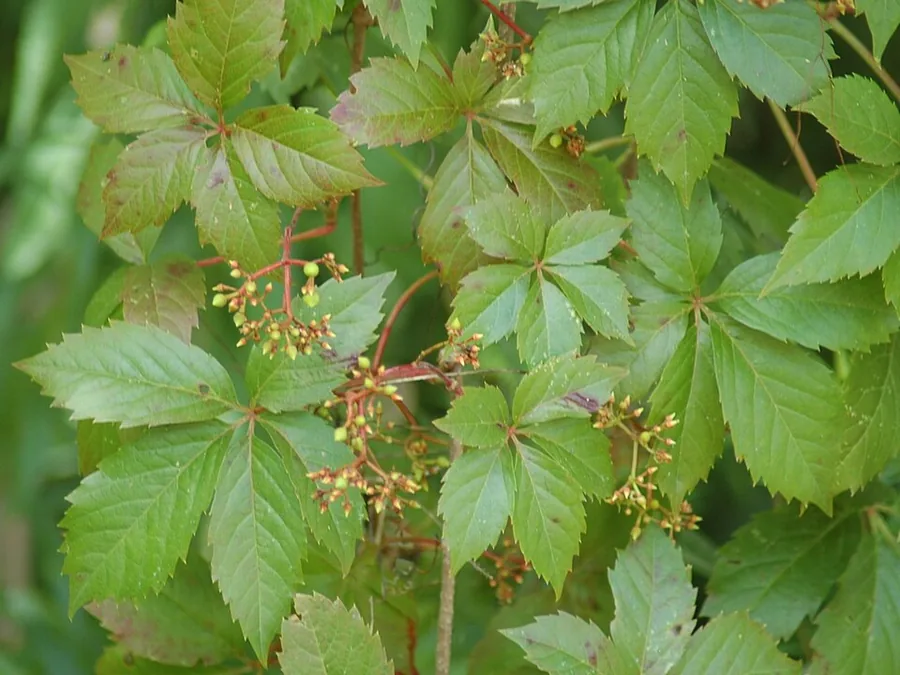
Virginia creeper is a fast, woody vine of eastern North America whose leaves fan into five toothed leaflets spread from a single point like the fingers of a hand. Green and glossy through summer, those leaflets ignite into fiery scarlet in fall, and that count of five is the plain mark that sets the leaf apart from three-leaflet poison ivy. Turned loose on a fence or a bare bank, the vine lays a thick quilt of leaves over the ground within a season or two.
Run a finger along a young stem and you meet the tools that let it climb: slim branching tendrils, each arm ending in a small swollen adhesive disk that presses flat and cements itself to bark, brick, or board. Those disks haul the vine up trees, walls, and trellises far above head height, and the same grip that anchors it also pulls at paint and works into mortar, so the plant belongs on a support set apart from the house.
The vine wears its toughness plainly, riding out sun or deep shade, sand or clay, and cold that plunges to -40°F (-40°C). Come late summer, thin greenish flowers give way to tight clusters of round blue-black berries, small dark orbs that read as wild grapes yet hold a poison to people and animals alike.
Care
The short version: it roots in almost any well-drained soil, colors reddest in full sun and duller in shade, wants watering only until it settles, and after that asks mainly for a blade to keep its clinging stems in check.
Light
Virginia creeper holds its leaves across the full range from full sun to full shade, a rare span for a climber. Under open sun the fall leaves burn to their deepest scarlet, while in shade the same foliage grows healthy but softens to a duller, muted red.
Water
Give a young plant a deep soak every 7 to 14 days as it roots, letting the top half of the soil crumble dry between drinks. Once its roots take hold the vine turns hard against drought and draws little beyond the rain that falls on it.
Soil
Its roots take to clay, loam, or loose sand alike, asking only for free drainage and a crumb of organic matter in the mix. The pH span it tolerates runs wide, from 5.0 to 8.0, so most ground receives it just as it is.
Temperature
Few vines carry this kind of cold in their wood. It rides out winter chill down to -40°F (-40°C) and summer heat up to 100°F (38°C), and that raw range is what stretches it across so broad a swath of country.
Humidity
Plain outdoor air on the skin of the leaf is enough, so there is no reading to chase. Moving air across the foliage does more than any humidity level, since it is the close, stagnant air that lets leaf spot or a mildew film settle on the blades.
Feeding
This vigorous native draws almost nothing from the fertilizer bag. Where the growth thins and pales, a light balanced feed in spring is plenty, and heavier feeding only floods the vine with the rampant new stem you will later cut away.
Pruning
The blade is the main tool this vine asks for. Cut it hard in late winter or early spring while the wood is bare, then trim the fresh stems through the season to peel it off masonry, gutters, shutters, and wiring, since the unchecked vine climbs fast and far.
Repotting
Rooted in open ground it never needs a pot at all, and even potted it seldom outgrows one. Shift it up a size only when roots coil around the base or water pours straight through the mix without wetting it.
Size & spacing
Given a wall of support, the vine climbs a startling 30 to 50 feet (9 to 15 m) and throws its stems 5 to 10 feet (1.5 to 3 m) wide. Hand it that much room on stout framing and hold it well off the house.
When to plant
This is a woody perennial vine rather than a crop on a clock, so its year turns on getting rooted, not on outrunning a frost. Set new plants out in spring or fall, watch the thin greenish flowers open from May into July, and wait for the round dark berries and the burning red leaves to arrive from late summer through fall.
Northern hemisphere
Southern hemisphere
Typical months for a temperate climate: start earlier in warm zones, later where spring frosts linger.
- Plant: spring or fall
- Harvest: Greenish-white insignificant flowers May to July, followed by blue-black berries in late summer to fall
Hardiness
USDA hardiness zones: 3–9
Temperature: down to -40°C
Troubleshooting
Virginia creeper is built tough, and most of what goes wrong shows up as reach rather than real sickness. The chief thing to watch is the way its clinging stems climb where they are not wanted and press flat against walls. Catch the handful of surface blemishes on its leaves early and the vine keeps its clean green sheet.
Vine on the wall, with sticky pads left clinging to the surface
Look close and each clinging pad is an adhesive holdfast, a slender tendril tipped with a small swollen disk that presses flat and grips the surface. Set against a house, those disks tug at paint, seat into the grain of the mortar, and choke the gutters, and their tacky footprints stay pressed to the wall after the stems tear away. Cut it back to the hard wood, work the stems off before the disks harden, and lead the growth onto a trellis standing well off the building.
Fix:
- Cut vines back hard and pull stems off surfaces before disks set
- Trim regularly through the growing season to keep growth in bounds
- Redirect onto a sturdy trellis, fence, or arbor away from buildings
Dark spots or a powdery white bloom across the leaf blades
Sharp-edged brown to black blotches on the leaf are fungal leaf spot, while a chalky, flour-fine dusting laid over the green surface is powdery mildew, and both settle in where shade and heavy, unmoving air hold the leaves damp. On a vine as tough as this the marks stay skin-deep, riding on the surface without eating into the plant. Open the crowded stems to let air slip between the leaves, strip the most blemished blades, and pour the water low so the foliage dries clean.
Fix:
- Improve air circulation by thinning crowded growth
- Remove and dispose of badly affected foliage
- Avoid wetting foliage when watering
Leaves eaten to lace or finely speckled, with insects on them
Japanese beetles chew away the soft green between the veins until the leaf hangs as a bronze skeleton of lacework, while leafhoppers prick the surface into a fine pale stipple and scale ride the stems as hard little raised bumps. A well-rooted vine wears this damage and keeps pushing new leaves. Drop the beetles into soapy water, rinse or clip out any patch that spreads, and bring out horticultural oil only where the scale crust thickens.
Fix:
- Hand-pick beetles into soapy water
- Hose off or prune out localized infestations
- Treat scale with horticultural oil if severe
Toxicity
Read the whole plant as poison from leaf to fruit. The tissue is threaded with fine, needle-sharp calcium oxalate crystals, and the round dark berries pile oxalic acid on top, which is why they have poisoned cats, dogs, horses, livestock, and people. The fruit is the real trap, hanging in grape-like clusters that pull children and pets in for a taste.
Toxic to
Cats · Dogs · Horses · Rabbits · Livestock · Birds · People
Cats Toxic
Every part of the plant is packed with needle-fine calcium oxalate crystals that jab the soft tissue the moment a cat bites a leaf or berry, setting off streams of drool and frantic pawing at the mouth, with vomiting close behind. The lips and throat can puff and swell as it goes on.
Dogs Toxic
When a dog crushes the leaves or the round blue-black berries between its teeth, the mouth burns, drool runs in ropes, and the stomach churns into vomiting or loose stools. The berries carry the densest load of oxalic acid, so their juice bites hardest.
Horses Toxic
A horse that tears at the vine ends up with a raw, stinging mouth and a griping gut, dribbling saliva and shifting with colicky pain. Any creeper threaded through the paddock fencing is best clipped away before teeth find it.
Rabbits Toxic
The same glassy crystals leave the vine no place in a rabbit's mouth, where even a small bite scrapes the tissue sore and knots the gut. Keep the cut stems and any dropped berry well clear of the hutch.
Livestock Toxic
Cattle, goats, and sheep that strip the leaves or berries come away with a stinging mouth, ropes of drool, and a churned, unsettled gut. Tear the vine from the pasture edge before the herd grazes into it.
Birds Toxic
Wild birds swallow the ripe berries whole and scatter the hard seed far off, yet that same acid-soaked pulp turns on a pet bird. A companion bird that pecks the fruit is left with a raw mouth and a churning gut.
People Caution
No part of this plant is food. The dark, round berries mimic wild grapes so closely that they have poisoned people, children above all, scorching the mouth and throat, drawing heavy drool, and turning the stomach, while the crushed sap can raise a rash across the skin.
Sap and oxalate crystals can cause skin irritation or contact dermatitis in sensitive people; wear gloves when pruning or removing the vine.
Helpline numbers

United States
ASPCA Animal Poison Control: (888) 426-4435 (fee applies)
Poison Control: (800) 222-1222



Canada
Poison Centres: 1-844-764-7669
Varieties
Most plantings show the plain wild vine, but a few named forms shift the look of the leaf, trading some raw reach for finer color or painted variegation. These are the ones most often met.
var. engelmannii (Engelmannii)
Its leaflets run smaller than the species and its fall foliage burns a deep bronze-red, packing the vine into a denser, finer-textured sheet of leaves.
'Monham' (Star Showers)
Its green leaves are streaked and splashed with white as though flicked with paint, and those pale markings blush pink once the air turns cold.
'Troki' (Red Wall)
The leaves open bronze in spring, deepen to plain green through summer, and blaze a hard fire-engine red in fall.
How to propagate
The same stems that root wherever they touch make this vine simple to multiply. A cut piece strikes root, a pinned shoot layers into the soil, and the hard seed grows once cold has broken its rest.
Stem cuttingsEasy
Late spring to summer from softwood or semi-hardwood · 4 to 8 weeks to root
Cut a length of the pliable softwood or firmer semi-hardwood stem from late spring into summer, and white roots push from the buried nodes within 4 to 8 weeks. The stems are so ready to root that any shoot resting on damp ground strikes down where it touches.
LayeringEasy
Spring through summer · One growing season
Layering is the plainest trick of all. From spring through summer, pin a trailing stem against the soil and roots grow straight from the swollen nodes pressed into the earth, so the pegged shoot lifts free as its own plant after one growing season.
SeedModerate
Sow outdoors in fall or cold-stratify before spring sowing · Germination after cold stratification
The hard seed inside each berry stays locked until cold cracks its rest. Sow it into open ground in fall, or chill it cold and moist before a spring sowing, and the sprouts break only after that cold has passed. In the wild, the birds crack the berries for you, swallowing the fruit and voiding the seed across the land.
Myths
Virginia creeper is just poison ivy, so any vine with five leaflets is poison ivy.
Count the leaflets radiating from each stalk and the two split apart at once. This vine spreads five leaflets like open fingers, the root of the old line 'leaves of five, let it thrive,' while poison ivy holds just three, 'leaves of three, let it be.' Its tissue carries none of the urushiol that makes poison ivy blister and itch, though the fine oxalate crystals in the sap can still redden a mild rash on tender skin.