Ornamental · Verbenaceae
Verbena
Verbena canadensis
In baking sun and sharply drained soil, verbena carries its bright flower clusters from spring until fall.
Full sun
Every 5–7 days
USDA 6–10
8–18 in · 20–46 cm
Overview
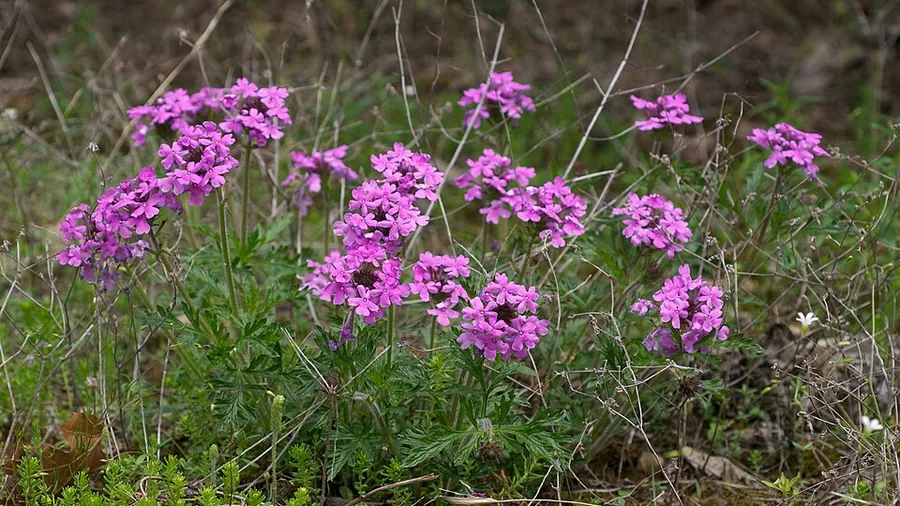
Verbena carries tight, rounded clusters of small, bright flowers on low stems that spread out and hug the ground. Rose verbena is a low, spreading perennial native to North America, and its bright flower clusters open from late spring well into fall above coarse, toothed green leaves. The stems root as they run, knitting a mat that trails over the edge of a pot or a bed.
Across the genus the form shifts from low, ground-hugging mats to the tall, wiry stems of Verbena bonariensis, whose thin, almost bare stalks hold small rose-violet heads high in the air. Bees and butterflies settle on the flat flower clusters all season, drawn to the open faces of the tiny blooms. Many of the garden types are short-lived perennials, dense with color for a couple of years before they thin.
The plant reads as low and full when its needs are met, a spreading cushion crowded with flower heads. Set in strong sun with sharp drainage, the stems stay firm and the blooms keep opening. Left in shade or wet ground, that fresh growth gives way to a dusty white film and soft rot.
Care
The short version: full sun and sharp drainage above all. About an inch of water a week keeps the flower clusters opening, a couple of feedings carry the growing season, and deadheading or shearing back brings on fresh bloom.
Light
Verbena wants full sun, and the more direct light it takes, the tighter and more crowded the flower clusters. A little afternoon shade is fine, but heavier shade stretches the stems, thins the bloom, and lets a dusty film settle on the leaves.
Water
Once established, verbena is drought tolerant and holds firm through a dry spell, but the flower clusters come thickest with about an inch of water a week. Water deeply once a week when rain falls short, sending it to the base rather than over the leaves, and never let the soil stay soggy. Plants in pots dry out faster and need a closer eye.
Soil
Give it well-drained sandy or loamy soil, since standing wet at the roots is the one thing verbena will not take. It roots into poor and rocky ground without complaint and copes across a wide pH range of 6.0 to 8.0, but a soggy, poorly drained spot softens and rots the base.
Humidity
Plain outdoor air suits it, so there is no humidity to manage. What matters more is airflow moving through the foliage, since still, muggy air is where a white film and gray fuzz first settle on leaves and flowers.
Feeding
Feed with a complete fertilizer such as 16-4-8 in mid to late spring, then again after a trim. Verbena is not a heavy feeder, and the extra feeding shows mainly on very sandy soils.
Pruning
Pinch the soft stem tips at planting for a denser, fuller cushion, and deadhead the spent heads through the season to keep new clusters opening. When bloom thins in midsummer, shear the whole plant back by about a quarter, then water and feed it lightly, and fresh flowers fill in within 2 to 3 weeks. Cut only lightly in fall and hold hard pruning for spring, since a deep fall cut can cost the plant its cold hardiness.
Size & spacing
Rose verbena stays low, the mounding stems reaching 8 to 18 inches (20 to 46 cm) tall and running 12 to 24 inches (30 to 61 cm) wide. Set each plant to that full spread so air moves through the foliage and the trailing stems can knit together.
When to plant
Verbena is a warm-weather plant that will not stand a frost. Start seed indoors in late winter, or set young plants out once the soil has warmed, and the tight flower clusters keep opening from spring through fall until the season closes.
Northern hemisphere
Southern hemisphere
Typical months for a temperate climate: start earlier in warm zones, later where spring frosts linger.
- Sow: Start seed indoors 6 to 8 weeks before the last spring frost
- Plant: Set plants out after the last spring frost once soil has warmed
- Harvest: Blooms spring through fall (April to September in North Carolina)
Hardiness
USDA hardiness zones: 6–10
Temperature: down to -23°C
Troubleshooting
Most of what mars verbena shows up first on the leaves, the flower heads, or the base of the stems, and it usually traces to too much shade or too much water. Look closely at the surfaces and the crown, since a small change caught early clears it. Match what you see below, then act before it spreads.
Stems gone limp and dark, rotting away just above the wet ground
Limp, collapsing stems above soil that is still wet signal root rot from Pythium or Rhizoctonia, or southern bacterial wilt working through waterlogged ground where the roots and lower stems turn dark and soft. A plant this far gone cannot recover, so lift it out and discard it. Set the drainage right, then replant healthy stock where water drains clear.
Fix:
- Improve drainage and stop overwatering
- Remove and discard affected plants
- Replant healthy stock in well-drained soil
Leaves and stems wearing a fine coat of talc-like white powder
A chalky white dust clinging to the leaves and stems is powdery mildew, a fungus that takes hold where a plant sits shaded, crowded, or dried out. Move it into stronger sun with air passing through, and send the water to the base rather than across the foliage. Pull away the most heavily coated leaves to check its spread.
Fix:
- Move or thin plants to improve sun and air flow
- Avoid overhead watering and water at the base
- Remove and discard severely affected foliage
Leaf surfaces peppered with pale pinpoints under silky threads
Pinprick specks and a fine, silken webbing across the leaves point to spider mites, which swarm in hot, dry air and settle on thirsty plants first. A hard jet of water washes them off, and steady soil moisture takes away the drought stress that invited them. If some cling on, insecticidal soap or horticultural oil clears the rest.
Fix:
- Rinse foliage with a strong spray of water
- Keep plants adequately watered to reduce stress
- Treat persistent infestations with insecticidal soap or horticultural oil
Petals collapsing into brown mush beneath furry gray growth
Blooms that brown at the edges and grow a soft gray fuzz are showing botrytis blight, which thrives in damp, humid air. Pluck off the spoiled flowers and the litter around them, and keep deadheading so faded petals never linger and turn. Open air and dry foliage keep the gray mold from creeping on.
Fix:
- Remove and discard affected flowers and debris
- Improve air circulation and reduce overhead moisture
- Deadhead spent blooms promptly
Toxicity
Good news for pet owners and parents: garden verbena is safe. The ASPCA does not list the genus Verbena as toxic to cats, dogs, or horses, so a stray nibble at a leaf or petal is nothing to fear. Just do not confuse it with lemon verbena or lantana, the so-called shrub verbena, which are separate plants and are toxic.
Safe for
People · Cats · Dogs · Horses · Rabbits · Livestock · Birds
Cats None
Garden verbena is safe for cats, and the ASPCA does not list it as toxic. A curious nibble at the leaves or petals will not poison them.
Dogs None
Dogs can nose through verbena without harm, since it stays off the ASPCA toxic list. A big mouthful of any plant might pass a mild stomach upset, and no more.
Horses Safe
A horse browsing close to a patch of verbena meets nothing harmful in the plant.
Rabbits Safe
Rabbits can nibble the low, spreading foliage of garden verbena safely, since it holds no toxins that affect them.
Livestock Safe
Cattle, goats, and sheep can graze a pasture holding verbena with nothing to fear from it.
Birds Safe
Birds come to no harm around the plant, and pollinators work the open flower clusters unharmed.
People Safe
Garden verbena is not toxic to people. It is grown for its flowers, not for eating, so there is no reason to taste it.
Varieties
Verbena runs from low, ground-hugging mats to tall, thin-stemmed forms, and the flower clusters shift with them. These are the types you will see most often.
Homestead Purple
A vigorous trailing rose verbena whose stems spill out glowing purple flower clusters from late spring into fall while shrugging off most abiotic disorders.
Verbena bonariensis (Purpletop vervain)
A tall, see-through species lifting airy rose-violet flower clusters on thin, wiry stems 2 to 5 feet high, an open silhouette that earned it the name verbena-on-a-stick.
Verbena × hybrida (Garden verbena)
The bedding hybrids whose flat flower heads come in pink, purple, red, and white, grown by most gardeners as warm-season annuals.
How to propagate
Verbena is easy to increase, whether you root a soft stem tip to copy a favorite or raise it from fine seed.
Stem cuttingsEasy
Take softwood cuttings during the growing season · Roots in about 2 to 4 weeks
Snip soft, green stem tips through the growing season and they strike roots in about 2 to 4 weeks. This is the usual way to keep a named cultivar true to type, since seed will not copy the parent reliably.
SeedEasy
Start indoors 6 to 8 weeks before last frost or direct sow after last frost · Germinates and blooms the first season
Sow the fine seed indoors 6 to 8 weeks before your last frost, or scatter it into warm ground once frost has passed, and it flowers the same season. The species types self-sow with ease, and bonariensis drops enough seed to come back on its own.
Myths
Every verbena hides toxins that put pets at risk.
Garden verbena in the genus Verbena never appears on the ASPCA toxic plant list. The mix-up traces to lemon verbena (Aloysia) and lantana (shrub verbena), two separate plants the ASPCA does flag for dogs and cats. The true Verbena in your bed is safe.
Verbena settles in as a permanent perennial in gardens of every climate.
Most garden verbenas are short-lived perennials and are best replaced after two or three years. Where winters turn cold they do not survive, so gardeners there grow them as annuals.