Houseplant · Droseraceae
Venus Flytrap
Dionaea muscipula
Those hinged, red-lined jaws want full sun, rainwater, and a cold winter rest, and then they feed themselves for years.
Full sun
Every 1–3 days
USDA 7–10
2–5 in · 5–13 cm
Overview
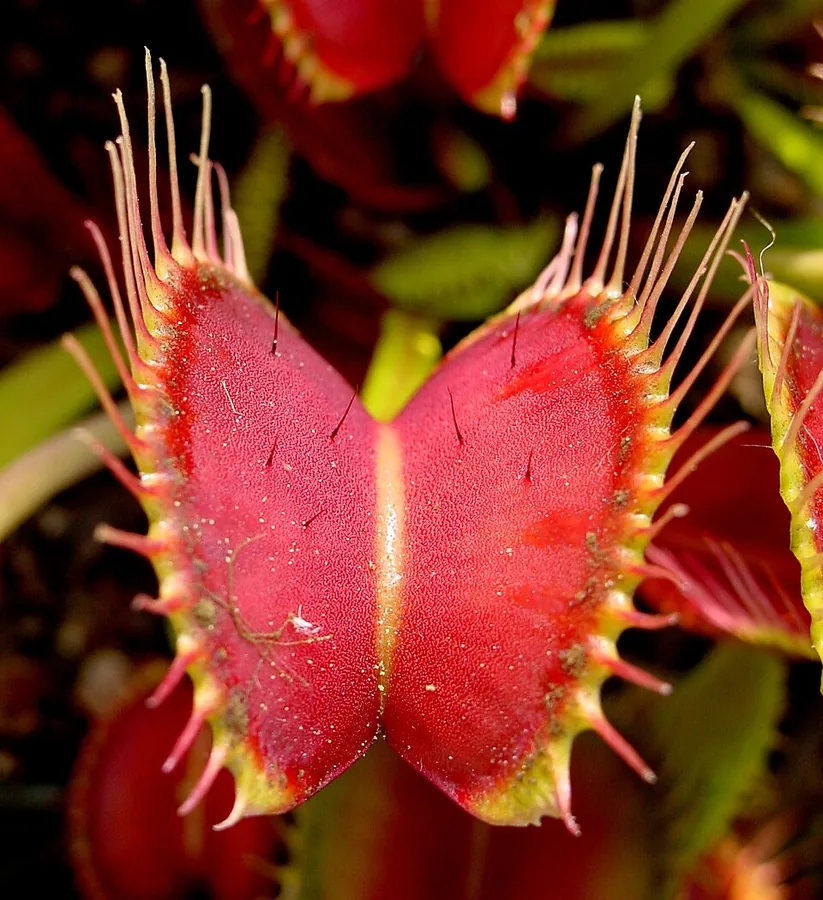
The Venus flytrap wears its hunting gear in plain sight: each leaf ends in a pair of hinged lobes, green outside and flushed deep red within, their edges fringed with stiff interlocking bristles that mesh shut over a trapped insect. It grows wild in a small patch of Carolina bog, where the soil is so lean that catching prey became the plant's way to feed. That same trapping habit is what makes it particular to grow, since ordinary houseplant care runs against it.
Up close the plant is a low rosette of traps, only a few inches across, its leaves radiating flat from a central crown rather than climbing on any stem. It is a true perennial with a slow, deliberate pace. The traps swell and redden through spring and summer, then the plant sinks into a cold winter rest, and skipping that pause is the most common way it is lost.
A short set of conditions keeps those traps firm and richly colored. Strong light deepens the red inside each lobe, mineral-free water and a lean acidic mix keep the roots sound, and a cold winter lets the crown rest. The plant hunts and digests on its own, so the less it is handled, the better it looks.
Care
The short version: give it full sun, water only with distilled, reverse-osmosis, or rainwater, keep it in a lean peat-and-sand mix, never fertilize or feed it meat, and let it rest cold and dormant for 3 to 4 months each winter.
Light
The flytrap wants full, direct sun, at least 6 hours a day and ideally more, and it answers with compact traps whose inner faces flush deep red. Starved of light, the leaf stalks draw out pale and floppy and the traps stay small and green, so a south-facing window or a summer place outdoors serves it far better than a shaded corner.
Water
Give it only distilled, reverse-osmosis, or rainwater, never tap or bottled mineral water, because the dissolved salts collect in the media and kill the plant. Through the growing season the pot sits in a tray holding about 1 to 2 cm of water, keeping the peat evenly damp. In winter dormancy the water drops so the mix stays just barely moist rather than standing wet.
Soil
Root it in a lean, acidic carnivorous mix of sphagnum peat with perlite or silica sand, the pale gritty blend and nothing richer. Ordinary potting soil, compost, or any fertilized mix scorches the fine roots and rots the crown. The correct medium runs strongly acidic at a pH of 3.5 to 5.0.
Temperature
The plant takes a wide range across the year, from about 41°F to 95°F (5°C to 35°C). Summer warmth swells the traps and drives growth, but a genuine cold spell in winter is what lets the crown rest, so steady year-round warmth works against it.
Humidity
Average room humidity around 50% to 70% suits it, and the constantly damp tray keeps the air about the traps moist enough. Misting and a sealed terrarium are unnecessary and can leave the leaves prone to mold.
Feeding
No fertilizer touches it, ever. The plant feeds itself by catching insects in its traps, and fertilizer in the soil burns the roots and kills it. Each closed trap digests its prey and draws in every nutrient the plant needs.
Pruning
Blackened or dead traps and spent leaves come off at the base with clean scissors to keep mold from taking hold. On a young or stressed plant, the tall flower stalk also comes off in spring, since the rising bloom pulls energy the small rosette cannot spare.
Repotting
The plant is repotted every 1 to 2 years in early spring into fresh carnivorous mix. The cues are rhizomes pressing at the pot edge, media broken down and compacted, or several offsets crowded together, and division fits the same moment.
Size & spacing
This is a small plant, its rosette only 2 to 5 inches (5 to 13 cm) tall and about as wide. A single flytrap fills one small pot, so spacing matters only when several crowns share a bog planter.
Troubleshooting
Almost every flytrap problem shows in the traps and leaves, and traces to one of four causes: the wrong water, too little light, ordinary potting soil, or a missed winter rest. The signs below tell them apart by how the plant looks. Caught early, a flytrap usually grows back sound.
Crown gone soft and brown as the plant collapses
Lifted from its pot, a collapsing plant reveals a rhizome gone soft and brown, almost always the result of ordinary soil or fertilizer. A prompt repotting into a lean sphagnum peat and perlite or sand mix, with the mushy tissue cut away, and a return to mineral-free water gives it a chance. Any length of firm white rhizome left intact still holds the capacity to push new growth.
Fix:
- Repot into nutrient-poor sphagnum peat and perlite/sand mix
- Resume mineral-free water only
- Remove rotted tissue; healthy white rhizome may still regrow
Traps shrinking year by year as the plant fades
A flytrap held warm and green all year fades a little more each season, its traps coming in smaller, because it never entered winter dormancy. A cold rest of 3 to 4 months at roughly 35°F to 50°F (2°C to 10°C), with dimmer light and less water, lets it reset. A sheltered outdoor spot suits a mild zone, and an unheated space or the refrigerator delivers the chill where winters run hard.
Fix:
- Provide a 3-4 month cold dormancy at roughly 2-10°C (35-50°F) with reduced light and watering
- Overwinter outdoors in mild zones or in an unheated cold space/refrigerator in colder climates
Traps darkening to black as the leaves wither
When the traps darken to black and the leaves shrivel, the usual cause is mineral buildup from tap or bottled water, seen as a whitish crust over the media while the newest growth comes in thin. A change to distilled, reverse-osmosis, or rainwater, plus a flush of the pot, carries the salts away. A few older traps going black on a plant that is still pushing fresh growth is only normal aging, since each trap blackens and drops after several catches.
Fix:
- Switch immediately to distilled, reverse-osmosis, or rainwater
- Flush the media with mineral-free water to leach out salts
- Trim off fully blackened traps at the base
- Stop hand-feeding and let the plant catch its own insects
Pale, elongated stalks bearing small green traps
The cause is too little light, and it shows plainly in the plant's shape. The leaf stalks draw out long and floppy, and the traps stay small and pale green rather than compact with the deep red lining across their inner faces. Full direct sun for at least 6 hours a day rebuilds that dense red-lined form, though the leaves need a week to harden off first so they do not scorch.
Fix:
- Move to full direct sun (a minimum of 6+ hours, ideally outdoors or a very bright sunny window/grow light)
- Acclimate gradually over a week to avoid scorch
Toxicity
The Venus flytrap is non-toxic to people and animals. The ASPCA clears it for cats and dogs, and each hinged trap spans barely an inch of soft tissue, far too small and weak to hurt anything larger than a fly. The only one at risk is the plant, which spends stored energy every time a trap is snapped shut for fun.
Safe for
People · Cats · Dogs · Horses · Rabbits · Livestock · Birds
Cats Safe
The ASPCA lists the Venus flytrap as non-toxic to cats. Each trap spans barely an inch of soft green and red tissue, far too small and weak to pinch a paw or a curious nose.
Dogs Safe
The plant is safe for dogs, with nothing poisonous in its leaves or traps. A dog that mouths one may feel the trap fold shut against its tongue, a light and harmless movement.
Horses Safe
No toxins sit anywhere in a flytrap, so a horse takes no risk from a taste. The whole plant is a low rosette only a few inches across, far too slight to figure in a horse's diet.
Rabbits Safe
Nothing in a flytrap will poison a rabbit, and the thin, hinged traps are far too flimsy to injure one. There is still no reason to let a rabbit crop a slow-growing rosette down to nothing.
Livestock Safe
Cattle, goats, and sheep face no poisoning from this plant. It is a small bog curiosity of soft leaves and hinged traps, nothing that belongs in a pasture.
Birds Safe
Birds are in no danger from a flytrap. The traps close on insect-sized prey, not feathers, and no part of the plant is toxic.
People Safe
The plant is harmless to handle, children included. A trap folding on a fingertip presses with the softest pinch of its bristled edges and cannot break skin, so the only cost is the energy wasted when it is set off for fun.
Touching the trigger hairs makes traps close; repeatedly poking traps for fun wastes the plant's energy and should be avoided.
Varieties
Beyond the familiar green trap with red-lined jaws, growers have selected cultivars that differ in color, trap size, and the shape of the marginal teeth. Three stand out.
'Akai Ryu' (Red Dragon)
Every part of this plant flushes a deep maroon-red, leaves and traps alike, instead of the usual green foliage set off by red-lined jaws.
'B52'
Bred for scale, 'B52' opens some of the largest traps found on any flytrap in cultivation.
'Dente'
Where most flytraps fringe their traps with long bristle teeth, 'Dente' lines its jaws with short, blunt triangular spines.
How to propagate
More flytraps come from three routes: dividing a clump, rooting a leaf, or raising seed. Division is quick and reliable, while seed is the slow path that builds full-size traps only after several years.
DivisionModerate
Early spring, during or just after dormancy when repotting · Several weeks to a few months
The simplest way to make more flytraps is to split a clump in early spring, during or just after dormancy while it is out for repotting. Each offset, teased free with its own white roots and central growth point intact, goes into carnivorous mix. The pieces knit in and settle over several weeks to a few months.
Leaf cuttingsModerate
Spring to early summer during active growth · About 1-3 months for plantlets to form
Leaf cuttings suit spring or early summer while the plant grows hard. A whole leaf drawn away with a sliver of the pale rhizome base lies flat against damp media in bright light. From that base, tiny green plantlets unfurl over about 1 to 3 months.
SeedDemanding
Sow after cold-moist stratification in late winter to spring · 3-5 years to reach mature size
Seed is the slow road and a real test of patience. The tiny seeds sow in late winter or spring after a cold-moist stratification that breaks their dormancy. They germinate into minute rosettes, but the traps need 3 to 5 years to reach full size, so most growers start with a division instead.
Myths
The traps will swallow chunks of raw hamburger or chicken.
Raw meat is too fatty and rich for a flytrap, so it rots inside the closed trap and blackens the whole leaf. The plant is built to digest insects and spiders, which it catches perfectly well on its own.
A flytrap is a tropical plant needing warmth the year round.
They are not tropical at all. They are temperate bog plants from the Carolinas, and they need a cold winter dormancy of 3 to 4 months to live more than a season or two.
A flytrap drinks ordinary tap water without any trouble.
The dissolved salts in tap or bottled water pile up as a pale crust in the peat and burn the fine roots. Give it distilled, reverse-osmosis, or rainwater only, never anything else.
A flytrap survives only if it is fed by hand again and again.
In full sun a flytrap makes its own food and snaps up plenty of insects unaided. Hand-feeding is optional and never required, and overdoing it only wears the traps out.