Houseplant · Droseraceae
Cape Sundew
Drosera capensis
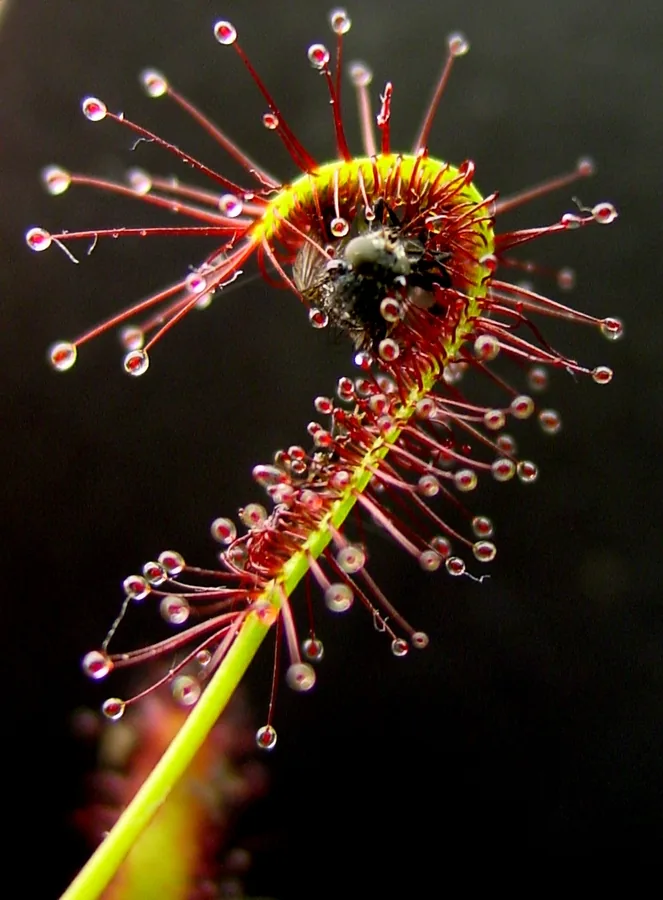
Under bright sun and pure rainwater, the Cape sundew rims each leaf with red tentacles and glistening beads of dew all year.
Full sun
Every 1–3 days
41–86°F · 5–30°C
180–365 days
Overview
Up close, the Cape sundew looks dusted in dew. This carnivorous plant from the bogs of South Africa lines each leaf with slender red dew-tipped tentacles, and every tentacle carries a glistening bead of dew that catches the light like nectar. Gnats and flies drawn to that shine land, stick fast, and are slowly digested. A member of the family Droseraceae, it forms a low, tidy rosette only a few inches across.
That jeweled look comes straight from how the plant lives. Adapted to nutrient-poor, acidic ground, its fine roots stay small and cannot take ordinary potting soil or fertilizer. Its water shows on the leaves too: the salts in tap and mineral water build up and poison it, so only distilled, reverse-osmosis, or rainwater keeps the tentacles wet and gleaming.
Grown in strong light, the whole rosette deepens from green to a rich red, tentacles and leaf blades alike. It holds that color year-round on a bright windowsill, and in season it lifts a tall, slender flower scape topped with pink to purple blooms. It also self-seeds freely, scattering fine seed that fills nearby pots with new red-fringed rosettes.
Care
The short version: the brightest light turns the tentacles deep red, a pot standing in mineral-free water keeps the peat mix wet and the dew beaded, and the roots take no feeding and nothing but distilled, RO, or rainwater.
Light
The Cape sundew wants the brightest spot available, ideally several hours of direct sun on a south-facing sill. In that light the tentacles and leaf blades flush a deep red and the rosette stays tight and low, while a dim corner drains the color and draws the leaves out long and pale. A strong grow light coaxes the same red where a window cannot.
Water
Water keeps the dew beaded and the leaves alive, so it has to be right. Use only distilled, reverse-osmosis, or rainwater, since the salts in tap and mineral water build up and kill carnivorous plants. Stand the pot in a tray of 1 to 3 cm of that mineral-free water so the peat mix stays dark and wet, easing off just slightly in winter and never letting it dry.
Soil
The plant sits in a lean, acidic carnivorous mix, roughly equal parts peat moss or live sphagnum with sand or perlite, held at a pH of 4.0 to 5.5. Ordinary potting soil, compost, and fertilized mixes burn the fine roots.
Temperature
The Cape sundew holds its dew and color across a broad range, from about 41°F to 86°F (5°C to 30°C). Normal room temperature keeps it in leaf all year, and it takes no cold winter rest the way some carnivorous plants do.
Humidity
Humidity shows on the leaves: the sundew keeps its fullest dew in air on the humid side, around 50% to 80%, which a windowsill water tray helps hold. It carries average household air better than most carnivorous plants, but a very dry room thins the beads to almost nothing.
Feeding
The roots take no feeding. Shaped for nutrient-poor bogs, they scorch under soil fertilizer, so the plant draws its nitrogen from the gnats and flies stuck fast on its glistening tentacles. Indoors, the dew usually catches all the small insects it needs.
Pruning
Little trimming is needed. Cut away any fully blackened or dead leaves and spent flower stalks at the base with clean scissors so the fresh red rosette shows. Leave the sticky dew untouched, since those beads are how the plant catches its prey.
Repotting
Move the plant into fresh carnivorous mix every 1 to 2 years, ideally in spring. Do it sooner when roots circle the pot, several rosettes crowd into one dense clump, or the old mix breaks down and stays sodden.
Size & spacing
This is a small, low plant. The rosette rises only 2 to 14 inches (5 to 35 cm) and spreads just 3 to 6 inches (8 to 15 cm) wide, a flat spray of dew-lined leaves that fits on any bright windowsill.
Troubleshooting
The leaves of a sundew wear their health openly, in the color of the blades and the shine of the dew. Nearly every problem shows up there first, and it traces back to the wrong water or too little light. Match the look of your plant below and correct it before the leaves fade further.
The dew stops beading on the tentacles
When the tentacles go dry and dull instead of beaded and bright, the cause is nearly always the wrong water, since tap and mineral water leave salts behind that poison a carnivorous plant. Thin light or dry air can flatten the dew too. Switch to distilled, reverse-osmosis, or rainwater, flush the mix to rinse out the salts, then give the plant a brighter, more humid spot, and the new leaves come back glistening.
Fix:
- Switch immediately to distilled, RO, or rainwater
- Flush the mix with mineral-free water to leach out salts
- Move to brighter light and raise humidity
Leaves darken to black and shrivel
Leaves that blacken usually signal mineral buildup from the wrong water, though a recent repot or the plant's own leaf cycle can leave the same dark, crumpled tissue. Watch which ones go: if only the older, outer leaves blacken while fresh red growth pushes up from the center, it is simply normal turnover. Correct the water, cut the dead leaves at the base, and hold steady wet, bright conditions while it recovers.
Fix:
- Correct the water source to mineral-free water
- Remove blackened leaves at the base
- Maintain stable wet conditions and bright light during recovery
Growth turns pale, long, and green as the red drains out
A sundew that pales to green and stretches tall is starved for light. Under full sun the tentacles and leaf blades saturate to deep red and the rosette pulls in tight; without it, the leaves lengthen and the color washes out. Move it to a sunnier window or under strong grow lights, raising the brightness over a few days so the leaves do not scorch.
Fix:
- Move to a sunnier window or add strong grow lights
- Acclimate gradually to avoid scorching
Toxicity
That beading dew looks dangerous but is not: the Cape sundew is not toxic to anyone. The sticky mucilage is harmless, and if it touches a finger or a paw it clings for a moment, then wipes away without a sting. The only thing to watch is the water tray the pot sits in, which a curious pet could tip over.
Safe for
People · Cats · Dogs · Horses · Rabbits · Livestock · Birds
Cats Safe
A cat can sniff or nibble a sundew without harm, since the plant holds no toxin. The sticky dew may cling to the whiskers for a moment, glinting there before it washes off and leaves no irritation.
Dogs Safe
A dog is in no danger from this plant. A chewed leaf leaves nothing worse than a smear of harmless sticky dew across the muzzle.
Horses Safe
The plant carries no toxin to trouble a horse, and its low, small rosette makes it an unlikely mouthful in any case.
Rabbits Safe
A rabbit is safe beside a sundew. A nibbled leaf brings no poisoning, only a dab of glistening dew left on the fur.
Livestock Safe
Goats, sheep, and cattle face no risk from the plant. The dew is sticky rather than harmful, and the tiny rosette offers almost nothing to graze.
Birds Safe
A bird comes to no harm from a sundew. Its dew-tipped tentacles are sized to catch gnats and flies, never to threaten anything larger.
People Safe
The plant is safe to handle, and the dew is a simple mucilage that wipes off the skin. It is best left on the leaves, though, since those beads are how the plant feeds.
The dew is a harmless sticky mucilage; it may briefly cling to skin or fur but causes no irritation. Avoid wiping it off the plant, as it is the trapping mechanism.
Varieties
Drosera capensis comes in a few easy-to-find forms, and the eye tells them apart by the shape of the leaves and the depth of their red. These three are the ones you will see most.
Drosera capensis 'Typical'
The most widely grown form shows narrow green strap-like leaves rimmed with red dew, and its easy nature makes it the one most beginners start with.
Drosera capensis 'Alba'
Stripped of its red pigment, this all-green form keeps pale, colorless tentacles and opens white flowers instead of pink.
Drosera capensis 'Red'/'Wide Leaf'
Under bright light this form spreads broader leaves soaked a strong, even red from edge to edge across the blade.
How to propagate
The Cape sundew makes copies of itself with ease, each new plant unfurling its own dew-tipped leaves. A single leaf, the fine seed it sets on its own, or a divided clump will all give rise to fresh rosettes.
Leaf cuttingsEasy
Spring to summer during active growth · 4-10 weeks for plantlets to form, several months to reach size
Take a leaf cutting in spring or summer, while the plant is in active growth. Lay a healthy leaf on damp mineral-free carnivorous mix or float it on mineral-free water, and small plantlets, each already tipped with tiny dew-bearing tentacles, emerge along the leaf within 4 to 10 weeks, then take several more months to reach full size.
SeedEasy
Spring; surface-sow on damp peat mix in light · 2-6 weeks to germinate, several months to a mature rosette
Drosera capensis pollinates itself and sets fine seed freely, which makes seed the easiest route of all. Scatter it over damp peat mix in spring and leave it uncovered, since the seed needs light to sprout. It germinates in 2 to 6 weeks with no chilling, and a full red-tinged rosette follows a few months later.
DivisionEasy
Spring at repotting · A few weeks to re-establish
At the spring repotting, a crowded clump can be pulled apart into separate plants. Tease the offset rosettes free with their roots and dew-lined leaves intact, pot each in fresh carnivorous mix, and they settle in within a few weeks.
Myths
Sundews must be hand-fed insects or they will starve.
Green leaves and photosynthesis feed a sundew like any other plant, and the dew catches plenty of small insects on its own. Feeding it by hand is optional, never a requirement, and a plant indoors usually traps every gnat it needs on those sticky tentacles.
The sticky dew should be misted or wiped off the leaves.
Those glistening beads are the plant's prey-trapping mucilage, so wiping them away strips off the very surface that feeds it. Misting with tap water does double harm, since it also leaves the minerals that poison carnivorous plants clinging to the leaves.
Carnivorous plants need rich soil and fertilizer to thrive.
Sundews grew up in nutrient-poor, acidic bogs, and their fine roots cannot take a rich diet. Ordinary soil and fertilizer burn the roots and kill the plant, which is why a lean peat-and-sand mix is the only safe footing for those red-fringed rosettes.