Houseplant · Orchidaceae
Vanda Orchid
Vanda
Strap-shaped leaves, thick aerial roots that silver and green with each soak, and big flat flowers in blue, pink, and gold.
Full sun
Every 1–2 days
59–95°F · 15–35°C
USDA 10–12
Overview
The Vanda grows as a single upright stem, a monopodial orchid that builds in one climbing column rather than branching sideways. Along that stem sit thick, strap-shaped leaves, the trait that earns it the name strap-leaf orchid. Around and below them hang the thick aerial roots, which turn a dull silver as they dry and flush green within minutes of a soak.
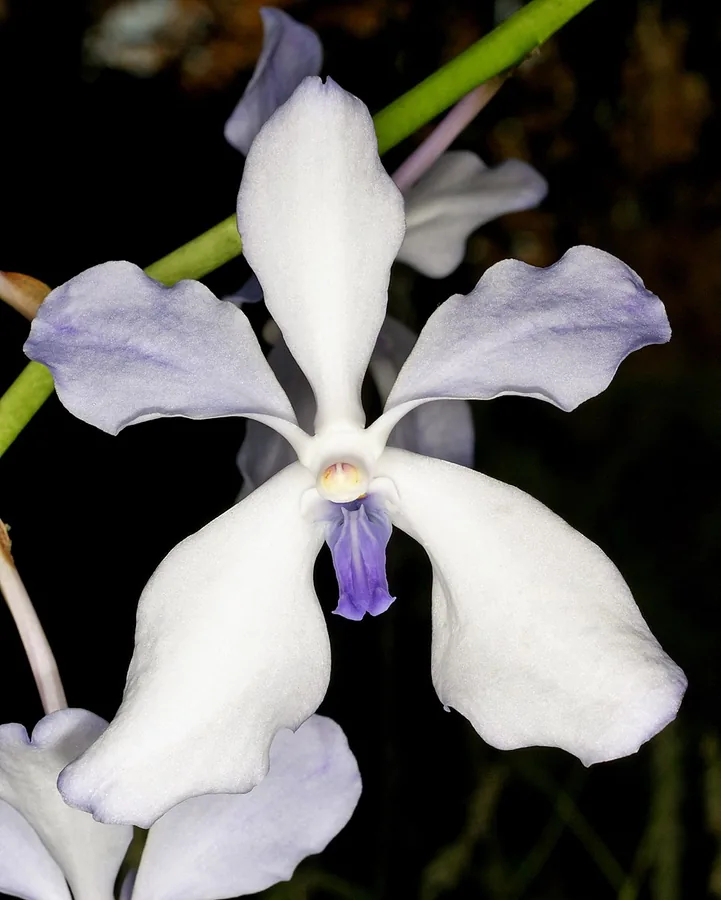
The flowers are the plant's showpiece, large, flat, and long-lasting, held out in colors that reach from the rare true blue of Vanda coerulea through deep pinks and golds. On Vanda coerulea the blue-to-violet petals carry a tessellated pattern, a fine checkered netting across each bloom. The leaves read as a firm yellow-green when the plant has enough light and darken to a duller green when it does not.
Up close, the plant is built around those roots. A Vanda stands 1 to 3 feet (30 to 100 cm) tall on its single stem, its leaves spanning 8 to 16 inches (20 to 40 cm) across. Healthy roots are firm and flush green when wet, while rotted ones darken to brown and turn hollow and soft.
Care
The short version: the brightest light on offer, warmth between 59°F and 95°F (15°C to 35°C), and humidity of 70% to 90%. Soak the bare roots daily until they turn from silver to green, let them silver again before the next soak, and keep air moving over them.
Light
Vanda are among the most light-hungry orchids and want near-full sun before they will flower. In bright indirect or partial sun they survive, and the tell is in the leaves, which should hold a firm yellow-green rather than deepening to dark green. Raise the light over several weeks so the strap-shaped leaves toughen instead of scorching.
Water
The thick aerial roots are drenched daily, often twice a day in heat, and you can watch them turn from silver to green as they drink. They dry back to silver before the next soaking, which is what keeps them from rotting. Hung bare-root with air moving past, a Vanda soaks up this much water without harm.
Soil
Most Vanda are grown bare-root with no medium at all, their thick roots left to hang free in a slatted basket. A potted plant takes only very coarse bark or charcoal in an open basket, so water runs straight through and air still reaches the roots. They sit best at a slightly acidic pH of 5.5 to 6.5.
Temperature
Vanda are warm-growing orchids, at home between 59°F to 95°F (15°C to 35°C). Cold is the real danger, since a chill can blacken the leaf bases and open them to rot, so keep the plant clear of cold drafts and cold nights.
Humidity
This is a high-humidity plant that wants 70% to 90% around it, far more than most rooms hold. That damp air needs steady airflow beside it, because still, wet conditions are where brown rot creeps into the roots and crown.
Feeding
Feed weekly with a balanced water-soluble orchid fertilizer, mixed weak and delivered with the frequent watering. Keep it going year-round while the plant grows, heaviest in spring and summer when new growth comes fastest.
Pruning
A Vanda gives you little to cut. Spent flower spikes come off once they finish, along with any dead or rotted aerial roots, but a healthy green or silver root is left alone, and the single growing stem of this monopodial orchid is never touched, since the plant has just one and cannot grow another.
Repotting
Vanda resent having their roots disturbed, so they are repotted only every 2 to 3 years or when the basket itself breaks down. Roots spilling out and circling the basket, slats rotting through, or a stem gone too top-heavy to stand upright are the visible signs that the time has come.
Size & spacing
A Vanda climbs 1 to 3 feet (30 to 100 cm) tall on its single stem, its strap-shaped leaves spanning 8 to 16 inches (20 to 40 cm) from side to side. Each plant hangs where its dangling roots find open air all around them.
Troubleshooting
Almost every Vanda problem shows on the roots or in the color of the leaves. Well-watered roots turn from silver to green within minutes, a plain visual cue that all is well. Match the look of your plant below and act early, before rot browns the roots or sun scorches the leaves.
Aerial roots gone brown and mushy instead of green
This is root rot, and it almost always traces to water sitting on the roots with nowhere to dry. A stagnant, packed basket cuts off the air the roots need, while the opposite trouble, drying out in low humidity, leaves them thin and shriveled instead. Cut the dead, brown sections off with a sterile blade, move the plant to an open basket with strong airflow, and go back to a daily soak that silvers off between waterings.
Fix:
- Remove dead rotted root sections with a sterile blade
- Move plant to a more open basket with strong air circulation
- Resume daily drenching but ensure roots dry to silver between waterings
Lower leaves yellowing or leaf bases blackening
Soft black crown and base rot appears after cold nights or after water pools in the leaf axils overnight. A single lower leaf going yellow with age is normal, but a blackened base is not, so look closely at where the color change starts. Move the plant somewhere reliably warm above 15°C (59°F), water early so the leaves dry before dark, and cut the black, rotted tissue out with a sterile blade.
Fix:
- Move plant to consistently warm conditions above 15°C
- Water early in the day so foliage dries before night
- Cut away blackened rotted tissue with a sterile blade
Bleached tan patches burned into the leaves
This is sunburn, the mark of a plant pushed into strong direct sun before it has adjusted, with heat and dry air deepening the damage. The pale patches land on the upper leaf surfaces that face the light and darken through the hottest hours. Draw the plant back into bright light with a little midday shade, lift the humidity and airflow to cool the leaves, then raise the light again over several weeks.
Fix:
- Shift to bright light with light shade during the hottest midday hours
- Increase humidity and airflow to cool the foliage
- Acclimate gradually to higher light over several weeks
Firm leaves and roots but not a single flower
A Vanda that grows well but never blooms is nearly always short on light. The leaves give it away by color: dark green and soft means too little sun, while a firm, faintly yellow-green leaf means enough. Lift the light toward full sun with careful acclimation, keep the plant warm and humid, and feed it steadily with a balanced orchid fertilizer.
Fix:
- Increase light to near-full-sun levels with adequate acclimation
- Maintain warm temperatures and high humidity
- Feed regularly with a balanced orchid fertilizer
Toxicity
The Vanda is non-toxic to pets and people alike. The ASPCA lists orchids as safe for cats and dogs, and nothing harmful has been found in Vanda. The only real caution runs the other way, since a chewing pet can shred an orchid that took years to grow to this size.
Safe for
People · Cats · Dogs · Horses · Rabbits · Livestock · Birds
Cats None
Cats are safe with this orchid. A nibbled leaf will not poison a cat, though a large mouthful of any plant can bring on a little drool or a passing stomach upset.
Dogs None
Dogs are safe as well. The orchid holds no toxin, so the worst a greedy dog meets is the mild stomach upset that follows eating too much green material.
Horses Safe
No toxicity is recorded for horses. A horse that mouths the foliage while grazing is in no danger from the plant itself.
Rabbits Safe
Rabbits are safe too. The leaves carry no known poison, so a curious chew is harmless, though a stem is best kept out of reach for the orchid's sake.
Livestock Safe
Livestock such as goats, sheep, and cattle are considered safe, with no toxic compounds documented in the plant.
Birds Safe
Birds are safe around it. A pet bird that pecks at a leaf or a flower takes no harm from this Vanda.
People Safe
People are safe as well. The orchid is not grown to eat, but a child who tastes a leaf is in no danger of poisoning.
Considered safe around pets; mild stomach upset is still possible if a curious animal eats large amounts of any plant material.
Varieties
A few Vanda appear again and again, some as striking species and some as the parents behind today's hybrids. These are the names worth knowing.
Vanda coerulea
This species carries rare blue-to-violet flowers marked with a tessellated, checkered netting, and it lies behind many of the blue-toned hybrids sold today.
Vanda Miss Joaquim
This historic natural hybrid went on to be named the national flower of Singapore.
Vanda sanderiana
A large-flowered species sometimes placed in Euanthe, it is a major parent behind the showy modern Vanda hybrids.
How to propagate
Vanda multiply slowly, so most plants are bought rather than raised at home. Propagating one means starting from a mature plant and waiting out a long, patient stretch.
Stem cuttingsDemanding
Spring to early summer during active growth · Several months to over a year to establish as an independent plant
Only a mature, tall plant carrying several aerial roots can be top-cut, and spring into early summer during active growth is the right window. The upper stem is severed so the cutting keeps several healthy aerial roots, then potted or basketed, and the base left behind may push out new growths of its own. The road is slow, from several months to more than a year before the cutting stands as an independent plant, and the cut leaves the orchid stressed.
Offsets & pupsModerate
When a keiki has formed several of its own roots, typically in the growing season · Several months once the keiki has rooted
Now and then a Vanda forms a keiki, a small plantlet that appears at the base or along the stem, usually in the growing season. It stays attached until it has grown 2 to 3 roots a few centimeters long, then it is detached and mounted on its own. Once those roots take hold, the keiki needs several months to grow into an independent plant.
Myths
Vanda orchids need potting soil like other houseplants.
They are epiphytes, and their roots must have air to stay alive. Grow them bare-root in a slatted basket, or in very coarse and open material instead. Packed into soil, the roots turn brown and rot.
Orchids are toxic to cats and dogs.
The ASPCA lists orchids broadly as non-toxic to cats and dogs, and no toxin has been documented in Vanda. The plant is safe to keep around pets, though a large mouthful might upset a sensitive stomach.