Houseplant · Orchidaceae
Brazilian Pansy Orchid
Miltonia
Give it warmth, steady moisture, and humid air, and the Brazilian pansy orchid unfurls star-shaped blooms.
Bright indirect
Every 5–7 days
55–84°F · 13–29°C
USDA 10–12
Overview
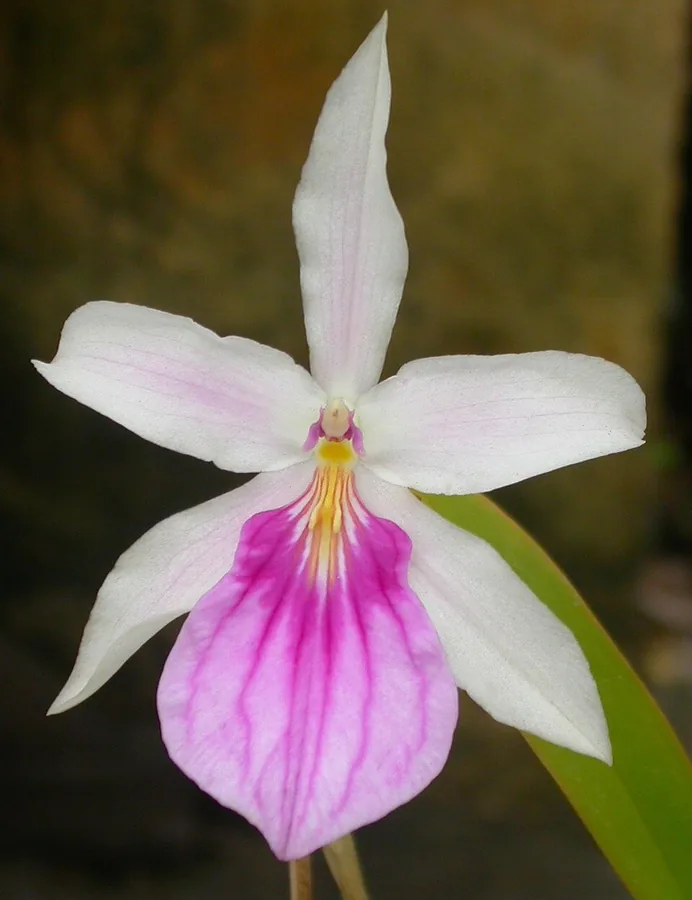
The Brazilian pansy orchid, known to botanists as Miltonia, is a warm-growing epiphyte from the forests of Brazil, and up close it is all soft greens and flat, open flowers. In the wild it clasps tree branches instead of soil, drinking from rain and humid air. Grown indoors it stays compact, around 8 to 18 inches (20 to 45 cm) tall, sending up sprays of flat, showy blooms above narrow, strap-like leaves.
It is easy to confuse with Miltoniopsis, the cooler flat-faced pansy orchid of florist shelves. Yet true Miltonia carry more star-shaped flowers, their petals reaching outward into points rather than sitting round and flat, and they want more warmth and brighter light. Reading that flower shape tells you which orchid is in front of you and how to water and place it.
It earns a moderate name because it wants two things at once: even moisture at the roots and humid air around the leaves. Meet both and it is forgiving and long-lived. Let the bark mix swing from bone-dry to soggy and the strain writes itself into the plant, the fresh leaves opening pleated and ridged and the plump pseudobulbs drawing in and creasing.
Care
The short version: give bright indirect light, tepid water whenever the bark mix nears dryness, and humid air around 50% to 70%, all held between 55°F and 84°F (13°C to 29°C) with a half-strength orchid feed through the growing season.
Light
Give it bright indirect light, the kind near an east window or set back from a brighter one. It puts up with medium light and a little shade, but harsh direct sun scorches the leaves, bleaching their green to yellow.
Water
Use tepid, low-mineral water whenever the bark mix nears dryness, roughly every 5 to 7 days, and never let the roots dry out fully. Let every drop drain away afterward, because roots left standing in water soften and rot fast.
Soil
Pot it in an open, free-draining orchid bark mix, fine to medium grade, with a little pale sphagnum or white perlite worked in. Keep it slightly acidic, around a pH of 5.5 to 6.5, and loose enough that air threads through to the roots.
Temperature
It is a warm grower, most content between 55°F and 84°F (13°C to 29°C). Ordinary room temperatures suit it, but keep it clear of cold drafts and chilly windowsills in winter.
Humidity
This orchid wants humid air, ideally 50% to 70%. Average indoor air runs too dry, so a pebble tray, a huddle of other plants, or a humidifier keeps the fresh leaves from crimping into folds.
Feeding
Through the growing season, from spring into early autumn, feed every two weeks with a balanced water-soluble orchid fertilizer diluted to half strength. Ease off as new growth slows for the year.
Pruning
Once the blooms fade, cut the spent flower spike right back to its base. Trim away any shriveled or dead pseudobulbs and shrunken roots with sterile tools, and leave the firm green leaves untouched.
Repotting
Repot every 1 to 2 years, ideally just after flowering as new growth begins. Move it on when new growth spills over the rim, roots crowd out of the pot in a tangle, or the bark has broken down to a soggy crumb.
Size & spacing
A compact orchid, it reaches 8 to 18 inches (20 to 45 cm) tall and spreads 6 to 12 inches (15 to 30 cm) across, its narrow leaves fanning out low. That tidy size fits a windowsill or a humid bathroom shelf.
Troubleshooting
Most Miltonia trouble shows on the surface you can see: the leaves, the pseudobulbs, and the roots beneath them. Pleated blades, creased bulbs, and yellowing all trace back to watering or humidity gone wrong. Match the look below, then slip the plant out and read the roots, where the real story sits.
Black, soft, mushy roots
Roots gone dark, slack, and mushy under the fingers are root rot, the gravest trouble these orchids meet, and it grows from a mix left waterlogged or so broken down that its air pockets have closed up. Lift the plant and squeeze along each root, since a sound one stays firm and pale while a rotted one flattens and darkens to brown or black. Cut out every dead root with sterile scissors, resettle the plant in fresh open bark, and water sparingly until pale new root tips push through.
Fix:
- Remove all dead roots with sterile scissors
- Repot into fresh, open bark mix
- Resume careful watering as new roots develop
Pseudobulbs shriveling and wrinkling
The pseudobulbs, those swollen green storage stems at the base, hold the plant's water, so when they draw in and crease the plant is running dry. Two things pucker them: plain dehydration, or roots gone to rot that can no longer drink. Slide the plant free and look at the roots. Firm white or green roots call for more water and higher humidity, while soft, browned roots reveal root rot, which means trimming, fresh mix, and cautious watering until new roots push out.
Fix:
- If roots are healthy, increase watering frequency and humidity
- If roots are rotted, trim dead roots, repot in fresh mix, and water carefully while new roots form
Leaves turning yellow
A single old leaf at the base fading to yellow is nothing but age. A yellow that washes across many leaves usually marks overwatering and root rot or foliage bleached by too much sun. Feel the roots for sogginess and see whether the plant sits in bare light. Cut back the water, sharpen the drainage, repot where roots have rotted, and set the plant in bright indirect light clear of the hot sun.
Fix:
- Reduce watering and improve drainage; repot if roots are rotting
- Move to bright indirect light away from hot direct sun
Emerging leaves creased into tight accordion folds
A leaf that opens in tight parallel folds, ridged like a squeezed accordion, is showing concertina growth. It forms when the roots cannot push enough water into a leaf as it unrolls, usually after the mix dried too far or the surrounding air went dry. Those folds harden into the blade for good, though they leave the rest of the plant sound. Keep the bark evenly moist, lift the humidity into the 50% to 70% band, and repot if the roots have failed or the mix has crumbled.
Fix:
- Establish a consistent watering schedule keeping the mix evenly moist
- Raise humidity to 50-70%
- Repot into fresh bark mix if roots are unhealthy or medium is broken down
Toxicity
For a home with pets and children, the Brazilian pansy orchid is non-toxic across the board. No part of it, not the leaves, the pseudobulbs, or the flowers, carries a poison, so a curious nibble from a cat, dog, or child is nothing to fear. The most that might follow is mild stomach upset from eating a plant that simply isn't food.
Safe for
People · Cats · Dogs · Horses · Rabbits · Livestock · Birds
Cats None
A curious cat can chew the strap-shaped leaves without harm, since they carry no toxin. The most that follows is a little stomach upset from swallowing something that is not food.
Dogs None
A dog that bites into a leaf or a flower meets no toxic compound at all. The coarse bark mix is worth keeping out of reach, though, since a swallowed chip can scratch the gut.
Horses Safe
Nothing in the plant harms a horse. This is an indoor orchid they seldom meet, but a stray mouthful of leaf would pass without trouble.
Rabbits Safe
A rabbit can crop the green foliage with no risk. The leaves hold no poison, though they are not a food worth setting out on purpose.
Livestock Safe
Goats, sheep, and cattle take no harm from this orchid. As a tropical houseplant it rarely reaches them, and a mouthful of leaf would do nothing.
Birds Safe
A pet bird can perch among the leaves and peck the blooms freely. Both are free of toxins, so a bit of chewing means nothing.
People Safe
The leaves and flowers are safe in the hands of adults and children alike. The plant is not grown to eat, yet no part of it poisons a child who mouths a leaf.
No special handling precautions for toxicity; wash hands after handling fertilizer or wet potting media as general practice.
Varieties
Several Brazilian species stand behind the Miltonia name, and they part ways most in the color and shape of their flowers. These are the ones you are most likely to see up close.
Miltonia spectabilis
The type species of the genus opens large, flat, strongly fragrant flowers whose broad lip deepens from pink into purple.
Miltonia regnellii
Each spike carries several pale white-to-pink flowers set over a lip veined in rose, and it grows easily outdoors in mild climates.
Miltonia clowesii
Its star-shaped flowers are barred in chestnut-brown and yellow above a fiddle-shaped lip painted white and purple.
Miltonia flavescens
This one lifts a tall arching spike crowded with many narrow, pale-yellow, star-shaped flowers.
How to propagate
Miltonia is increased by splitting an established clump rather than from seed at home. It is a slow, patient job, and it hands you exact copies of a plant you already know down to the last leaf.
DivisionModerate
Just after flowering, as new growth begins (typically spring) · 1-2 years to re-establish and reach flowering size
Divide a mature clump just after it flowers, as new growth begins in spring. Cut through the rhizome so each piece keeps at least three to four plump, healthy pseudobulbs along with an active new growth, work with sterile tools, and pot each division into fresh bark mix. The new plants take a year or two to settle in and reach flowering size, so give them time.
Myths
That round, flat-faced pansy orchid at the garden center is a Miltonia.
The cool-growing, flat pansy-faced plants most people picture are usually Miltoniopsis, a separate genus that was split off from Miltonia. True Miltonia are warm-growing Brazilian species whose flowers take a more star-shaped outline, and they want warmer, brighter conditions than their look-alike cousins.
Orchids clamp onto their host trees and drain them for food.
Miltonia and most cultivated orchids are epiphytes that grip a tree only for support. They make their own food through photosynthesis and take up water and nutrients from rain, air, and the debris around their roots, drawing nothing from the host.
Melting ice cubes over the roots is how these orchids should be watered.
These orchids hail from the warm tropics, and icy meltwater can chill and bruise the tender roots. What they want is tepid water delivered regularly, so the bark mix holds a soft, even dampness.