Houseplant · Orchidaceae
Dendrobium Orchid
Dendrobium
Give it bright light and a cool, dry winter rest, and the dendrobium answers with canes lined in flowers.
Bright indirect
Every 5–7 days
50–84°F · 10–29°C
USDA 9–12
Overview
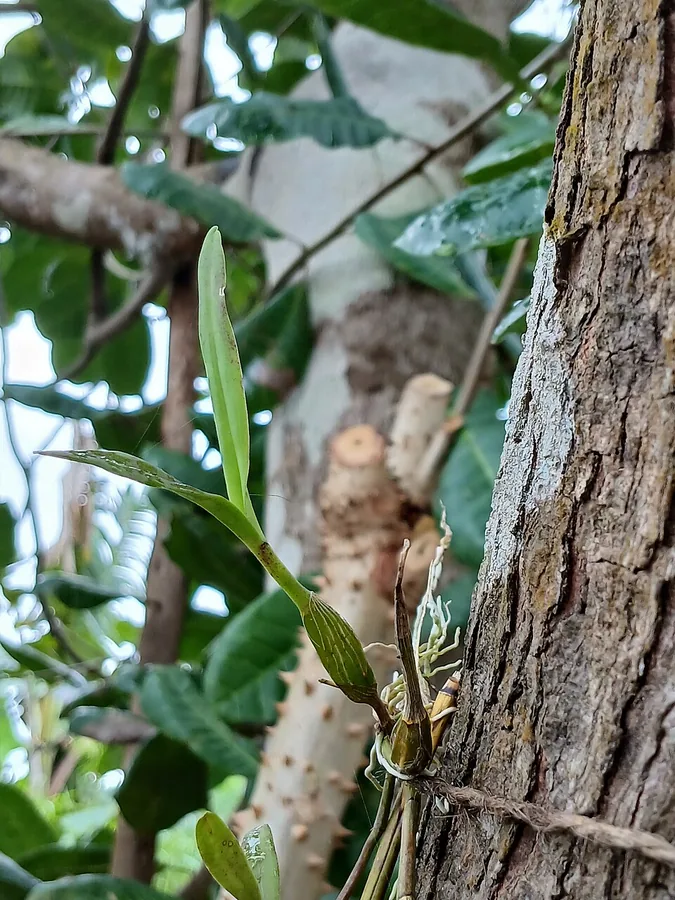
The dendrobium is one of the largest groups in the orchid family, hundreds of species spread across Asia and the Pacific. Nearly all are epiphytes, gripping bare tree bark with thick, pale roots instead of digging into soil, and that single habit shapes how one is grown indoors. Water and food are packed into upright stems called canes, plump and often ridged, which is why an old, leafless cane stays useful rather than something to cut.
Two kinds dominate the houseplant shelves, and they look the part of their differences. The noble types, led by D. nobile, shed their leaves and stand as bare canes that demand a cold, dry winter spell before flowering. The Den-Phal hybrids hold their glossy leaves year round and bloom more freely. Knowing which type you own sets how it is watered through the cold months and whether the canes ever carry flowers.
The plant reads simply once its growth and rest fall into rhythm. A dendrobium wants bright light, a chunky bark mix that drains fast, and a clear turn between its growing time and its rest. Meet those and a single healthy cane can line itself with dozens of flowers, each holding its form for weeks.
Care
The short version: bright indirect light, a fast-draining bark mix, water about weekly while the canes are growing, and a cool, dry rest in late fall to set the blooms.
Light
Dendrobium want bright indirect light, roughly twice what a Phalaenopsis takes, and a little direct morning sun does the leaves no harm. The color of the foliage is the gauge, and a healthy mid-green is the mark to hit. Leaves that turn dark and heavy with a soft sheen signal a spot too dim, and such foliage rarely carries flowers.
Water
While the canes are lengthening, water about once a week and let the bark go a shade lighter and drier between drinks. The change comes in late fall, when deciduous types like D. nobile have their water cut back sharply, the leaves yellow and drop, and the bare canes settle into a cool, dry rest. That dry spell is what swells the buds.
Soil
Garden soil packs tight around these roots and is never used. The plants sit in a coarse, bark-based epiphyte mix studded with chunks of horticultural charcoal, open enough that air threads between the pieces while a little moisture clings. The mix runs slightly acidic, in the 5.5 to 6.5 range.
Temperature
A dendrobium holds up across a wide band, about 50°F to 84°F (10°C to 29°C). The cooler end of that range in late fall is part of what stirs many types into setting buds, so a natural winter drop works on the plant rather than against it.
Humidity
Keep humidity in the 40% to 60% range, a level most rooms reach. When winter air dries out, set the pot on a tray of pebbles and water so moisture rises around the canes, or cluster it with other plants, and let air drift across the leaves to keep rot and pests off them.
Feeding
Feed from spring through early fall, while new canes are fattening, with a balanced orchid fertilizer diluted to half strength. Apply it monthly and only after watering, so it never meets dry roots. Ease off as the canes finish and growth slows for winter.
Pruning
Little cutting is called for. Snip away the spent flower spikes once they brown and dry, and remove only canes that have gone fully dead, brown, and shriveled to a husk. Leafless old canes that are still green or just yellowing remain firm stores of water and food, so they stay on the plant.
Repotting
Repot every 2 to 3 years, or sooner once the bark crumbles dark and holds water against the roots. Pale roots arching over the rim and canes pressed hard to the pot's edge are the other tells. Step up only a little, since dendrobium flower best with their roots packed snug.
Size & spacing
Depending on the type, canes rise about 6 to 47 inches (15 to 120 cm) tall, with a clump spreading 6 to 18 inches (15 to 45 cm) across. Leave each plant enough room for air to move freely between the canes.
Troubleshooting
Most dendrobium trouble shows in the canes and roots themselves: a cane that softens, a leaf that darkens, bark that has slumped into mush. Look closely at those parts and the cause, whether light, water, or spent medium, is usually written right there. Match what you see below, then treat the cause.
Yellow, soft, mushy canes at the base
Canes that yellow, soften, and squash to mush at the base mean root and crown rot from too much water. Slide the plant from its pot and read the roots, since firm white or green roots are sound while brown, soft, hollow ones have collapsed, and dark, soggy crumbled bark confirms it. Repot into fresh coarse bark, cut every rotted root away to clean tissue, and water less often in a pot that drains freely.
Fix:
- Repot into fresh coarse bark, trimming away all rotted roots and tissue
- Water less often and ensure the pot drains freely
Plenty of leaf, bare of flowers
A dendrobium thick with green leaf but showing no blooms is almost always short on light. The genus wants about twice what a Phalaenopsis takes, so move it into strong indirect light or a little morning sun. Deciduous types like D. nobile also need a cool, dry rest of 4 to 6 weeks in late fall to set buds, and leaves that have gone dark and lush instead of mid-green are the clearest sign the light falls short.
Fix:
- Move to a brighter spot with strong indirect or some direct morning sun
- Provide a 4-6 week cooler, drier rest in late fall/early winter for deciduous types
Sticky sheen, cottony flecks, and raised specks across the foliage
A sticky film and small odd growths on the foliage point to mealybugs, scale, or spider mites. Cottony white tufts are mealybugs, raised brown limpet-like bumps are scale, and fine webbing over stippled, speckled leaves marks mites, so search the leaf axils and undersides where they tuck in. Wipe them off with a cloth dipped in diluted rubbing alcohol, then treat with insecticidal soap or horticultural oil and repeat as directed.
Fix:
- Wipe pests off with a cloth dipped in diluted rubbing alcohol
- Treat with insecticidal soap or horticultural oil, repeating as directed
Toxicity
The dendrobium is safe, down to its leaves, canes, and flowers. The ASPCA lists it as non-toxic to cats, dogs, and horses, and orchids as a family carry no dangerous compounds. A pet that bites a leaf gets only a brief, mild stomach upset from the tough plant fiber, so it still belongs out of easy reach, but no part of it can poison.
Safe for
People · Cats · Dogs · Horses · Rabbits · Livestock · Birds
Cats None
Cats are safe with it, and the ASPCA lists dendrobium as non-toxic. A cat that nibbles a leaf might drool or get a brief upset stomach, nothing more.
Dogs None
Dogs are in no danger from this orchid. The most a determined chewer risks is a little mild, passing tummy trouble from the fibrous leaf itself.
Horses Safe
No toxins sit in the leaves, canes, or flowers to harm a horse, so a dendrobium poses no poisoning risk if one takes a bite.
Rabbits Safe
Rabbits are fine around this plant. It carries no toxic compounds, though it is not a food and should not be offered as forage.
Livestock Safe
Grazing livestock take no harm from dendrobium; its leaves and canes hold none of the poisons that spoil certain pasture plants.
Birds Safe
Pet birds are safe near these orchids. Nothing in the leaves, canes, or flowers is poisonous to them.
People Safe
Not one piece of a dendrobium will poison a person, and a few species even lend their flowers to the plate as a garnish. It is raised for the eye, never the table.
Although non-toxic, chewing more than a bite or two of any houseplant can cause mild, transient stomach upset, so it is still best kept out of easy reach.
Varieties
The genus runs to hundreds of species, but a few turn up again and again on windowsills, each with its own look. These are the ones worth telling apart by sight.
Dendrobium nobile
A deciduous, cool-growing type whose leafless canes, after a cold dry winter rest, line themselves with flowers in clusters from base to tip.
Dendrobium phalaenopsis / Den-Phal hybrids
Evergreen, warm-growing hybrids that send arching sprays of bloom from the tops of their leafy canes and ask for far less of a winter rest.
Dendrobium kingianum
A compact Australian pink rock orchid with slim canes that shrug off cold and sprout keikis, the little plantlets, freely along their length.
How to propagate
You can raise more dendrobium without seed, either by splitting a crowded clump of canes or by potting up the small plantlets that sprout along the old ones.
DivisionModerate
Spring, at repotting just as new growth begins · 1-2 years to a flowering-sized clump
Divide an established clump of canes in spring at repotting, just as pale new growth pushes up, keeping several healthy canes and a growing point on each piece. A stingy division with too few canes sits and sulks, slow to take hold, and a piece needs 1 to 2 years to bulk back into a flowering-sized clump.
Offsets & pupsEasy
When a keiki on a cane has several roots 3-5 cm long · 1-2 years
Dendrobium often sprout keikis, small plantlets, straight from the nodes of their old canes. Once a keiki has trailed its own roots out to about 3 to 5 cm long, snip it free and pot it on its own, where it fills out into a flowering plant over the next 1 to 2 years.
Myths
Orchids act as parasites, siphoning food from the bark they cling to.
The roots tell a different story, because dendrobium are epiphytes, not parasites. They clasp bark only for a foothold and pull their water and nutrients from rain and the air around them. They take nothing from the host tree.
When flowering ends, slice each cane down to the base.
Those bare canes are too valuable to lose. The old leafless canes, the plump pseudobulbs, are the plant's pantry, swollen with water and food and often reblooming or sprouting keikis later. Remove only the canes that are fully dead, brown, and shriveled, and leave the rest standing.