Houseplant · Orchidaceae
Cymbidium Orchid
Cymbidium
Give it bright light and cool fall nights, and the cymbidium throws up long, arching sprays of bloom.
Bright indirect
Every 5–7 days
50–86°F · 10–30°C
USDA 10–12
Overview
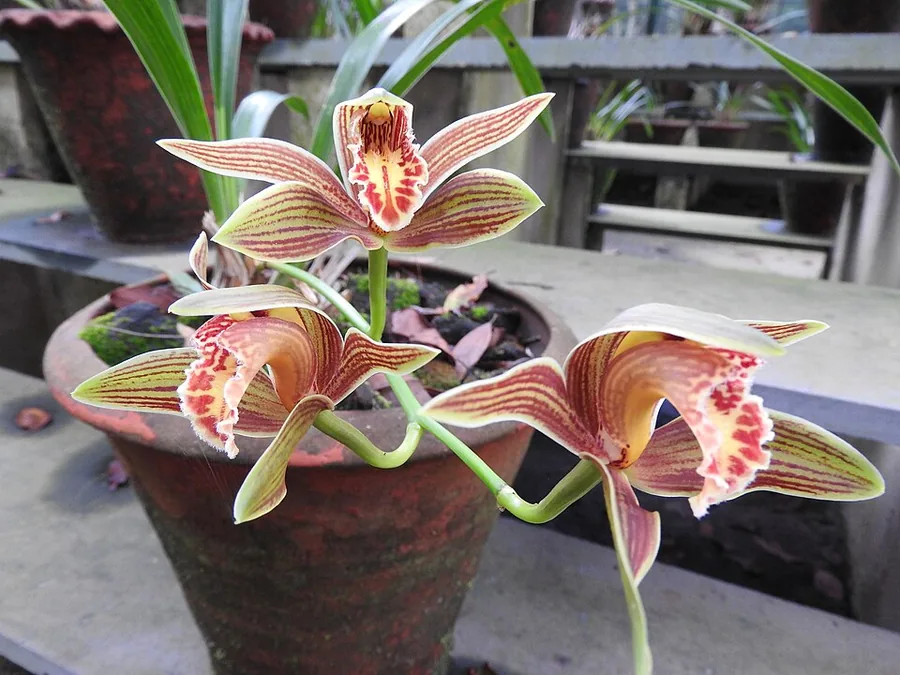
The cymbidium, or boat orchid, grows from fat, green swollen stems called pseudobulbs that cluster at the base like a row of smooth bulbs above the bark. From each one rise long, strap-shaped leaves, leathery and arching, and between them climb tall flower spikes that bend under rows of waxy blooms for weeks through late winter and spring. Its roots are thick and pale, threading down into a loose bark mix rather than gripping a tree the way many orchids do.
Color comes late and on a schedule the plant keeps for itself. The cymbidium needs a stretch of cool fall nights before a single spike will push up between the leaves, so a specimen kept warm all year stays a fountain of green blades and never colors. Match the seasonal rhythm, bright light through the year and that autumn chill, and the spikes rise on their own, each one lined with flower after flower.
Up close the plant reads as tough rather than delicate: firm pseudobulbs, stiff arching leaves, and a dense knot of pale roots that prefers to sit a little crowded in its pot. The bark around it should stay moist but never waterlogged. Grown this way a single clump thickens for years, sending up more leaves and heavier sprays of bloom each season.
Care
The short version: bright indirect light all year, a bark mix kept moist but never soggy, and a run of cool fall nights to lift the spikes. Feed weekly through the growing season at a weak dilution, and repot only every couple of years.
Light
Cymbidiums want bright indirect light, with strong full light through winter and bright filtered light in summer so the broad leaves do not scorch and brown at the tips. Light that is too dim is the second most common reason the plant grows leaves but never lifts a spike.
Water
Water thoroughly with tepid water every 5 to 7 days, soaking the bark until it is moist but never soggy, then letting every drop drain through the chunky medium. The bark should feel damp, not wet, since standing water around those pale roots is the fastest way to rot them.
Soil
Plant it in a bark-based orchid mix of coarse, open chips that drain freely, never ordinary potting soil, which packs down and smothers the thick roots. A slightly acidic pH of 5.5 to 6.5 suits it, and the gaps between the bark chips keep air against the roots.
Temperature
The leaves and pseudobulbs hold up across a wide span, from about 50°F to 86°F (10°C to 30°C). The seasonal swing is what counts, since a stretch of cool fall nights is the cue that sends a spike climbing up out of the foliage.
Humidity
Aim for 50% to 70% humidity, more than most rooms hold in winter, so the strap-shaped leaves stay firm and unblemished. A pebble tray or a nearby humidifier lifts the moisture, and steady airflow keeps the damp blades clear of stippling pests and rot.
Feeding
Feed weekly from spring through fall with a balanced fertilizer cut to quarter or half strength, poured on right after watering so it never lands on dry roots. Through winter the growth slows and the feeding eases off with it.
Pruning
No structural pruning shapes this plant. Once the waxy blooms drop and the spike browns, cut it back to the base, and peel away any yellowed or dead leaves so the clump of pseudobulbs stays clean and open.
Repotting
Repot only every 2 to 3 years, in spring after flowering, since the plant blooms better when its roots sit a little crowded. Move it up when the leading pseudobulb presses against the pot edge, the pale roots crowd or escape over the rim, or the old bark has crumbled and stays wet.
Size & spacing
A mature clump stands 1 to 4 feet (30 to 120 cm) tall and spreads 9 to 35 inches (23 to 90 cm) wide, the long leaves and arching spikes accounting for most of that height. Leave room for the spikes to bow outward under their blooms without leaning on anything.
Troubleshooting
Most cymbidium trouble shows up in three forms you can see on the plant itself: too little light or warmth at the wrong season, the speckling and webbing of common pests, or roots gone soft in a pot that stays too wet. Match what you see below and act early, before a setback eats into the roots.
Blackened, mushy roots beneath a soggy crown
When the crown sits soft and dark and the roots have turned to root rot, the cause is a medium held too wet, often after the bark has crumbled to a soggy mush that no longer drains. Slide the plant out and run the roots through your fingers: the sound ones are firm and pale, the rotted ones brown and collapsing. Cut the dead roots away, repack the plant in fresh chunky bark, and water it less often.
Fix:
- Remove rotted roots and repot into fresh well-draining bark medium
- Reduce watering frequency and ensure free drainage
Strap-shaped leaves only, with no flower spikes rising
When a cymbidium pushes out leaf after leaf but no upright spike ever rises between them, it is almost always going without its cool fall nights, the day-to-night temperature drop that triggers spike formation. Dim winter light holds the spikes down as well. Give it strong seasonal light and a stretch of chilly autumn nights, and the spikes climb up.
Fix:
- Expose to cool fall nights with a marked day-night temperature drop
- Increase light to full winter light and bright filtered summer light
Yellowing leaves flecked with pale stipple and fine webbing
Tiny pale flecks across the leaf and a thread of fine webbing across its underside mark spider mites, while soft bodied clusters and a glossy sticky film mark aphids. Both crowd onto the undersides of leaves and the soft new growth where the tissue is tenderest. Rinse the foliage, wipe the pests from the leaf, and follow with insecticidal soap or horticultural oil until the stippling stops spreading.
Fix:
- Rinse foliage and wipe off pests
- Treat with insecticidal soap or horticultural oil, repeating as needed
Toxicity
For pet owners and parents the cymbidium is non-toxic, leaves, pseudobulbs, and all. The ASPCA lists orchids as safe for cats, dogs, and horses, and the same holds for the other animals in a home. A curious pet that chews into the firm, fibrous leaf might get a brief stomach upset from the roughage, but there is no poison in the tissue.
Safe for
People · Cats · Dogs · Horses · Rabbits · Livestock · Birds
Cats None
Cats are safe with it. A cat that bites into the firm, fibrous leaf gets only a brief upset stomach from the roughage, nothing worse.
Dogs None
Dogs are safe too. A chewer who works through the tough leaf blade risks no more than mild, passing tummy trouble.
Horses Safe
Horses are not at risk. The strap-shaped leaves carry no toxin that could harm them.
Rabbits Safe
Rabbits are safe near it, though the leathery leaves are no part of their diet and should never replace their proper greens.
Livestock Safe
Sheep, goats, and cattle graze near it without harm, since its strap-shaped leaves carry nothing that could poison them.
Birds Safe
Pet birds can perch among the arching leaves without worry, since the plant carries no toxic compounds.
People Safe
People are safe around it, children included. The plant simply is not grown to be eaten.
Although non-toxic, eating large amounts of any plant material may cause mild, temporary stomach upset.
Varieties
Cymbidiums come in hundreds of species and hybrids, from cool-growing wild types to award-winning crosses bred for color and flower shape. A few stand out by their blooms.
Cymbidium erythraeum
A species that thrives in cooler conditions and has taken the RHS Award of Garden Merit for how steadily it performs in the garden.
Cymbidium lowianum
A large species that arches out long sprays of green flowers, each one carrying a lip stamped with red, and it holds an Award of Garden Merit as well.
Cymbidium Sarah Jean gx 'Ice Cascade'
A hybrid whose white flowers tumble in a cascade, looking their best where the spray can spill over the edge of a raised pot or shelf.
Cymbidium Tiger Tail gx
An Award of Garden Merit hybrid grown for the dependable patterning that marks its blooms.
How to propagate
Cymbidiums are multiplied by division rather than from seed at home, cutting one mature clump of pseudobulbs into several new plants.
DivisionModerate
Spring, after flowering and at repotting · 1-2 years to re-establish and flower again
A crowded clump of pseudobulbs can be cut apart in spring, right after flowering as you repot. Leave each split section with at least three healthy pseudobulbs, plump and firm, along with a leading growth, so it holds the stored energy to recover. Then wait, since a fresh division usually takes one to two years to settle in and flower again.
Myths
Cats and dogs are poisoned by every orchid.
The ASPCA lists orchids as non-toxic to cats, dogs, and horses, and cymbidiums are no exception. A pet that chews through a leaf risks nothing worse than a mild, short-lived stomach upset.
An orchid leeches its living from whatever plant it sits on.
Not so. Cymbidiums are terrestrial and semi-terrestrial orchids that root down into their own bark medium and make their own food through their leaves. They draw nothing from a host and never have.