Herb · Caprifoliaceae
Valerian
Valeriana officinalis
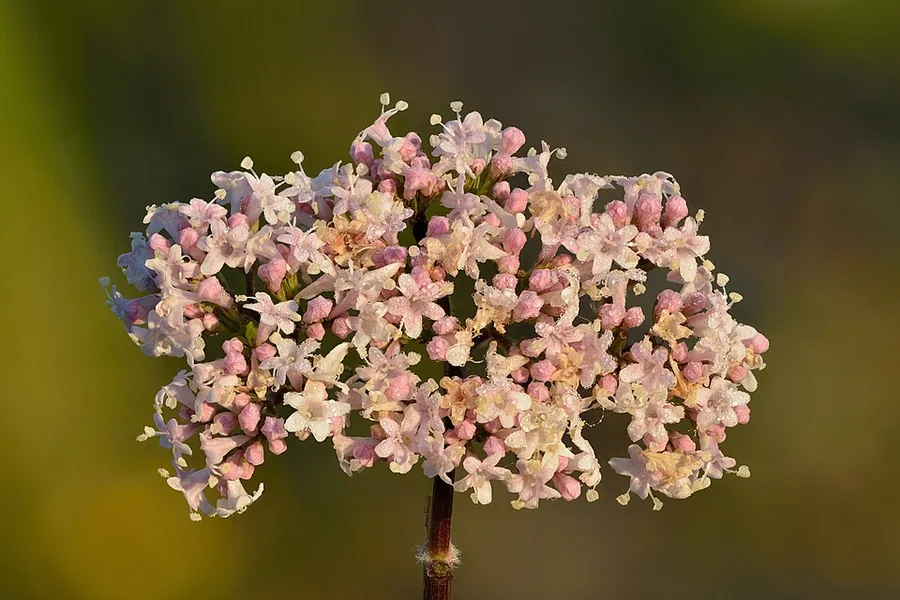
Valerian lifts airy domes of pale-pink and white bloom on tall stems, over roots that carry a heavy, distinctive scent.
Full sun
Every 3–7 days
USDA 4–9
3–5 ft · 0.9–1.5 m
Overview
Valerian shows its character from a distance and up close. Tall stems rise well overhead and branch near the top into airy, domed clusters of small flowers, loosely packed so light passes through them. The bloom runs from early to midsummer in shades that drift from pale pink to clean white, and the whole head gives off a sweet, far-reaching fragrance.
The root is the plant's most striking feature to the nose. Below the crown sit aromatic roots with a strong, unmistakable scent, the part dried and steeped for centuries as a herbal sedative behind the old name all-heal. That same pungent root holds compounds that pull at cats the way catnip does, setting them rolling and playing beside it with no harm done.
Set against its looks is the way valerian grows and multiplies. It puts on height fast, sends up flower after flower that ripens into freely scattered seed, and creeps outward on underground rhizomes, enough to have escaped into the wild and earned an invasive listing in some regions. The flowers give way to seed heads that can carry the plant far, so cutting them before they ripen keeps a single clump from becoming a colony.
Care
The short version: valerian wants full sun and steady moisture in rich, fertile soil, with the faded flower heads cut before they seed. It takes most soils and deep cold in stride, so watering and tidying make up the routine.
Light
Valerian colors up and flowers best in full sun, which also keeps its tall stems standing straight rather than leaning. It will hold on in partial shade, but out of the light the stems stretch thin and flop, so an open, bright position shows it at its best.
Water
Valerian leans toward damp, rich ground and shows stress when the soil dries out. Watering every 3 to 7 days, and more often in heat, keeps the foliage full and the stems firm. It bears the occasional dry spell, but a parched plant thins and fades.
Soil
The strongest growth comes in fertile, moist, well-drained loam, though valerian roots into clay, loam, or sand without complaint. It prefers a soil pH between 6.0 and 7.5, a range that fits most ordinary ground.
Temperature
Valerian is deeply cold-hardy, holding through winters as low as -31°F (-35°C) and enduring summer heat to about 86°F (30°C). It looks its freshest in cool air and can flag where the summer runs long and hot.
Humidity
Ordinary outdoor humidity, somewhere near 40% to 70%, is all valerian needs. As a hardy garden perennial it lives on whatever moisture the air holds, so nothing here needs adjusting.
Feeding
A light feed in spring, as the new shoots push up, is enough, whether from a balanced fertilizer or compost worked into the soil. More than that swells the stems into soft, floppy growth rather than adding flowers.
Pruning
The faded flower heads are best cut the moment they brown, since valerian scatters seed heavily once they ripen. The stems come down after bloom, and the dead foliage is cleared as the whole plant sinks back to the ground for winter.
Repotting
Valerian is rarely kept potted for long, but an established clump stays vigorous when divided every 2 to 3 years. A crowded, congested crown, thinner flowering, and roots winding through a container are the signs it is ready to split.
Size & spacing
The flowering stems climb to about 3 to 5 feet (90 to 150 cm), tall enough to sit at the back of a bed. Each plant spreads to fill 2 to 4 feet (60 to 120 cm), so leaving that much room lets light and air reach the airy heads.
When to plant
Valerian moves through the year on a cool-season rhythm. Seed starts indoors in late winter to early spring, young plants go out once hard frost has passed, and the scented flower heads open through early and midsummer. The aromatic roots are lifted in the fall of the second year, when their scent and strength peak.
Northern hemisphere
Southern hemisphere
Typical months for a temperate climate: start earlier in warm zones, later where spring frosts linger.
- Sow: Late winter to early spring, 6-8 weeks before last frost
- Plant: Spring after danger of hard frost
- Harvest: Fragrant pinkish-white flower clusters in early-to-mid summer (June-July); harvest roots in fall of the second year for medicinal use
Hardiness
USDA hardiness zones: 4–9
Temperature: down to -34°C
Troubleshooting
Valerian gives little trouble, and the two issues that show up have to do with how the tall stems carry themselves and how far the plant travels, not with pests or disease. Match the look of the plant to the notes below and step in early.
Young seedlings dotted through the beds
Valerian is a prolific self-seeder whose ripe heads shed freely, and it also runs outward on rhizomes, so a lone clump soon rings itself with offspring. Small seedlings show up around the parent and across nearby beds, ditches, and rough ground. Cutting the flowers before they seed, lifting the young seedlings, and digging out stray rhizomes hold the spread back.
Fix:
- Deadhead before seed set
- Remove volunteer seedlings while young
- Dig and discard escaped rhizomes
Tall stems bending and sprawling low
Stems that bend and sprawl instead of standing tall point to too little sun. In shade, or in ground that runs too rich, valerian throws soft, thin growth that cannot hold its own height. A move into full sun firms it up, less nitrogen helps, and a stake supports the tallest stems if they still sag.
Fix:
- Site in full sun
- Provide staking or grow-through support for tall stems
- Avoid excess nitrogen
Toxicity
For homes with animals, valerian is non-toxic and safe to grow. Its root sets cats off the way catnip does, though that is playful excitement rather than poisoning, and the same root is used as a gentle calming herb for people and pets.
Safe for
People · Cats · Dogs · Horses · Rabbits · Livestock · Birds
Cats None
Cats fall on the root much as they do catnip, rolling against it, rubbing their faces on it, and turning playful. The reaction is a harmless behavioral high rather than poisoning, so it can run its course and be tidied up after.
Dogs None
Dogs are safe beside it. Nothing in the plant harms them, and the root even serves as a mild calming herb for anxious dogs.
Horses Safe
Horses are at no risk, since grazing on the leaves brings no poisoning.
Rabbits Safe
Rabbits can nibble the leaves without harm, though any new green is best given in small amounts to start.
Livestock Safe
Grazing livestock are unharmed by valerian, which feeds as ordinary forage rather than a poisonous weed.
Birds Safe
Birds are safe around the plant, with no toxic parts to trouble them if they peck at the foliage or seed heads.
People Safe
People take the dried root as a long-standing herbal sedative for sleep and calm. The plant is non-toxic, though anyone using it as a remedy should follow sensible dosing.
The root acts as a catnip-like attractant: many cats become excited, playful or euphoric around it. This is a benign behavioral response, not toxicity. Store dried root away from cats if you do not want them disturbing it.
Varieties
Valerian is grown almost entirely as the wild species rather than as named cultivars, so a single form is worth knowing.
Valeriana officinalis (species)
This is the standard medicinal garden valerian, its tall stems crowned with loose, domed heads of fragrant pale-pink to white flowers, over the aromatic, sedative roots from which the plant takes its name.
How to propagate
Valerian is simple to increase, whether by sowing the fine seed for a fresh batch of plants or by splitting an established crown to copy one already grown.
SeedEasy
Sow indoors late winter to early spring or direct sow in spring; self-sows readily · Germinates in roughly 2-3 weeks; establishes and flowers within the first to second season
Seed offers the easiest start for a fresh set of plants. The fine seed is sown indoors from late winter to early spring, or dropped straight onto the ground once spring comes, and it sits right on the surface, since a little light triggers germination. Green sprouts break through in about 2 to 3 weeks, and the plants fill out and flower across the first or second season. Any heads left to ripen scatter seed freely, often more freely than expected.
DivisionEasy
Spring or early fall · Divisions re-establish within a few weeks to a single growing season
Division copies an existing plant fastest. In spring or early fall, an established clump is eased from the ground, the crown is pulled apart into sections, and the pieces go back into moist, fertile soil. Each new piece takes root and grows away within a few weeks to a single growing season.
Myths
Because valerian throws cats into a frenzy like catnip, it must be a drug that harms them.
The frenzy looks alarming, but it is the same innocent pull cats feel toward catnip, set off by the root's aromatic compounds and not by any poison. Valerian is non-toxic and even doubles as a gentle calming herb for anxious pets. The catnip-style reaction is play, not poisoning.