Shrub · Caprifoliaceae
Honeyberry
Lonicera caerulea
Two cultivars together bring the year's first berry, a long, dusty-blue fruit that eats sweet-tart and shrugs off frost.
Full sun
Every 5–7 days
USDA 2–7
4–6 ft · 1.2–1.8 m
Overview
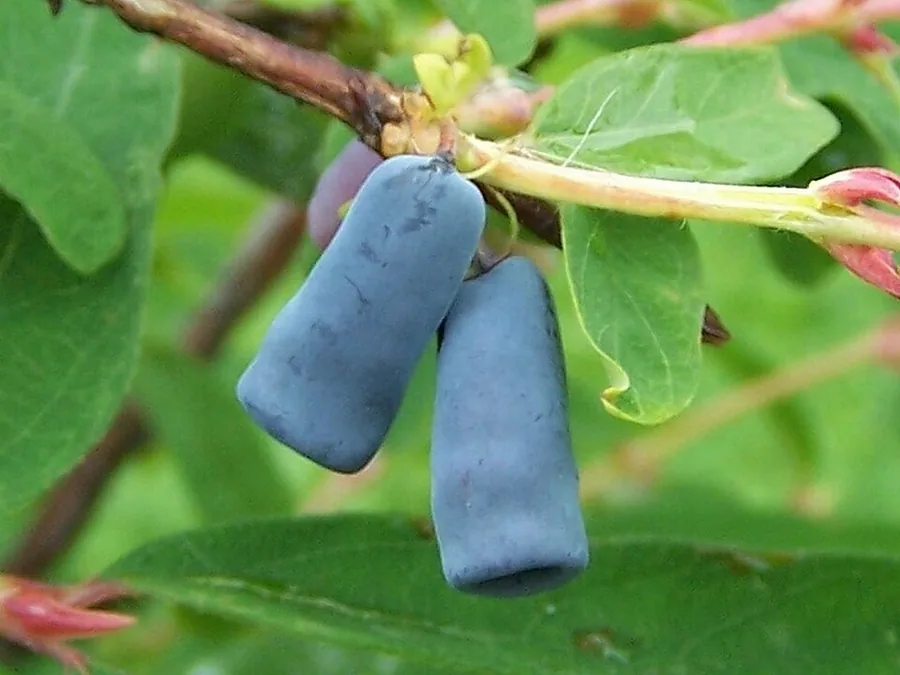
Honeyberry, or haskap, is the edible-fruited honeysuckle, and the fruit itself sets it apart: a long, oval, dusty-blue berry carried in loose clusters, and usually the first to ripen anywhere in the garden. The shrub belongs to the honeysuckle family and grows wild along riverbanks and damp northern ground, so it leans toward steady moisture over a dry corner. Bite through the thin skin and the flavor lands between a blueberry and a raspberry, whether fresh or frozen.
The plant is built to endure cold. Its woody stems hold firm down to -45°C (-49°F), and the small cream-yellow flowers that open first each spring take frost to about 19°F, so a late chill rarely blackens them. Its roots reach into almost any ground as well, from acidic soil to pale, chalky, limey beds that the blueberry would refuse outright.
For all that fruit, it will not go it alone. A single bush covers itself in flowers and then hangs almost no berries, because honeyberry cannot pollinate itself. Two unrelated cultivars blooming side by side let the bees carry pollen between the flowers, and by late spring the branches bend under heavy, blue-fruited clusters.
Care
The short version: give it full sun and steady moisture, plant a second compatible cultivar close by for pollination, and net the branches against birds as the blue berries begin to color.
Light
Honeyberry colors up its heaviest fruit in full sun, though it will crop in partial sun or light shade. Where summers turn hot, a little afternoon shade spares the leaves the heat this cold-country shrub was never built for.
Water
The plant is no drought-holder. Sprung from riverbanks and damp ground, its roots want a deep soak every 5 to 7 days, and more in a heat wave. Drip irrigation keeps the soil evenly damp while leaving the foliage dry.
Soil
Set it in moist, well-drained loam. Its roots take a pH from 5.0 to 8.0, reaching even into pale, chalky, calcareous soils that most berries refuse, so the ground rarely needs amending.
Temperature
Few fruit shrubs match this hardiness. The woody stems survive from -45°C to 30°C (-49°F to 86°F), and the early flowers take frost to about 19°F, though sustained summer heat past zone 6 browns the leaves and stresses the plant.
Humidity
Ordinary outdoor humidity across the 40% to 70% range suits it well. Air moving through the branches matters more than any exact figure, since crowded, still air is what films the leaves with powdery mildew late in the season.
Feeding
One feed in early spring does it, a balanced granular such as 16-16-16 at about a half cup per plant. Late-season nitrogen is left off, since it draws out soft new growth that will not harden before winter.
Pruning
A young bush wants little for its first 3 to 4 years beyond cutting away dead or damaged wood. From around year 6, up to 25 percent of the oldest branches come out each dormant winter to keep the canopy open and the fruit coming.
Repotting
This is an in-ground shrub, not a potted plant, so repotting rarely arises. A plant begun in a container moves to its permanent ground once roots circle the pot or water runs straight through.
Size & spacing
A mature bush stands about 4 to 6 feet (120 to 180 cm) tall and spreads about as wide, a rounded, twiggy shape. Give it that same width in spacing so air threads through the branches and a pollinator partner sits within the bees' reach.
When to plant
Honeyberry runs early through the year. New plants go in during early spring or early fall, the small cream-yellow flowers open on the first warm days, and the ripe blue berries come off the branches from late May into mid June, often before the strawberries color.
Northern hemisphere
Southern hemisphere
Typical months for a temperate climate: start earlier in warm zones, later where spring frosts linger.
- Plant: Early spring or early fall
- Harvest: Blooms very early spring with cream-yellow flowers that tolerate frost to about 19°F; berries ripen late May to mid June, often just before strawberries
Hardiness
USDA hardiness zones: 2–7
Temperature: down to -46°C
Troubleshooting
Most honeyberry trouble shows on the fruit or the leaves and traces to three causes: a missing pollinator partner, birds at the early blue berries, or summer heat browning the foliage where the climate runs too warm. Match what you see to the notes below. Catching the first signs saves the crop.
A shrub thick with bloom yet nearly bare of fruit
The bush hangs full of cream-yellow flowers and then swells almost no blue fruit behind them, because honeyberry cannot pollinate itself. It takes a second, unrelated cultivar flowering at the same moment, such as Tundra beside Aurora or Honey Bee, set within about 6 feet so bees can travel bloom to bloom between them. A scatter of early flowers close by draws those pollinators onto the cold-weather blossoms.
Fix:
- Plant at least two unrelated cultivars that bloom together (for example Tundra with Aurora or Honey Bee)
- Site them within about 6 ft of each other to aid bee transfer
- Encourage early-spring bees with companion flowers
A chalky white bloom filming the upper leaves
A dry, dusty white film coats the tops of the leaves, and that is powdery mildew, settling in after harvest when the air turns warm and motionless. It seldom spoils the fruit, but it can leave the branches stripped of foliage early. Pick off the most coated leaves, widen the gaps between plants so air slips through, and lean on a resistant cultivar such as Tundra.
Fix:
- Remove and dispose of badly affected foliage
- Improve spacing and airflow
- Choose mildew-resistant cultivars such as Tundra
Browned leaf edges and bare branches in the heat
Honeyberry is a plant of cold ground, so heat stress shows on its leaves past zone 6, worst on the Russian-type cultivars. The leaf margins scorch to brown and the branches drop their foliage early. A place with afternoon shade and evenly moist soil settles it, and the Japanese or Kamchatka types hold their leaves through warmth far better.
Fix:
- Provide afternoon shade and steady soil moisture
- Use Japanese or Kamchatka-type cultivars better suited to warmth
Blue fruit pecked away as it deepens in color
As the berries darken from green to a dusty blue, birds find them ahead of any other fruit in the garden and strip the branches. The guard is plain: lay bird netting over the whole bush before the fruit colors up, and leave it draped there through late May and June until the last berry is picked.
Fix:
- Drape bird netting over plants before fruit ripens
- Net in late May through June
Toxicity
Nothing on this plant will harm you or an animal. The ripe blue berries are grown as a food crop and eaten by people, and the green leaves hold nothing toxic to pets, livestock, or wildlife. The single caution is one of identity: keep it apart from the ornamental honeysuckles, whose red berries are inedible.
Safe for
People · Cats · Dogs · Horses · Rabbits · Livestock · Birds
Cats None
A cat is safe with honeyberry. A bite of the green leaf or a blue berry carries no poison, though a bellyful of any plant can leave a cat briefly queasy.
Dogs None
A dog is safe here. The blue berries are the very fruit people eat, and the leaves carry nothing harmful in them.
Horses Safe
A horse can crop the leaves and fruit of honeyberry without harm, since neither the foliage nor the blue berries hold any toxin.
Rabbits Safe
Rabbits are safe around honeyberry. A little browsing on the green leaves does no harm, and a few of the ripe blue berries are a harmless treat.
Livestock Safe
Cattle, goats, and sheep can browse the foliage and fruit safely, as the plant holds no poisonous compound.
Birds Safe
Birds strip the early blue fruit and take no harm from it. The real trouble is saving enough of the berries for yourself.
People Safe
The ripe blue berries are grown as a food crop and eaten fresh, frozen, or in preserves. They are good to eat with no special care.
No special handling required; ripe berries are edible and safe to pick by hand.
Varieties
Most honeyberry cultivars trace to breeding programs in Russia, Japan, and Canada, and a fruiting planting wants at least two that bloom together. These are the ones worth knowing by their fruit.
Tundra
Its berries hold firm enough to come off by machine, and its foliage shrugs off powdery mildew better than most.
Borealis
It hangs large berries with a sweet-tart flavor that ranks among the best for eating straight off the branch.
Indigo Gem
It loads its branches with small, tangy berries that come into their own in jams, juice, and other processing.
Aurora
A vigorous University of Saskatchewan cultivar of large fruit and long bloom that makes it a strong pollinizer for the Boreal and Honey Bee group.
Honey Bee
A University of Saskatchewan pollinizer bearing tart fruit on a long-running bloom that overlaps well with its partners.
Companions
Honeyberry's best neighbors are the ones that help it set fruit: a second compatible cultivar to cross-pollinate, and early flowers that pull bees in while the bloom is still cold.
Plant near
A second unrelated haskap cultivar: Required cross-pollinizer that must bloom at the same time for good fruit set
Early-spring flowering plants such as crocus: Draw bumblebees and bees during haskap's very early bloom, improving pollination
How to propagate
More honeyberry comes from cuttings or from seed, but only cuttings return the same plant, fruit and all, that you started with.
Stem cuttingsModerate
Softwood cuttings in early summer or hardwood cuttings taken during dormancy · About 4 to 8 weeks to root; transplant out the following season
Cuttings copy a cultivar true to type. Take green softwood in early summer or bare hardwood while the plant is dormant, dip the cut ends in rooting hormone to lift your odds, and watch for roots in about 4 to 8 weeks. Grow the young plants on and set them out the following season.
SeedModerate
Sow after cold stratification in spring · Several years to first fruiting
Seed is a breeder's tool, not a way to copy a favorite bush. The small seed needs cold stratification before a spring sowing, but the seedlings come up variable, none quite matching the parent, and they take several years to reach first fruit.
Myths
All honeysuckle berries are poisonous, so honeyberries are unsafe to eat.
Many ornamental honeysuckles, L. tatarica and L. maackii among them, do hang mildly toxic, inedible red berries, and that is where the fear starts. Honeyberry is the separate species L. caerulea, grown as a food crop for its blue fruit. Its ripe blue fruit is non-toxic and eaten fresh, frozen, and in preserves.
Honeyberries need acidic soil like blueberries.
That rule belongs to the blueberry, not to haskap. Honeyberry handles a wide pH range and even roots well into chalky, calcareous ground up around 7.7 or higher, which places it among the most soil-forgiving berries you can grow.
A single honeyberry plant will produce a full crop on its own.
Honeyberry cannot fertilize its own flowers. It needs a second, unrelated cultivar blooming at the same time nearby to cross-pollinate, or the branches carry plenty of bloom and almost no fruit.