Tree · Magnoliaceae
Tulip Tree
Liriodendron tulipifera
A fast, towering shade tree lifting cup-shaped greenish-yellow flowers into the canopy, its four-lobed leaves burning clear gold in fall.
Full sun
Every 7–14 days
USDA 4–9
60–120 ft · 18.3–36.6 m
Overview
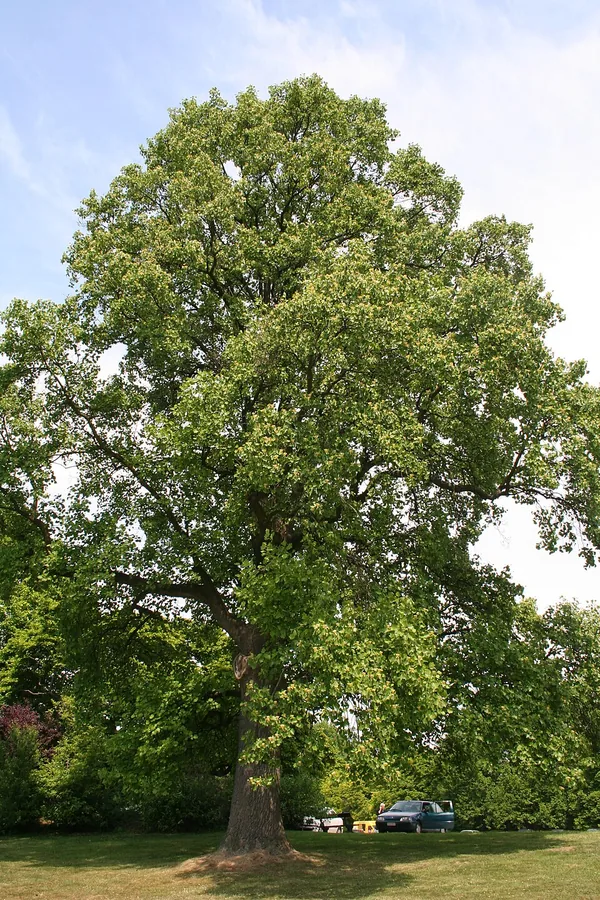
Up close, the tulip tree reads first through its foliage. Each leaf carries four broad lobes, cut so cleanly that the whole outline suggests a cat's silhouette, green through the summer and turning a clear yellow as autumn arrives. The tree stands among the tallest hardwoods of eastern North America, a magnolia relative that lifts a straight trunk to 60 to 120 feet (18 to 37 m). In late spring the crown holds cup-shaped greenish-yellow flowers, each ringed with a band of orange, the tulip-like blooms behind its name, though they perch so high they are easy to miss.
The trunk climbs tall and arrow-straight, and the wood inside is pale, soft, and even-grained, the very timber once shaped into canoes and crates. That same wood is brittle, so a limb can crack away in wind, ice, or snow. For all the labels tulip poplar and yellow poplar, the tree is neither a poplar nor a true tulip.
Overhead the crown fans wide, reaching 30 to 60 feet (9 to 18 m) across, while the roots stay shallow beneath the surface. Under a mature specimen the sheer scale registers: a straight column topped with those broad, four-lobed leaves, set well away from buildings and pavement where its reach has open ground. Given depth and moisture in the soil, it grows into a living landmark that outlasts the hand that planted it.
Care
The short version: picture a very large tree with a straight trunk, broad four-lobed leaves, and high greenish-yellow flowers, set in full sun and deep, moist, slightly acidic soil with plenty of open room. Water young trees through drought, prune the brittle wood in late winter, and keep it clear of anything a falling limb could strike.
Light
In full sun the trunk rises straight and the flowers set well, and a young tree will take a little partial shade. Deep shade draws the growth thin and sparse, so an open, sunlit spot shows the tree at its fullest.
Water
The tree draws on deep, moist, fertile soil and shows drought quickly. Through a hot, dry summer the inner leaves yellow and fall early, thinning the crown from within, so young and establishing trees want deep watering in dry spells. An older tree on good ground carries itself.
Soil
Give it deep, rich, well-drained loam worked with organic matter. It leans slightly acidic, most at ease around a pH of 5.0 to 6.5, though it takes a wider range. Compacted or confined soil is what it will not stand, so avoid cramped or paved-over ground.
Temperature
The tree is cold-hardy, holding across USDA zones 4 to 9 and enduring from roughly -29°F to 100°F (-34°C to 38°C). That reach spans most of the temperate country it grows in across its native eastern North America.
Humidity
Out of doors the humidity is simply the season's, with no level to set. The tree grows through humid and drier country alike, and soil moisture weighs far more on it than the air.
Feeding
On rich native soil the tree needs no feeding. Where the ground is poor, a balanced tree fertilizer worked in during early spring helps, and otherwise it draws on the earth around its roots.
Pruning
Cut in late winter, clearing dead, weak, or crossing limbs from the bare frame. The pale wood is brittle and parts easily, so sound early structure quietly guards against limb breakage in later years. Keep the cuts modest and well timed.
Repotting
This is no container plant. It is a large landscape and forest shade tree, rooted in open ground, so once it settles into its permanent place there is no repotting to consider.
Size & spacing
Expect a straight trunk reaching 60 to 120 feet (18 to 37 m) and a crown fanning 30 to 60 feet (9 to 18 m) wide. Plan the spot around that full frame, well clear of buildings, power lines, and pavement, since a tree of this size does poorly hemmed in.
When to plant
Set a tulip tree out in spring or fall, as soon as the soil turns workable, allowing more room than the slim young trunk suggests. The flowers unfold in late spring, May into June, greenish-yellow cups banded orange, sitting high in the canopy. Growth is fast from the first, so the trunk and crown gain size quickly and the choice of place carries more weight than the season.
Northern hemisphere
Southern hemisphere
Typical months for a temperate climate: start earlier in warm zones, later where spring frosts linger.
- Plant: Spring or fall, after the soil can be worked; give ample room for a very large mature canopy.
- Harvest: Cup-shaped greenish-yellow flowers with an orange band bloom in late spring (May to June), often high in the canopy.
Hardiness
USDA hardiness zones: 4–9
Temperature: down to -34°C
Troubleshooting
Most of what troubles a tulip tree writes itself across the leaves, from sap-feeding insects or the strain of a dry summer. On a tree this size the marks tend to stay cosmetic, yet the earliest changes in the foliage signal whether to act or wait. Match the look of the leaves to the entries below.
Sticky, blackened leaves shedding early
A slick, sticky film and a coat of black sooty mold across the leaves mark tuliptree scale or tuliptree aphid, sap feeders whose honeydew drips onto the foliage below and darkens it. Scale meets dormant oil in early spring, or its crawlers from mid-August into September, while aphids meet horticultural oil or insecticidal soap. Lady beetles and lacewings tend to thin the aphids on their own by early summer.
Fix:
- Apply dormant horticultural oil in early spring to scale-infested twigs.
- Treat scale crawlers with an appropriate insecticide from mid-August through mid-September, or use a systemic soil application in early spring with adequate soil moisture.
- For aphids, use horticultural oil or insecticidal soap; natural enemies such as lady beetles, lacewings, and parasitoids often reduce aphid populations by early summer.
Crescent notches and a scorched brown cast to the leaves
Neat half-moon notches and a browned, scorched cast across the leaves are the work of the yellowpoplar weevil, a tiny black beetle that folds up and plays dead the moment a leaf is touched. On an established tree the marks are largely cosmetic, so spraying is not called for. Watering through drought keeps the tree strong, and treatment waits for a young or small tree under heavy feeding.
Fix:
- Damage is largely aesthetic on established trees; tolerate light feeding.
- Maintain tree vigor and adequate soil moisture so the tree can recover from heavy summer feeding.
- Treat only severe infestations on small or young trees following extension guidance.
Inner leaves yellowing and falling in the summer heat
Under drought stress the tulip tree drops its older inner leaves first, so the crown thins from the middle and dry soil in a hot spell is the likely cause. The leaves that remain are worth a close look for honeydew, scale, and aphids, which can quicken the yellowing. Deep, slow watering through long dry stretches and mulch across the root zone carry the tree through.
Fix:
- Provide deep, slow watering during prolonged dry spells, especially for young trees.
- Mulch over the root zone to conserve soil moisture.
- Address any aphid or scale honeydew that is worsening leaf decline.
Toxicity
For all its towering size, the tulip tree holds nothing toxic. The ASPCA lists it as non-toxic to dogs, cats, and horses, and as a magnolia relative rather than a true Tulipa tulip, it carries none of the bulb toxins that make garden tulips dangerous. Neither the four-lobed leaves nor the greenish-yellow flowers pose a hazard to pets, livestock, or children.
Safe for
People · Cats · Dogs · Horses · Rabbits · Livestock · Birds
Cats None
The ASPCA rates this tree non-toxic to cats, so a fallen four-lobed leaf in a curious mouth carries no danger.
Dogs None
Dogs are safe beneath it. The name misleads: this is not a true tulip, and it holds none of the bulb poisons that make garden tulips risky.
Horses None
A tulip tree poses no risk to grazing horses, since the ASPCA also rates it non-toxic to them.
Rabbits Safe
The leaves and twigs of this magnolia relative bring rabbits no harm.
Livestock Safe
Grazing the foliage brings cattle, goats, and sheep no known poisoning risk.
Birds Safe
Birds roost and feed through the canopy without harm, and the flowers, seeds, and bark hold no hazard.
People Safe
Nothing in the tree is toxic to people, though no part of it, leaf, flower, or seed, is grown to be eaten.
No special handling precautions for toxicity; this is a very large landscape tree rather than a household plant.
Varieties
Most tulip trees are the plain species, but a few named cultivars alter the outline or the leaf color. These are the ones most likely to appear at a nursery.
'Fastigiatum' (also 'Arnold')
Its habit is narrow and upright, a slim column that fits a tighter space than the wide-spreading species ever would.
'Aureomarginatum' (Aureo-marginatum)
Each leaf is variegated, bordered in yellow to greenish-yellow that frames a green center.
'Little Volunteer'
A dwarf selection, it keeps to a much smaller frame, with smaller leaves and a far more compact size overall.
How to propagate
A tulip tree is not easily raised at home, so most arrive from a nursery. Seed is slow and unreliable, and the named cultivars must be grafted to hold their form.
SeedDemanding
Sow stratified seed in fall to early spring · Several years to a sapling
Raising a tulip tree from seed rewards patience. The seed rides within the cone-like samara clusters, and much of it never proves viable, so sow well beyond what seems needed and expect germination to come unevenly. Stratified seed goes in from fall into early spring, and a seedling needs several years to stand as a sapling.
GraftingDemanding
Late winter to early spring · 1-2 seasons to establish a graft
The named cultivars will not come true from seed, so nurseries graft them, usually from late winter into early spring. A graft takes about one to two seasons to knit and hold. Softwood cuttings remain a notion more than a method, notoriously slow to root.
Myths
The tulip poplar is a true poplar and as toxic to pets as garden tulips.
The tulip poplar and yellow poplar names point the wrong way. Liriodendron tulipifera belongs to the magnolia family, set apart from the true poplars and from the Tulipa tulips that rise from poisonous bulbs. The ASPCA lists it as non-toxic to dogs, cats, and horses, so the bulb toxicity its name hints at is nowhere in the tree.