Houseplant · Nepenthaceae
Tropical Pitcher Plant
Nepenthes
Give it warmth, high humidity, and rainwater, and each leaf tip swells into its own insect-trapping cup.
Bright indirect
Every 2–4 days
64–84°F · 18–29°C
USDA 10–12
Overview
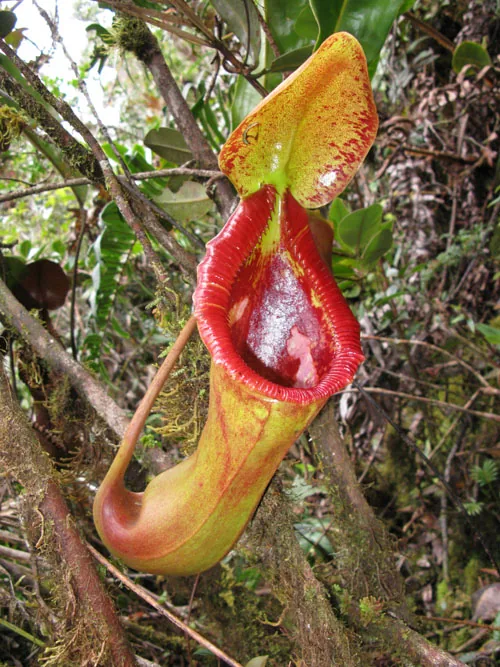
The tropical pitcher plant, or Nepenthes, is a climbing carnivore of the warm, humid forests of Southeast Asia and the tropics beyond, and every part of it leads the eye to the cups. A leaf runs out along a slender tendril, and at the tip that tendril swells and curls down into a hollow, hanging cup. Insects lose their grip on the rim, tumble into the pool of fluid inside, and the plant slowly digests them, drawing the nourishment its thin native soil withholds. The cups swing free below the foliage, the very habit that earned the plant its nickname, monkey cups.
Up close the plant reads as a long climbing vine hung with these swollen traps at intervals along its length. It wants bright indirect light, steady warmth, and humid air to keep the tendrils fattening into new cups rather than trailing off thin and empty. Give it those conditions and each fresh leaf finishes in a firm-walled cup; withhold them and the tips stay bare, and the plant shows only plain foliage.
This is a demanding grower rather than a beginner's plant, and the challenge is water and air more than feeding. The roots recoil from tap-water minerals, and the mix has to stay loose and lean around them. At heart it is a bog plant, and grown that way it carries one of the strangest silhouettes in any collection: a trailing vine strung with pendent, living cups.
Care
The short version: bright indirect light, warmth between 64°F and 84°F, and humid air around 60% to 80%. Root it in an airy, nutrient-poor carnivorous mix, water only with distilled or rainwater, and let each hanging cup catch its own meals.
Light
The cups need bright, indirect light for most of the day, the kind near an east window or a lightly shaded south one. A little direct morning sun is fine, but harsh midday rays scorch brown patches into the leaves, and too little light leaves the tendril tips bare instead of swelling into cups.
Water
Keep the mix damp but never waterlogged, watering every 2 to 4 days, and let a shallow pool of fluid stand in each cup. Use only low-mineral water, distilled, reverse-osmosis, or rainwater, since tap-water minerals settle into the airy mix and burn the fine roots.
Soil
Root it in an airy, nutrient-poor carnivorous mix of long-fiber sphagnum moss laced with perlite and orchid bark. Ordinary potting soil packs too dense and too rich for a plant built for lean ground. Keep the pH slightly acidic, between 5.0 and 6.5.
Temperature
Warmth keeps the cups forming, ideally between 64°F and 84°F (18°C to 29°C). The plant has no frost tolerance and slumps in a cold draft, so hold it in an indoor spot away from chilly windows.
Humidity
Humidity decides whether the cups appear at all. Hold it in the 60% to 80% range with a humid room, a tray, or an enclosure, since dry air leaves the tendril tips thin and cupless.
Feeding
The roots take no feeding, since each cup traps its own insects through spring and summer, closing its fluid over the catch. A plant kept from any prey will accept a rare, very dilute foliar feed, and that is the limit.
Pruning
Cut away browned or spent cups and dead leaves at the base to clear the tired growth. Shortening the longest, trailing vines pushes the plant to branch and hang fresh cups.
Repotting
Renew the mix every 1 to 2 years, since old sphagnum breaks down into a dense mat that holds water without air. Roots pushing through the drainage holes, a soggy collapsed mix, or smaller and fewer cups all mark the moment.
Size & spacing
The vines trail from 1 to 6 feet (30 to 180 cm) depending on the species and training, spreading around 12 to 35 inches (30 to 90 cm) across. Leave open air below the growth so the heavy cups can hang and swing free rather than crushing against a wall or another plant.
Troubleshooting
Most of what ails a Nepenthes shows first on the plant itself, in the cups and the leaf tips, and it traces back to water, light, or humidity rather than pests. Read the tendril tips, the cup walls, and the leaf edges closely, since they signal trouble before it spreads. Match what you see below and adjust early, before the decline sets in.
Cups and leaf tips going brown and papery
Cups that shrivel and leaf tips that turn brown and papery are the marks of mineral burn from tap water, whose salts pack quickly into the lean carnivorous mix. Dry air and any fertilizer at the roots deepen the scorch along the edges. A change to distilled, reverse-osmosis, or rainwater, a flush that carries the salts out, and higher humidity around the plant turn it back.
Fix:
- Switch to distilled, RO, or rainwater
- Flush the mix with low-mineral water to leach salts
- Increase humidity and stop any root fertilizing
Limp vines above wet, collapsed mix
Vines that go limp above a wet, packed pot reveal root rot in a mix that has slumped shut. As the sphagnum strands break down they pack together and hold water with no air, and ordinary potting soil sits that dense from the first day. Slide the plant out to find dark, softened roots, cut them away, and set it into fresh airy sphagnum threaded with perlite and bark.
Fix:
- Repot into fresh airy sphagnum and perlite/bark mix
- Trim mushy roots
- Keep the mix damp but never waterlogged
Bare leaf tips with no cups swelling
When a Nepenthes pushes out leaf after leaf yet the tendril tips stay thin and never balloon into cups, dry air or weak light is behind it. The tendrils swell into hanging cups only when humidity holds in the 60% to 80% range and the plant sits in strong indirect light for most of the day. Steady warmth and low-mineral water then let each young cup fill and firm up.
Fix:
- Raise humidity around the plant
- Move to a brighter spot with strong indirect light
- Maintain stable warm temperatures and keep watering with low-mineral water
Toxicity
For a home with pets, the record is easy: the tropical pitcher plant is not toxic to cats, dogs, or any other household animal. The fluid pooled inside each cup is mild rather than dangerous, and while it is not for drinking, keeping curious pets from biting the thin-walled traps mostly spares the plant.
Safe for
People · Cats · Dogs · Horses · Rabbits · Livestock · Birds
Cats None
Cats stay safe. A cat that swats at a swinging cup or laps the fluid pooled inside takes no harm, though setting the dangling traps out of reach keeps their thin walls from tearing.
Dogs None
Dogs stay safe, with no toxic compound in the plant to reach them. One that mouths a leaf or laps the fluid from a cup may feel a brief upset from the strangeness of it, nothing more.
Horses Safe
Horses run no poisoning risk from this plant, and its slight, low-hanging form never appears where they would graze.
Rabbits Safe
Rabbits can nibble a leaf or the wall of a cup without harm. The tissue holds no toxin, so a stray bite is fine, even though the plant rarely tempts one.
Livestock Safe
Cattle, goats, and sheep face no danger. Neither the leaves nor the fluid inside the cups holds anything for them to react to.
Birds Safe
Pet birds stay safe beside it. The plant carries no poison, though a small bird is more likely to be caught in a deep cup than harmed by the plant itself.
People Safe
People stay safe. The fluid held in the cups is not for tasting, but the plant carries no poison, so handling a pitcher or a child's small taste poses no real danger.
The digestive fluid in the pitchers is mild but it is sensible to keep pets from drinking it or chewing the traps.
Varieties
The genus runs to hundreds of species and hybrids, and their cups vary widely in size and shape, from squat beginners' traps to the deep giants collectors prize. These are the ones you are most likely to see.
Nepenthes ventricosa
A highland species whose cups pinch inward at the middle into a clear hourglass waist, and it takes ordinary household conditions in stride as a common first plant.
Nepenthes × ventrata
A sturdy cross of ventricosa and alata whose full, firm-walled cups make it one of the easiest tropical pitcher plants to grow indoors.
Nepenthes alata
A widespread, adaptable species with slim cups edged by a pair of narrow wings running down the front, sold as a houseplant more than nearly any other.
Nepenthes rajah
A Borneo giant that swells some of the largest cups in the whole genus, deep and broad enough to hold well over a quart of fluid.
How to propagate
More pitcher plants come the quick way from a length of vine or the slow way from fine seed. Both want the same warm, humid air that keeps the parent plant swelling its cups.
Stem cuttingsModerate
Active growth in spring to summer · 6 to 12 weeks to root in warm, humid conditions
Cuttings are the dependable way to raise more plants, taken while the vines are pushing new growth in spring and summer. Lay a length of vine bearing two or three nodes into damp sphagnum in warm, humid air, and pale new roots thread out over about 6 to 12 weeks.
SeedDemanding
Fresh seed sown any time under warm, humid conditions · Several months to germinate and a few years to reach mature size
Seed is the slow road and asks for patience. The fine, fresh seed needs steady warmth and humidity, and it may sit for several months before the first thread of a seedling shows, then take a few years to build to mature size.
Myths
You have to feed pitcher plants meat or fertilizer to keep them alive.
These light feeders draw their meals from the insects that drop into the cups, and the roots take nothing at all. Light, humidity, and low-mineral water build a far fuller plant than any feeding, while meat scraps or houseplant fertilizer soften and rot the cup walls.
Pitcher plants need rich, fertile potting soil like other houseplants.
They root in thin, poor ground and want the loose strands of long-fiber sphagnum laced with perlite. Dense potting soil packs too much fertilizer and water around the roots and can kill the plant outright.