Ornamental · Saxifragaceae
Foamflower
Tiarella cordifolia
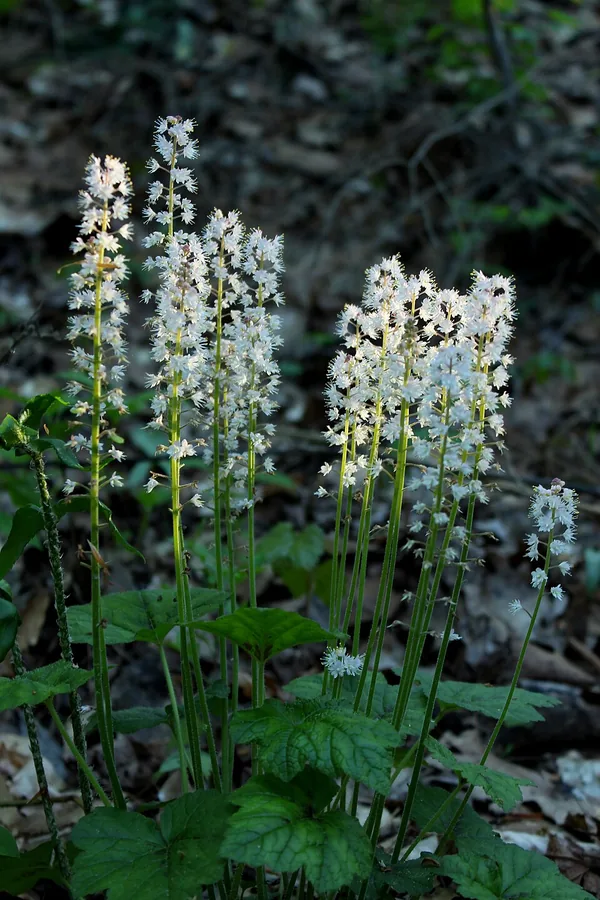
Slender spring spikes of tiny white-to-pink flowers froth above a low mound of heart-shaped, red-veined leaves.
Partial shade
Every 3–7 days
USDA 3–9
5–12 in · 13–30 cm
Overview
In spring, foamflower throws up slim, upright spikes crowded with tiny flowers, each one white and often washed with pink, so densely set that the spike reads as a froth of foam hovering just above the leaves. The bloom is what names the plant. Down below, this eastern North American woodland plant, a member of the saxifrage family, runs along the soil on thin rhizomes and stolons, laying down a low, close mat of foliage.
The leaves are the plant's steady feature: broad and heart-shaped at the base, often cut into shallow lobes, and carried close to the ground. They stay green as semi-evergreen foliage through much of winter, and as the cold comes on many forms wash bronze or deepen to red along the veins, so the flat green leaf turns marbled and tinted. It holds this look through USDA zones 3 to 9.
Gathered together, the plants form a low carpet only 5 to 12 inches (13 to 30 cm) tall that spreads to 12 to 24 inches (30 to 60 cm) across, the leaf rosettes overlapping edge to edge. New growth rises from a central crown, and fresh rosettes root along the running stems, thickening the mat season by season into an unbroken sheet of heart-shaped leaves.
Care
The short version: foamflower wants part to full shade, rich humusy soil kept evenly moist, good drainage through winter, and next to no feeding, and it answers with dense rosettes of heart-shaped, red-veined leaves.
Light
Foamflower colors best in part shade to full shade, the low light under trees or along a north-facing wall. It is one of few flowering ground covers that keeps its leaves full and its spikes coming in heavy shade.
Water
Keep the soil consistently moist, since this plant has no drought tolerance and the leaves brown at the edges once it dries. Water every 3 to 7 days at most sites, and ease off in winter, when soil left wet through the cold rots the crown from the center out.
Soil
Foamflower roots into rich, humusy soil that stays moist yet drains, the dark, crumbling leaf-litter of a forest floor. A pH of 6.0 to 7.0, slightly acidic to neutral, suits it, so work compost or leaf mold through the bed before planting.
Humidity
There is no humidity mark to hit, since ordinary outdoor air is fine. It is moisture at the roots, not in the air, that keeps the leaves plump and green.
Feeding
This is a light feeder that fills out well on good woodland soil alone. A thin topdressing of compost or a balanced fertilizer once in the growing season is plenty, and heavy feeding adds nothing to the leaves or the bloom.
Pruning
Pruning is a light clean-up. At the start of the growing season, cut away the tattered, winter-browned leaves, and new heart-shaped rosettes unfurl to fill the gap.
Size & spacing
Each plant sits low, 5 to 12 inches (13 to 30 cm) tall, and widens slowly to 12 to 24 inches (30 to 60 cm) across as the rosettes multiply. Set about a spread apart, the leaves close over the soil into one continuous carpet.
When to plant
Foamflower's year shows in its growth. Set out in the cool, damp soil of spring or early fall, it sends up its flower spikes in spring, peaking in May when the white-to-pink froth stands tallest above the leaves, after which the foliage carries the low green mat on through the rest of the season.
Northern hemisphere
Southern hemisphere
Typical months for a temperate climate: start earlier in warm zones, later where spring frosts linger.
- Sow: Late winter; seed germination can be slow and plants are largely self-incompatible.
- Plant: Spring or early fall in shaded, moist sites.
- Harvest: Blooms in spring, peaking in May, with spikes of small white to pink flowers.
Hardiness
USDA hardiness zones: 3–9
Temperature: down to -40°C
Troubleshooting
Foamflower is mostly trouble-free, and what does go wrong shows plainly in the plant itself, in dry soil or wet. The leaves and crown are where the first marks appear, so a close look catches the change early. Match what you see below to the cause.
Crowns going soft and plants collapsing over winter
Cold, standing wet through winter, not the frost, is what rots foamflower. Waterlogged soil brings on crown and root rot, and the crown that should feel firm turns mushy and discolored at the center. A rotted crown will not come back, so lift out the softened growth, dig organic matter through to open the drainage, or move the plant to ground that never stays wet.
Fix:
- Improve drainage by amending with organic matter
- Relocate to a better-drained site
- Remove and discard rotted crowns
Leaves wilting and browning in hot, dry weather
In heat and dry soil the leaves go limp and brown at the margins, the clear look of drought on a plant with no tolerance for it. Feel the soil a few centimeters down, then water deeply until the moisture runs even again. A dark mulch of compost or leaf mold seals that moisture in, and a screen of extra shade over the hottest part of the day slows the browning.
Fix:
- Water deeply to restore even moisture
- Apply a layer of leaf-mold or compost mulch to retain moisture
- Provide additional shade in hottest part of day
Notched leaf edges and plants losing their fullness
Look for clean, C-shaped bites cut from the leaf edges, the signature of the black vine weevil. The adults notch the margins at night, while below the soil the pale, legless grubs chew through the roots. Check the leaf rims, dig for the grubs, then drench the soil with beneficial nematodes and pick off or trap the adults after dark.
Fix:
- Remove and destroy affected debris
- Apply beneficial nematodes to soil for larvae
- Hand-pick or trap adult weevils at night
Toxicity
Beyond its looks, foamflower is non-toxic to pets and people. It is on neither the ASPCA toxic plant list nor Cornell's poisonous plants database, so the leaves and flower spikes are safe for curious cats, dogs, and children who get close.
Safe for
People · Cats · Dogs · Horses · Rabbits · Livestock · Birds
Cats Safe
Foamflower is safe for cats. It appears on neither the ASPCA toxic list nor Cornell's poisonous plants database, so a curious nibble at the leaves does no harm.
Dogs Safe
No toxicity is on record for dogs. A dog that digs at the low foliage or bites off a leaf is fine, though swallowing a large wad of leaves can briefly turn the stomach.
Horses Safe
No case links foamflower to a poisoned horse, and its leaves hold no compounds known to harm them.
Rabbits Safe
Rabbits can crop the leaves without harm. The plant carries no toxins, so a few bitten rosettes are only a gap in the green.
Livestock Safe
Grazing stock such as cattle, goats, and sheep take no harm from this low woodland cover.
Birds Safe
Birds that peck at the foliage or nip the flower spikes take no harm from foamflower.
People Safe
Foamflower is non-toxic to people. It is not a food plant, but a leaf tasted by a child does no harm.
Varieties
Beside the wild species, a few named selections stand out for the cut of their leaves or the color of their bloom, each a small variation on the same heart-shaped foliage.
Oakleaf
Its leaves are cut into deep lobes like an oak's, sharper and more divided than the rounded heart shape of the species.
Montrose 13
Its flowers open flushed with pink, a warmer tint than the plain white of the species.
Cygnet
It carries finely divided leaves, cut into narrow, distinct segments.
How to propagate
Foamflower makes more of itself readily, and dividing an established clump into its rooted rosettes is the quicker, surer route than seed.
DivisionEasy
Spring or early fall; benefits from being divided or transplanted at least every other year. · One growing season
Division is the quickest, surest way to increase foamflower, and it works with the plant's own habit. The running rhizomes and stolons throw out rooted rosettes, so a clump lifted in spring or early fall pulls apart into those small rooted pieces, each one a new plant. The clumps grow denser for it, so split or move them at least every other year, and a division fills back in over one growing season.
SeedModerate
Sow in late winter to spring. · Multiple seasons to flowering size
Seed is the slow route. Sown from late winter into spring, it comes up slowly and unevenly, and the seedlings need several seasons before they reach flowering size. Foamflower is largely self-incompatible, so more than one plant must trade pollen before any seed forms.
Myths
Foamflower needs full sun to bloom well.
It does not, being a woodland plant that flowers freely in part shade to full shade. In heavy shade it makes a dense ground cover, thick with leaves where most flowering plants thin out and fade.
Foamflower is toxic to cats and dogs.
It is absent from both the ASPCA toxic plant list and the Cornell University poisonous plants database. The plant is non-toxic, so its leaves and spikes are safe in a shaded bed where pets pass through.