Herb · Asteraceae
French Tarragon
Artemisia dracunculus
Brush the anise-scented leaves of French tarragon and the warm, pungent aroma rises at once.
Full sun
Every 5–10 days
USDA 4–8
24–35 in · 60–90 cm
Overview
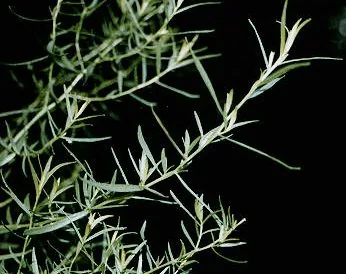
Crush a leaf of French tarragon and a clean, warm anise scent lifts straight off it, the plant's most striking trait up close. It sits among the daisies and sagebrush, and as a hardy perennial it dies back to the ground each winter, then pushes up soft, tender new shoots in spring. From that returning crown one plant supplies aromatic leaves for years.
Look for flowers and you will rarely find them, because the true French herb is a sterile clone that blooms little and sets no viable seed. New plants come only as a living division or a rooted piece, never from a packet. Seed labeled tarragon grows into the Russian kind, a coarser, larger plant whose leaves carry almost none of the anise punch. The genuine clone, once in hand, divides into more of itself for years.
Below the aromatic top growth, tarragon runs on fine roots that will not tolerate sitting wet. The plant reaches its fullest, most fragrant when given full sun, lean soil, and very sharp drainage, and it turns limp and rots in heavy, soggy ground. With drainage handled, the foliage stays soft and pungent on little water, almost no feeding, and a clean cutback before winter.
Care
The short version: full sun and lean, fast-draining soil, watered only once the top half has dried. Feed little or not at all, pick the soft shoot tips through summer, and split the woody clump every few years to keep the leaves fragrant and full.
Light
In full sun the leaves grow densest and most sharply anise-scented, though the plant holds up under a little afternoon shade. Pushed into deeper shade, the foliage thins out and the scent and flavor in each leaf fade.
Water
Let the top half of the soil go dry to the touch between waterings rather than staying damp against the roots. Tarragon's fine roots rot in standing wet, and a winter of overwatering leaves them brown and soft.
Soil
Set the roots into light, sandy, well-drained loam that crumbles loose rather than packing down, since sharp drainage matters more than richness. A pH of 6.0 to 7.5 suits it, and heavy, waterlogged ground is the one soil that defeats it.
Temperature
The dormant crown endures cold to about -20°F (-29°C), and the leafy growth holds up to roughly 84°F (29°C). That hard winter chill is not damage but a needed rest, and the plant returns fragrant from it.
Humidity
Drier air, around 30% to 50%, keeps the foliage clean and lets the leaves breathe. In damp, still air the surfaces stay wet and take on the powdery mildew and rust-colored patches that mar them.
Feeding
As a light feeder, tarragon wants only a thin spring feed of balanced fertilizer or compost. Heap on nitrogen and the leaves come in soft, lush, and watery, thin on the oils that give the scent.
Pruning
Pinch the soft shoot tips through the season and the plant answers with dense, bushy growth instead of long bare stems. Cut the stems low in late summer, and strip away the dead, brittle top growth before the crown settles into winter.
Repotting
Lift and refresh a potted plant every 2 to 3 years, before the crown hardens into a woody, crowded knot. Thinner flavor, fewer soft new shoots, and a stiff center show the old roots are spent.
Size & spacing
In full growth the plant stands 24 to 35 inches (60 to 90 cm) tall and its leafy stems fan out 12 to 18 inches (30 to 45 cm) wide. That much space lets air slip between the stems and keeps the foliage dry.
When to plant
Hardy from zones 4 through 8, tarragon moves through the year in clear stages. Soft divisions or rooted cuttings go into warm spring ground once frost has passed, the aromatic leaves fill out and are gathered through summer, and the top growth dies away into a dormant winter crown. That cold spell is what wakes the plant into strong, fragrant regrowth the next spring.
Northern hemisphere
Southern hemisphere
Typical months for a temperate climate: start earlier in warm zones, later where spring frosts linger.
- Plant: Spring, after the last frost, from divisions or rooted stem cuttings
- Harvest: Rarely flowers and sets no viable seed; harvest leaves through summer. Benefits from a period of winter dormancy and chilling to perform well the following season.
Hardiness
USDA hardiness zones: 4–8
Temperature: down to -34°C
Troubleshooting
The look and feel of tarragon tells you when something is wrong, whether the roots have turned soft below or the leaves have taken on patches and pests above. A close look at both catches most trouble early. Match the appearance below, then act before it spreads.
Wilting stems above brown, soft roots and a blackened crown
What you see is root and crown rot, where wet soil has turned the roots brown, soft, and foul-smelling and left the crown blackened at the base. Tarragon collapses this way after sitting wet, most of all through winter, so lift a failing plant and feel for that mushy, rotted tissue. Cut away the worst, then set firm, healthy divisions back into raised, sandy ground with sharp drainage.
Fix:
- Improve drainage and reduce watering
- Remove and discard severely rotted plants
- Replant healthy divisions in raised or sandy, well-drained beds
Stippled, yellowing leaves dusted with patches or crawling insects
On crowded, humid plants the leaves take on downy mildew or rust, dusted pale or flecked with rust-colored patches, while aphids cluster soft and green on the newest growth, curling and puckering the leaves. Turn a leaf over and the difference is plain on the underside. Open the stems for airflow, strip the marked foliage, and rinse or treat the aphids away.
Fix:
- Improve air circulation and spacing
- Remove and destroy infected foliage
- Rinse off or treat aphids as needed
A hollow, woody old clump with sparse, weak leaves
By its third or fourth year the plant hardens at the heart, its center gone woody and hollow, throwing only thin, sparse shoots whose leaves taste flat. This is the look of age, not disease. Dig the clump in early spring, keep the firm, leafy outer pieces, and discard the dry, spent middle.
Fix:
- Divide the clump in early spring
- Replant vigorous outer divisions
- Discard the spent woody center
Toxicity
Tarragon carries its warning in its scent: the leaves are strongly aromatic, dense with pungent oils, yet the herb is safe to eat and no poisoning risk to pets. Handled or cooked, it stays a harmless kitchen plant. The only real note is that a large mouthful of that concentrated, sharply scented foliage can leave a cat, dog, or other animal briefly queasy, a mild caution for pets rather than a hazard.
Toxic to
Cats · Dogs · Horses · Rabbits · Livestock · Birds
Safe for
People
Cats Mild
One nibble of the aromatic leaves leaves a cat unharmed, but a good mouthful of that oily, sharp-scented foliage may bring a little drool or a brief upset stomach.
Dogs Mild
The strong-smelling leaves hold no poison for a dog, though a large helping of the pungent foliage can loosen the stools or bring on brief nausea that soon passes.
Horses Mild
A small taste of the scented leaves means nothing to a horse. A large amount of the same pungent foliage can settle into mild digestive upset for a short while.
Rabbits Mild
Only the odd sprig suits a rabbit, since the concentrated oils in the leaves can loosen its sensitive gut once it eats past a small taste.
Livestock Mild
The sharp scent keeps most grazing animals off the plant, and a casual mouthful of the pungent leaves causes nothing worse than passing stomach upset.
Birds Mild
A few of the aromatic leaves do a backyard bird no harm, but the oils packed into that foliage make it best as a rare treat rather than a regular feed.
People Safe
For people the leaves are a safe kitchen staple in the amounts a recipe calls for. The estragole in that concentrated oil matters only at very large medicinal doses, far past any pinch used in cooking.
No special handling precautions are needed for the intact plant; use the leaves as a culinary herb.
Helpline numbers

United States
ASPCA Animal Poison Control: (888) 426-4435 (fee applies)

United Kingdom
Animal PoisonLine: 01202 509000 (fee applies)

Australia
Animal Poisons Helpline: 1300 869 738
Varieties
The two tarragons share the same green look at a distance, yet up close the leaf gives them away, one sharply anise-scented, the other coarser, larger, and nearly odorless. Crush a leaf and its aroma reveals which one is in front of you before planting.
French tarragon ('Sativa' clone)
This is the true culinary tarragon, a sterile clone whose leaves carry a strong anise flavor, grown only from divisions or cuttings because it never sets viable seed.
Russian tarragon (Artemisia dracunculoides)
Easy to raise from seed, this one grows coarser and larger with almost no scent in the leaf, which is why it fills seed packets yet falls flat on the plate.
How to propagate
Because true French tarragon sets no seed, more plants come only from its own tissue, a lifted division or a soft shoot rooted into a cutting. Both carry the same fragrant leaf forward.
DivisionEasy
Early spring as growth resumes, or early fall · 4 to 8 weeks
Division makes the most dependable new plants from the true French clone. Lift an established clump in early spring as the first shoots break, or in early fall, pull apart the firm, leafy outer sections, and set them back in the ground, repeating every 3 to 4 years to keep the crown young. The fresh divisions root down and take hold within 4 to 8 weeks.
Stem cuttingsModerate
Late spring to early summer from softwood growth · 4 to 6 weeks
Cut soft, non-flowering shoots in late spring or early summer and sink them into a sharp, well-drained medium, where they strike roots in about 4 to 6 weeks. Grown this way the leaves keep their true French anise scent, since only the coarser Russian tarragon rises from seed.
Myths
True French tarragon can be grown from a packet of seed.
The plant itself gives the lie away, since true French tarragon is a sterile clone that flowers little and sets no viable seed, so its flavor passes on only through a division or a rooted cutting. Whatever sprouts from a tarragon seed packet is the inferior, nearly flavorless Russian type, coarse-leaved and thin on aroma, not the real culinary herb.