Herb · Asteraceae
Curry Plant
Helichrysum italicum
A low silver mound that smells of warm curry when you brush it.
Full sun
Every 7–14 days
USDA 8–11
16–24 in · 40–60 cm
Overview
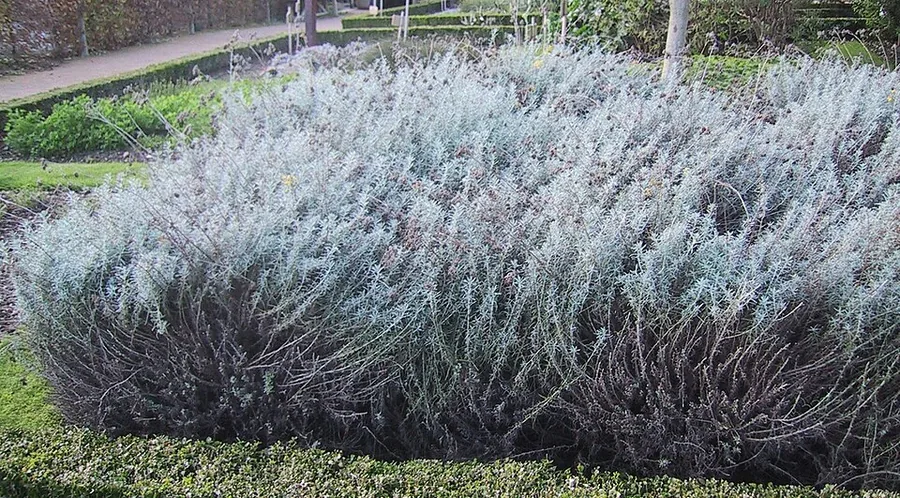
Up close the curry plant reads as silver before anything else. Its leaves are slim, almost needle-fine, and washed in a soft silvery sheen that catches the light along a low woody mound. The stems beneath turn firm and pale and a little bark-like with age, holding the whole low cushion of narrow foliage together close to the ground.
Brush a hand across that silver and the plant gives up its real signature, a warm, curry-like scent that lifts straight off the leaves. The name traces to that smell and to nothing else. This is not the source of curry powder, which is a blend of ground spices, and not the curry leaf, which comes from the unrelated tree Murraya koenigii. The scent alone is the whole link, the rest of the plant is pure Mediterranean silver subshrub.
Through summer the mound lifts small yellow everlasting flowers in tight clusters above the silver, the papery, long-lasting kind that hold their color. It comes from dry, sunny Mediterranean hillsides, a member of Asteraceae, the daisy family, and it carries that origin in its build: a compact silver mound that spreads wider than it stands, easy to grow and unfussy once it has sun and sharp drainage.
Care
The short version: give this silver subshrub full sun and gritty, fast-draining soil, then water only when the top half dries, usually once every 7 to 14 days. Shear it lightly each spring to keep the mound tight, feed barely or not at all, and keep the air moving around it. Soggy soil is its one real enemy.
Light
Set it in full sun, which is where the silver runs brightest and the curry scent comes through strongest. It will take partial sun, but shade leaves the narrow foliage stretched and floppy, the silver color washed out, and the smell faint and weak.
Water
Let the top half of the soil dry before you water again, which usually works out to once every 7 to 14 days. Once it has settled in, it shrugs off drought like the Mediterranean plant it is, but soggy soil rots it from the roots, and that is the single thing most likely to kill it.
Soil
It wants sharp, gritty, well-drained sandy loam in the pH 6.0 to 7.5 range, and it puts up with poor ground happily. Heavy clay that clings to water sits around the roots and rots them, so lighten and open anything dense before planting.
Temperature
It runs through 23°F to 86°F (-5°C to 30°C) and settles into hardiness zones 8 to 11. Hard frost is the wall it cannot pass, so in colder spots shelter it or keep it in a pot you can move out of the cold.
Humidity
Keep the air dry and low, around 30% to 50%. Muggy, motionless air invites gray mold onto the silver leaves, and what the plant really needs is moving air rather than any misting.
Feeding
Feed it lightly in spring or leave it alone entirely, since it does its best in lean, poor soil. Pile on fertilizer and you push out soft, leggy growth and flatten the curry scent that makes the foliage worth growing.
Pruning
Shear it lightly every spring to hold the silver mound compact and head off woody, leggy, bare-in-the-middle growth. Do not cut hard back into the old bare wood, because it is slow to break and regrow from those aged stems.
Repotting
A potted plant wants fresh soil and a roomier pot every 2 to 3 years. Watch for roots circling the inside of the pot, roots pushing out the drainage holes, and soil that dries out almost the moment you finish watering.
Size & spacing
Expect a low mound of 16 to 24 inches (40 to 60 cm) tall that spreads wider than it climbs, reaching 2 to 3 feet (60 to 100 cm) across. Hand it that full width so air can move through the silver foliage.
When to plant
This is a tender, sun-loving plant that resents frost while it is young, so the calendar leans warm. Start seed indoors 6 to 8 weeks before the last frost, set the plants out after the last spring frost once the soil has warmed, and look for the small yellow everlasting flowers through summer.
Northern hemisphere
Southern hemisphere
Typical months for a temperate climate: start earlier in warm zones, later where spring frosts linger.
- Sow: 6-8 weeks before last frost
- Plant: after the last spring frost when soil has warmed
- Harvest: clusters of small yellow everlasting flowers in summer
Hardiness
USDA hardiness zones: 8–11
Temperature: down to -12°C
Troubleshooting
Most trouble shows up first in the look and feel of the plant: a softening base, a hollowing woody center, or a gray fuzz on the silver leaves.
The base turns dark and soft, then the whole mound folds
When a plant sags and the stem base goes dark, slick, and mushy before the mound collapses, root rot has set in from below. Lift it and the roots that should be pale and firm come up brown, soft, and sour-smelling while the soil around them stays wet. Hold off all water and let the soil dry, work grit or sand in for drainage, shift a potted one to a sunnier breezier spot, and snip a few healthy stems as cuttings if the crown is already going.
Fix:
- Stop watering and allow soil to dry
- Improve drainage with grit or sand
- Move container plants to a sunnier, airier spot
- Take healthy stem cuttings to salvage the plant if the crown is failing
A bare woody heart with all the silver pushed out to the edges
Run a hand over an untended plant and you feel the trouble: the middle is hard, woody, and thinning while the soft silver growth has fled to the tips, so the mound goes leggy and flops open. Bare lower stems and growth crowded only at the ends mean it never got sheared, or it stretched reaching for light it didn't have. Clip it back lightly in spring, set it in full sun, and start very old woody plants over from cuttings.
Fix:
- Shear lightly in spring to encourage compact growth
- Provide full sun
- Replace very old woody plants with fresh cuttings
Fuzz on the foliage where the silver leaves stay damp and crowded
In muggy, still, packed conditions the narrow leaves pick up a fuzzy gray fur or brown out at the edges, the look of gray mold taking hold on wet foliage. You see the fuzzy coating or browning spots most in humid weather with no breeze, often where overhead watering leaves the leaves slick. Open up the spacing for airflow, deliver water to the base instead of over the top, and pick off any leaves already spoiled.
Fix:
- Improve spacing and airflow
- Water at the base rather than overhead
- Remove affected foliage
Toxicity
Across the board this is a non-toxic ornamental, and its strong scent does more to keep curious mouths off it than any toxin would.
Safe for
People · Cats · Dogs · Horses · Rabbits · Livestock · Birds
Cats None
Safe around cats. The pungent silvery leaves may put a cat off, but a nibble does it no harm.
Dogs None
Safe for dogs. The strong aroma usually stops a second bite, and a curious chew leads to no real trouble.
Horses Safe
Safe for horses. The foliage is not listed as a toxin, so a grazing mouthful does no harm.
Rabbits Safe
Safe for rabbits, which the sharply scented leaves rarely tempt in the first place.
Livestock Safe
Safe near cattle, goats, and sheep; the heavy scent keeps them browsing somewhere else.
Birds Safe
Safe for backyard birds and poultry, with no toxin in either the leaves or the flowers.
People Safe
Safe to handle and to grow around children; the leaves serve only in tiny amounts for their curry-like scent, never as a true cooking herb.
The aromatic foliage is used only very sparingly for scent; the plant is not a culinary herb in the way kitchen curry is.
Varieties
Two forms stand out for the close, low silver look, differing mainly in how compact the mound stays and how strong the scent runs.
Helichrysum italicum subsp. serotinum
A compact form whose narrow silver foliage carries an especially strong curry scent, grown for ornament and sometimes sold as the dwarf curry plant.
'Nana'
A low, tight dwarf selection that keeps its silver mound small enough for rock gardens and the edges of paths.
How to propagate
There are two ways to make more, one quick and sure off the stems and one slow and uneven from seed.
Stem cuttingsEasy
Late spring to summer · 4-8 weeks to root
The easy, dependable route. Take semi-ripe cuttings of the woody silver stems any time from late spring through summer and push them into a gritty, well-drained mix, where they root over the next 4 to 8 weeks into plants identical to the parent.
SeedModerate
Spring · Several weeks to germinate and establish
The slower, less certain route. Sow in spring and expect germination and early growth to take several weeks, and because the seedlings come up less even than cuttings, most gardeners skip it.
Myths
The curry plant is where curry powder and the curry leaf used in Indian cooking come from.
It supplies neither one. Brush the silvery foliage and it smells curry-like, and that scent is the whole connection. Curry powder is a blend of ground spices, while true curry leaf grows on the unrelated tree Murraya koenigii.
You can pick curry plant leaves and cook with them by the handful the way you would rosemary.
The aroma in those narrow leaves is far too strong for that. You tuck a single sprig in while cooking and lift it back out, because this is an ornamental, not a kitchen herb measured by the handful.