Vegetable · Cucurbitaceae
Summer Squash
Cucurbita pepo
Set in sun and rich, moist soil, summer squash fills out with tender yellow fruit by midsummer.
Full sun
Every 2–4 days
59–95°F · 15–35°C
45–55 days
Overview
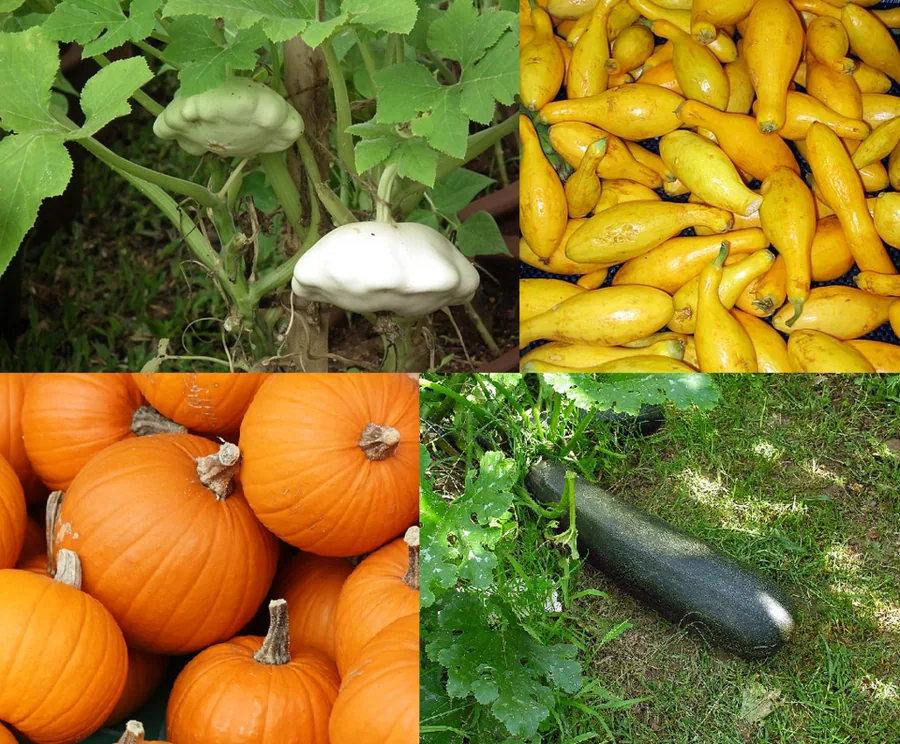
Summer squash shows itself first in the fruit: smooth yellow crooknecks that bend at a narrow neck, straightnecks that run even and true, and round, flattened pattypans rimmed with a scalloped edge like a small saucer. Zucchini rounds out the group, and every one of these is the same species, Cucurbita pepo, a member of the gourd family. Picked young, the rind stays thin and soft enough to eat skin and all, long before it hardens.
The plant grows bushy and full rather than trailing, forming a mound 18 to 35 inches (45 to 90 cm) tall that spreads well past its height. It carries two kinds of bloom, separate male and female flowers on the same plant, and bees move between them to set the fruit. Once a fruit takes, it fattens quickly, and a squash left a few days too long swells from a slim, tender thing into something as thick and heavy as a baseball bat.
Behind that abundance the plant stays simple to read. Watch the fruit, keep the soil evenly damp, and check the stems and leaves for borers and bugs, and a couple of plants will keep bearing all summer.
Care
The short version: full sun, rich soil kept evenly moist, and a close eye on the swelling fruit. Hold the water at about an inch a week, feed once at planting, and cut each squash while it is still slim and tender.
Light
Summer squash wants full sun, a full 6 or more hours of direct light each day. Starved of it, the plant stretches leggy and open, its flowering thins, and the fruit set falls away.
Water
Keep the soil evenly moist to a depth of about 6 inches, close to an inch of water a week. Water at the roots in the morning and leave the leaves dry, since wet foliage is where mildew settles. While the fruit is setting and swelling, the ground should never go dry.
Soil
Summer squash roots into fertile, well-drained loam dark with compost or aged manure. A pH between 6.0 and 6.5 suits it, and that rich ground feeds a hungry plant.
Temperature
Summer squash holds up in warmth, from 59°F to 95°F (15°C to 35°C). Frost cuts it down at either end of the season, so it waits for warm soil before going out.
Humidity
Ordinary outdoor air suits it, with no figure to meet. Moving air matters more, since crowded, damp leaves are exactly where the white bloom of powdery mildew forms.
Feeding
A balanced fertilizer such as 5-10-10 is worked into the bed before planting, with a light nitrogen side-dressing once the vines lengthen. Too much nitrogen swells the leaves and starves the fruit, so the feeding stays light.
Pruning
No routine pruning is needed. Pull away any leaf gone diseased or dusted with mildew as it shows, and cut the fruit often, since steady picking keeps new squash forming.
Size & spacing
A mature plant stands 18 to 35 inches (45 to 90 cm) tall and spreads 2 to 4 feet (60 to 120 cm) across, a low, wide mound of leaves. Thin the seedlings to 12 to 15 inches apart so air slips between them and mildew has less to grip.
When to plant
Summer squash is a warm-weather plant with no tolerance for frost, and it surges once the soil warms. Seed can start indoors a few weeks before the last frost or go straight into warm ground, with young plants set out after the cold has gone. The first tender fruit appears in midsummer and keeps coming until the season ends.
Northern hemisphere
Southern hemisphere
Typical months for a temperate climate: start earlier in warm zones, later where spring frosts linger.
- Sow: 2 to 4 weeks before the last spring frost
- Plant: After the last frost when soil reaches 60-70°F at planting depth
- Harvest: Harvest fruit when young and tender: crookneck/straightneck at 1.5-2 in diameter, scallop at 3-4 in diameter
Hardiness
USDA hardiness zones: 3–11
Temperature: down to -40°C
Troubleshooting
The clearest signs of trouble show right on the plant: on the stems, across the leaves, and at the fruit, and the worst of them advance fast. Catching the first mark or discoloration early can save a plant that would fold within a day. Look closely at what appears below, then act while it still helps.
Wilting collapse with damp sawdust heaped at the stem base
This is the squash vine borer, whose white grub tunnels inside the stem and cuts off the water rising through it. Low on the stem, an entry hole weeps moist, sawdust-like frass in a small pile. Slit the stem lengthwise to reach the pale larva, lift it out, and mound soil over the open wound so the vine can root again above it.
Fix:
- Slit the stem and remove the larva, then mound soil over the wound to encourage rooting
- Remove and destroy severely infested vines at season end
A white, powdery bloom dusting the leaf surfaces
This is powdery mildew, a fungus that coats the leaves in a pale, floury film late in the season, when the days stay warm and the nights cool. The bloom rubs off in part, and the green beneath yellows and thins. Strip the worst leaves, open the plant to moving air, and reach for a labeled fungicide only if the film keeps spreading.
Fix:
- Remove and dispose of heavily infected leaves
- Apply a labeled fungicide if needed and improve air circulation
Yellow-speckled, drooping leaves hiding brown shield-backed bugs
These are squash bugs, flat, brown, shield-shaped insects that pierce the leaves and drain the sap until the foliage flecks yellow and sags. Turn a leaf and the adults sit clustered underneath beside neat masses of bronze eggs laid along the vein angles. Crush the eggs, pick off the adults, and rake out the litter where they shelter through winter.
Fix:
- Hand-pick adults and crush egg masses
- Remove plant debris where bugs overwinter
A dark, sunken patch spreading at the blossom end of the fruit
This is blossom end rot, and it rises from uneven watering that keeps calcium from reaching the fruit, not from any insect. The blemish opens at the blossom end and hardens dark and leathery over the skin. Water on a steady schedule, mulch to hold the moisture, and ease off the nitrogen and potash.
Fix:
- Maintain even soil moisture and mulch
- Avoid over-application of nitrogen and potash
Toxicity
Every part of summer squash is safe, which is welcome in a home with pets or children. The yellow fruit, the open flowers, and the flat seeds are all edible, and the leaves and vines hold nothing that poisons cats, dogs, livestock, or people. The only warning sign is taste, not appearance: a rare squash turns sharply bitter and should be spat out and discarded.
Safe for
People · Cats · Dogs · Horses · Rabbits · Livestock · Birds
Cats None
Safe for cats. A cat that bites a leaf or laps up a little cooked squash comes to no harm, though rich scraps beyond its usual food can loosen the stomach.
Dogs None
No toxin reaches dogs here. A spoon of plain cooked squash, soft and mild, sits well in the bowl, and even a torn-off mouthful of raw leaf does nothing.
Horses None
Horses can crop the vines and eat the fruit without harm. Bring any new food in slowly so the gut settles to it.
Rabbits None
Rabbits take the leaves, the flowers, and the fruit without trouble. Give fresh squash as one part of a mixed diet rather than the whole of it.
Livestock None
Goats, sheep, and cattle can eat the leaves and the extra fruit safely, so a heavy crop becomes plain, useful feed.
Birds None
Wild birds and backyard poultry pick at the seeds and soft flesh with no risk at all.
People None
The fruit, the flowers, and the seeds are all edible, raw or cooked. A rare squash carries a bitter, sharp taste from built-up cucurbitacin, so anything harsh on the tongue is spat out and thrown away.
Fruit, flowers, and seeds are edible; no special handling precautions required.
Varieties
Summer squash sorts itself by the shape of the fruit, and a few forms turn up again and again. Here is what each one looks like.
Yellow Crookneck (e.g., 'Summer Crookneck', 'Gold Star')
The fruit is smooth and yellow, tapering into a curved, slender neck, and it eats best cut young at 1.5 to 2 inches across.
Yellow Straightneck (e.g., 'Early Prolific Straightneck', 'Multipik')
The fruit is the same yellow but runs a straight, even neck, borne on trim bush-type plants.
Pattypan / Scallop (e.g., 'Early White Bush', 'Peter Pan', 'Sunburst')
The fruit is round and pressed flat, its rim cut into a scalloped edge, and it comes small at 3 to 4 inches wide.
Companions
Summer squash grows best beside the partners of the old three-sisters planting and the flowers that pull its pests away.
Plant near
corn: In the three-sisters planting, corn provides structure and acts as a visual deterrent to squash insects such as squash vine borer.
beans: Beans fix nitrogen for the heavy-feeding squash in the three-sisters system.
nasturtium: Research-supported companion that helps reduce and confuse squash bug populations.
How to propagate
Summer squash comes almost entirely from seed, and it sprouts so willingly that most gardeners drop the seeds right where the plants will stand.
SeedEasy
Direct-sow after the last frost when soil is 60-70°F; or start indoors 2-4 weeks earlier · Germinates in about 7-10 days; transplants establish within 1-2 weeks
Summer squash rises easily from seed. Set the seed 0.5 to 1.5 inches deep once frost has passed and the soil holds 60°F to 70°F (16°C to 21°C), or start it indoors 2 to 4 weeks sooner, and the seedlings break the surface in about 7 to 10 days. Thin the young plants to 12 to 15 inches apart, and shift any transplant gently, since squash resents a disturbed root.
Myths
Summer squash growing beside cucumbers or melons will cross with them and spoil the flavor of this year's fruit.
It will not. Summer squash crosses only with other Cucurbita pepo types, never with cucumbers or melons, and even then the change hides in the seeds alone. The fruit you cut this season tastes exactly as it should, whatever grows at its side.