Vegetable · Cucurbitaceae
Cantaloupe
Cucumis melo
Give it full sun, warm soil, and steady water, and the netted rind ripens over sweet, deep orange flesh by late summer.
Full sun
Every 2–4 days
59–95°F · 15–35°C
75–90 days
Overview
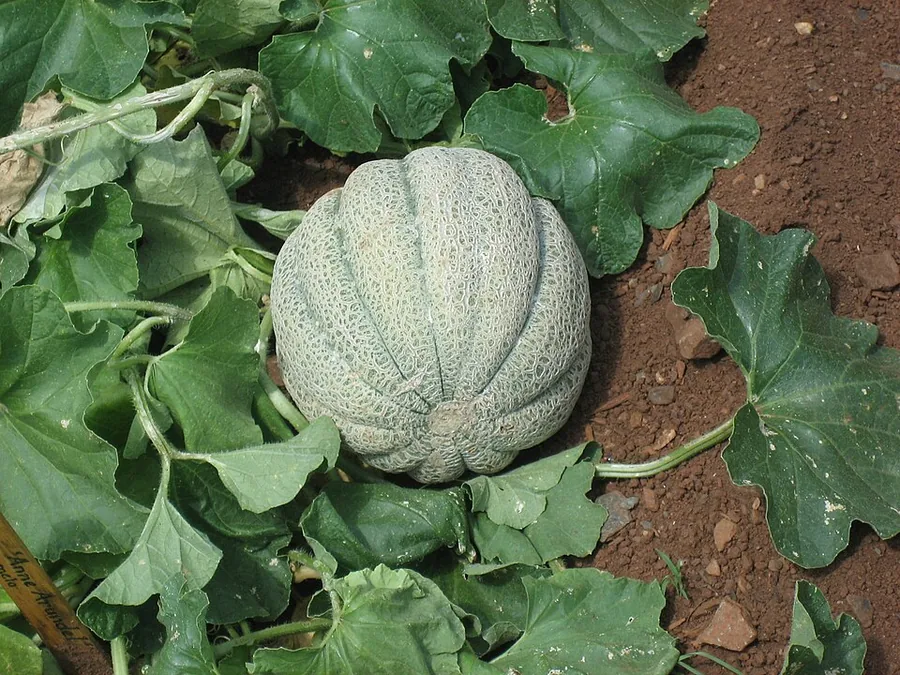
Cantaloupe is a sprawling warm season melon in the cucumber and squash family, grown for the deep orange flesh that fills the hollow inside its netted rind. That rind is the plant's signature, a hard skin webbed over with raised tan corky lines, and the flesh beneath it is sweet, soft, and fragrant. Africa and Asia gave the vine its taste for heat, and the names muskmelon and rockmelon ride on the same plant.
The vines run long and bristly across the ground, throwing out coiling tendrils that grip a trellis where one is offered, the broad leaves lobed and rough to the touch. The flowers open a clear yellow, and they need bees to set fruit, since they cannot pollinate themselves. With the timing right, a single hill carries enough fruit to feed a household into late summer.
The fruit swells from a small green knot behind the flower into a round melon, the netting standing up tan and corky against the rind as it matures. Sugar gathers in the flesh up to the last moment, because a melon stops sweetening the instant it leaves the vine. Let it slip free on its own and the cut shows the deep, sugary flesh the plant spent all season filling.
Care
The short version: full sun and warm, well-drained soil, with steady water of about 1 to 2 inches a week, eased off in the final week before harvest to draw the sugar into the flesh.
Light
Cantaloupe needs full sun across its broad, rough leaves, with as little shade as possible. That direct light builds the sugars that load the orange flesh, so the brightest spot gives the sweetest melon.
Water
The soil stays evenly moist, never lurching from dry to soaked, at roughly 1 to 2 inches (2.5 to 5 cm) of water a week while the fruit fills and the rind rounds out. Water eases off in the final week before harvest, since a touch of dryness then pulls the sugar tight into the flesh.
Soil
Cantaloupe roots into fertile, well-drained loam worked through with compost. A pH of 6.0 to 6.8 suits it best, and the drainage matters, because soggy ground invites the wilts that brown the inside of the stem.
Temperature
This is a heat lover, comfortable between 59°F and 95°F (15°C to 35°C). Frost blackens the soft foliage and cold soil stalls it, so planting waits for real warmth.
Humidity
Average humidity around 40% to 70% is fine, so no number needs watching. Air moving through the leaves matters more, since damp, crowded foliage is where the white powder of mildew and the angular spots of downy mildew take hold.
Feeding
Cantaloupe takes a balanced fertilizer through the growing season, side-dressed once the vines start to run. Nitrogen stays low, or the plant throws broad leaves and long runners while the fruit stays thin.
Pruning
Cantaloupe needs no real pruning. The bristly vines can be trained up a trellis to save room or thinned a little for airflow, but otherwise they sprawl on their own.
Repotting
Not typically container-grown; direct sow or transplant outdoors
Size & spacing
Trained vines stretch 6 to 9 feet (183 to 274 cm) along their length, and each plant spreads 1 to 3 feet (30 to 91 cm) wide across the bed. The rough, sprawling growth wants room so air slips between the leaves and disease finds less to hold.
When to plant
Cantaloupe lives on warmth and goes down at frost. Seeds start indoors a few weeks ahead or drop into warm ground, the clear yellow flowers open across the vines in midsummer, and the netted fruit comes off from mid to late summer once it slips from the stem.
Northern hemisphere
Southern hemisphere
Typical months for a temperate climate: start earlier in warm zones, later where spring frosts linger.
- Sow: 2 to 4 weeks before the last frost
- Plant: After danger of frost has passed and soil warms to about 65°F (18°C)
- Harvest: Yellow flowers bloom July to August; harvest mid to late summer at full slip
Hardiness
USDA hardiness zones: 2–11
Temperature: down to -46°C
Troubleshooting
Most cantaloupe trouble shows first on the leaves and vines, in chewed holes, pale dusts, and angular spots, with a few problems tracing back to cucumber beetles. Reading those marks early lets you stop a small patch of damage before it runs across the whole vine. Match what you see below to the description, then act while it still helps.
Leaves go limp in the sun, firm up by night, then fail
Leaves that hang limp in the afternoon sun, draw themselves firm again overnight, and finally go slack for good are showing bacterial wilt, brought in by cucumber beetles feeding on the tissue. Once the bacteria fill the stem there is no reversing it, so the affected vine is pulled and destroyed. The cut stem tells the story plainly, with sticky sap that pulls into fine strings between the severed ends.
Fix:
- Remove and destroy infected plants, as there is no cure once infected
- Control cucumber beetles to limit further spread
Sharp-cornered yellow blocks walled in by leaf veins
Sharp-cornered yellow blocks pressed flat against the upper leaf and walled in by the veins, backed by a soft gray-purple felt on the underside in the morning damp, mark downy mildew. The angular shape comes straight from the veins, which fence each lesion into a tidy patch. Pulling the spotted leaves, watering early or at the roots to keep the surfaces dry, and adding a protectant fungicide through wet spells holds it back.
Fix:
- Remove infected foliage and improve airflow
- Apply a protectant fungicide during humid conditions
Single runners yellowing and folding while others stay green
Single runners that yellow and fold while the rest of the plant still looks green, the wilt creeping along one side at a time until the whole vine slumps, point to fusarium wilt, a fungus living in the soil. A stem split lengthwise shows brown streaks running through the inner tissue, dry and free of any stringy sap, which is what tells it apart from bacterial wilt. There is no cure, so the plant is removed and melons stay off that ground for at least 3 years.
Fix:
- Remove infected plants, as this soilborne fungus cannot be cured
Ragged holes punched through leaves and rinds
Ragged holes punched through the leaves and pale scars scratched into the rinds are the mark of cucumber beetles, slim insects banded or spotted in yellow and black and roughly a quarter inch long. They cluster on the foliage and flowers where they are easy to pick off or trap. Row covers shield the young, soft-leaved plants and come off once the flowers open so bees can reach the blooms.
Fix:
- Handpick or trap beetles
- Apply row covers over young plants, removing them at flowering for pollination
A chalk-white bloom dusting both leaf surfaces
A chalk-white, talc-like bloom that dusts both the top and underside of the leaves and resists rubbing off is powdery mildew, settling first on the older, shaded foliage. As it thickens the green fades to yellow and the leaves die back, and the melons it leaves behind run smaller and less sweet. Opening the canopy for air and stripping the worst-coated leaves slows it, with a labeled fungicide held back unless it keeps creeping across the plant.
Fix:
- Improve air circulation and remove severely infected leaves
- Apply a labeled fungicide if needed
Yellow blooms crowding the vine with no fruit swelling
Yellow blooms crowding the vine while no small green melons swell behind them usually means poor bee pollination, since the flowers cannot pollinate themselves. The first flush of bloom is male only, opening on slender stalks with no fruit forming behind, so a wait is normal while bees find the patch. Drawing in pollinators, keeping insecticides off the open flowers, and brushing pollen from a male bloom onto a female one by hand will start the melons forming.
Fix:
- Encourage pollinators and avoid spraying insecticides during bloom
- Hand-pollinate by transferring pollen from male to female flowers
Toxicity
Cantaloupe is not toxic. The soft orange flesh is a safe treat for most animals, and the only real risk is a mild stomach upset when a pet overeats the tough rind or the slick seeds. Keep portions small and there is nothing here to worry about.
Safe for
People · Cats · Dogs · Horses · Rabbits · Livestock · Birds
Cats None
The soft orange flesh holds nothing toxic to cats, so a small cube is safe to share. A large helping can leave a cat with a soft stomach or loose stool, so the portion stays small.
Dogs None
A few cubes of the ripe orange flesh make a safe treat for a dog. The tough netted rind and the slick seeds in the central cavity are harder going, and too much of either can bring on mild gas or an upset stomach, nothing worse.
Horses Safe
Horses take small pieces of the sweet flesh without harm. The flesh runs high in sugar, so the helping stays modest to keep the gut settled.
Rabbits Safe
Rabbits can nibble a thin sliver of the ripe flesh now and then. The sugar in it is high for them, so it stays an occasional treat rather than a regular food.
Livestock Safe
Goats, sheep, and cattle chew through both the soft flesh and the firm netted rind without trouble, and leftover fruit is a common treat. The fruit is brought in gradually so a sudden large feed does not loosen the gut.
Birds Safe
Pet birds and backyard hens peck at the ripe flesh and the flat seeds alike, with nothing harmful in either. The fruit can be shared freely in reasonable amounts.
People Safe
For people, the sweet orange flesh is eaten fresh, scooped or sliced from the rind. The raised, corky netting on that rind can hold surface bacteria, so the outside is rinsed before the knife passes through into the flesh.
Offer only small amounts of ripe flesh and remove rind and seeds.
Varieties
Cantaloupe comes in dozens of varieties, from old heirlooms to modern disease-resistant hybrids, differing in the depth of their flesh color and the weight of their netting. These are the ones worth knowing by name.
Hale's Best
An oval heirloom muskmelon wrapped in heavy raised netting, with deep orange flesh and only a small seed cavity at the core.
Ambrosia
A hybrid whose flesh runs a deep salmon-orange and very sweet, on a plant that shrugs off the common melon diseases.
Athena
An eastern-type F1 hybrid with firm flesh that holds its shape and stores well, carrying tolerance to several diseases.
Hearts of Gold
An old heirloom sheathed in dense netting over deep orange flesh that gives off a strong aroma.
How to propagate
Cantaloupe is grown almost entirely from its flat, cream-colored seeds, which split and push up fast once the soil is warm enough.
SeedEasy
Start indoors 2 to 4 weeks before the last frost, or direct sow after the soil warms · Germinates in 5 to 10 days; seedlings establish in 1 to 2 weeks
Cantaloupe grows easily from its flat, cream-colored seeds. Sown straight into ground that has reached about 65°F (18°C), or set indoors 2 to 4 weeks before the last frost, the seeds split and push up in 5 to 10 days, the first pair of rounded seed leaves opening before the true lobed leaves follow over the next week or two. The fine roots resent any tearing, so an early start belongs in biodegradable pots that drop into the soil whole.
Myths
Cantaloupe and muskmelon are two completely different fruits.
In the US both names land on one plant. The fruit called cantaloupe here is a netted muskmelon, its rind webbed in raised tan corky lines, while the true European cantaloupe wears a warty, scaly rind instead and is rarely grown in this country. The names are used interchangeably in the US.
A cantaloupe is ripe whenever you cut it from the vine.
A melon stops sweetening the moment it leaves the vine. Ripeness shows at full slip, when the fruit parts cleanly from the stem under a light push and lets off a sweet smell. A melon cut before that point keeps the flesh it has and gains no more sweetness.
More fertilizer makes bigger, sweeter melons.
Heavy nitrogen pushes out broad green leaves and long runners while leaving the fruit thin on the vine. Balanced feeding plus easing off the water near harvest is what builds sweetness, not a heavier hand at the fertilizer.