Vegetable · Cucurbitaceae
Muskmelon
Cucumis melo
Fed on heat, all-day sun, and the work of busy bees, the fruit swells sweet beneath raised tan netting by late summer.
Full sun
Every 3–7 days
64–75°F · 18–24°C
80–90 days
Overview
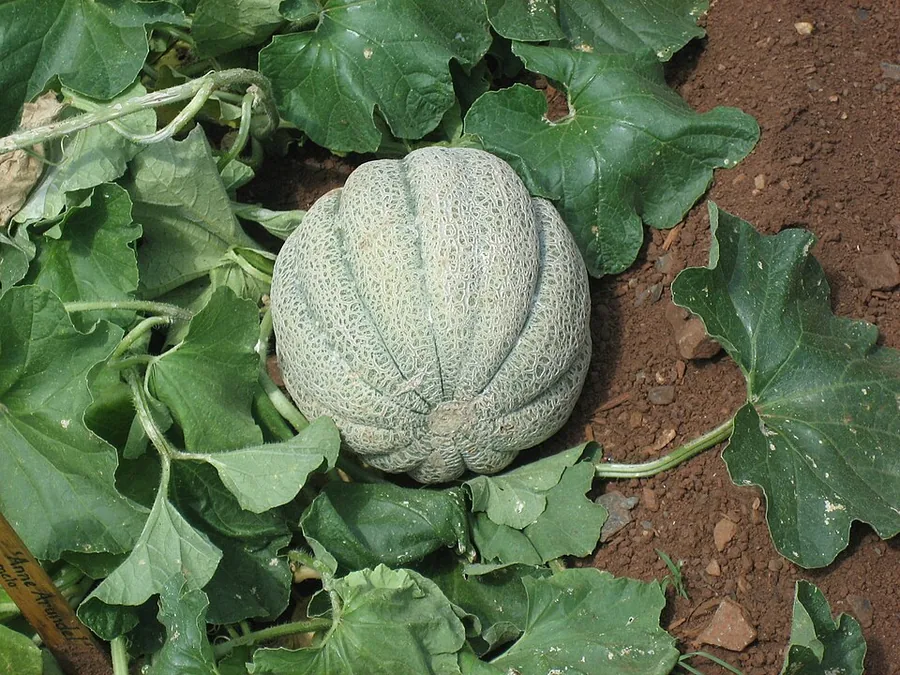
Muskmelon is the netted, musk-scented melon that most American gardeners call cantaloupe, named for the raised, corky webbing that stands out across its rind. It grows in the gourd family alongside cucumbers and squash, running as a warm season annual vine over the ground on long, hot days. Split a ripe one and the flesh inside is sweet, fragrant, and a deep orange straight through to the seed cavity.
The vine itself is a sprawling thing. Its seeds sit tight in cold ground and refuse to break until warmth arrives, and the roots pull back from any disturbance, so its stir into growth waits on the soil. Once the ground warms, the runners stretch out fast across the bed and the first flowers open along them by early summer.
The fruit takes its character from two things: steady moisture early and busy bees at bloom. Each flower holds open for only about a day, so the number of bee visits decides whether the melon rounds out full or swells lopsided on one side. Ease the water back as the fruit colors up, and the sugars draw tight into that classic sweet, orange flesh.
Care
The short version: full sun and warm, fertile, well-drained soil. Keep the soil evenly moist while the vines grow, ease off the water as the fruit ripens, and leave the bees a clear run at the flowers.
Light
Muskmelons want full sun all day to color and sweeten the fruit. In less light the runners grow thin and weak, the flowers come sparse, and the melons never load up their orange flesh with sugar.
Water
Keep the soil evenly moist while the vines run, about 1 to 2 inches (2.5 to 5 cm) of water a week. Lay it at the base with a drip or soaker hose so the broad leaves stay dry, then ease off as the fruit ripens so the sugars draw in.
Soil
Root them in fertile, well-drained sandy loam worked full of organic matter. A pH of 6.0 to 6.5 suits them, and a raised bed or a sheet of black plastic mulch warms the ground to push early growth.
Temperature
The vines run best between 64°F and 75°F (18°C to 24°C). The seeds stay shut in cold soil, and a frost blackens and finishes the runners, so warmth from start to finish is what they hold out for.
Humidity
Ordinary outdoor humidity is fine, with no number to chase. Air moving through the leaves matters far more, since a damp, crowded canopy is where the white and gray films of powdery and downy mildew settle.
Feeding
Work a complete fertilizer such as 5-10-10 into the bed before planting. Side-dress with nitrogen as the runners begin to stretch out and again at fruit set to carry the crop through.
Pruning
Muskmelons need little pruning. Strip off diseased or damaged leaves as they show to slow foliar disease, and train the running vines onto a trellis where space is tight.
Size & spacing
The vines climb and sprawl from 6 to 9 feet (183 to 274 cm) and spread 1 to 3 feet (30 to 91 cm) across the ground. Give each plant that much room so air threads through the leaves and mildew stays down.
When to plant
Muskmelons want heat and fold at the first frost. The seeds go in indoors a few weeks before the last frost or straight into warm soil, and the transplants move out once the cold has broken. Flowers open along the runners in early summer, and the netted fruit ripens from midsummer until the first frost ends the run.
Northern hemisphere
Southern hemisphere
Typical months for a temperate climate: start earlier in warm zones, later where spring frosts linger.
- Sow: Start seeds indoors in peat or paper pots about 2 to 4 weeks before the last spring frost, using bottom heat; melons resent root disturbance
- Plant: After all danger of frost when soil has warmed to at least 60 to 65°F (16 to 18°C); seeds will not germinate in cold soil
- Harvest: Flowers in early to midsummer; fruit matures about 30 to 45 days after pollination and is picked at full slip from midsummer until first frost
Hardiness
USDA hardiness zones: 4–11
Temperature: down to -34°C
Troubleshooting
Most muskmelon trouble surfaces on the leaves and vines first, in dusty films, colored blotches, and wilting runners, while the fruit problems usually trace back to weather or the bees. Reading those early marks lets you step in before a wilt or mildew claims the whole patch. Match the look below to its cause, then act while it still helps.
Slack, drooping leaves by day that stiffen at night before the vine dies off
Leaves that go limp under the sun and firm up again by dark are the first mark of bacterial wilt, which cucumber beetles feed into the plant. Once inside a vine it cannot be cured, so the whole limp runner is pulled and destroyed. Cut a wilted stem, and pressing the two faces together and drawing them apart pulls a sticky, string-like thread of ooze between them.
Fix:
- Remove and destroy infected plants; bacterial wilt cannot be cured
- Control cucumber beetles early with row covers, removing them at flowering for pollination
- Hand-pick beetles and eliminate nearby weeds
Angular yellow blotches on top, a purplish-gray mold felting the underside
Downy mildew paints sharp-edged yellow blotches across the tops of the leaves while a gray-purple mold mats the undersides, a pairing that shows up in cool, wet, humid weather. The yellow areas darken to brown lesions as they spread, and the fruit beneath a blighted canopy ripens noticeably less sweet. Morning base watering, wider spacing, and a preventive copper or chlorothalonil before the blotches appear hold it off.
Fix:
- Apply preventive fungicides such as chlorothalonil or copper before symptoms appear
- Improve airflow and avoid wetting foliage
- Remove severely infected foliage
Shrunken vines whose runners shrivel along one flank first
A stunted plant with whole runners wilting away on one side points to fusarium wilt, a soil fungus that plugs the plant's inner channels from the roots up, past the reach of any spray. Slice a runner near the crown and brown streaks run through it, with a honey-brown stain washed through the cut roots and stems. The affected plant is removed, and resistant varieties in fresh, rotated ground are the way past it.
Fix:
- No chemical cure; remove and destroy affected plants
- Grow in fresh or rotated soil
A floury white coat over the leaf surface that yellows and withers
A chalky white film dusts both faces of the leaves, the sign of powdery mildew that takes hold when warm days drop to cool nights over a crowded planting. The patches start on the older, shaded leaves and partly rub off under a finger, then the leaf yellows, dries, and dies. Stripping the worst leaves and spreading the vines wider or onto a trellis pulls the film back.
Fix:
- Remove heavily infected leaves
- Improve air circulation with spacing or trellising
- Apply a labeled fungicide at first sign if pressure is high
Tan pinpricks widening into concentric bullseye rings before the leaves fall
Small round tan spots open across the leaves and widen into lesions up to about 4 cm (1.5 in), ringed with concentric bands that read like a bull's-eye, the signature of alternaria leaf blight in warm, wet weather. As the rings spread the leaves brown and drop in numbers. Clearing the infected debris after harvest, rotating the crop, and sowing treated seed into clean ground break the cycle.
Fix:
- Remove infected plant debris after harvest
- Rotate crops and use treated seed
- Apply preventive fungicide such as chlorothalonil or copper when the disease is consistent
Slack, glaze-coated leaves with insects packed along the undersides
Wilting, speckled, sticky leaves carry clusters of insects on their undersides, and two culprits fit. Squash bugs show up as flat, bronze-brown adults over neat clusters of copper-colored eggs, injecting a toxin as they feed, while aphids are soft, small, and huddled, leaving a sticky glaze of honeydew and the black film of sooty mold. Hand-picking the squash bugs and crushing the eggs, then a hard spray of water for the aphids, clears them.
Fix:
- Hand-pick squash bugs and crush egg masses
- Knock aphids off with a strong spray of water
- Apply a labeled insecticide to young nymphs if pressure is high
Scant fruit set, with melons filling out small and one-sided
Melons that come in small, one-sided, and poorly filled are the shape of poor pollination. Each flower opens receptive for only about a day, so it takes a steady stream of bee visits to round a melon out evenly on every side. Keeping insecticides off the blooming plants, pulling the misshapen fruit so the vine feeds the rest, and setting flowers nearby to draw bees fill the crop out.
Fix:
- Avoid spraying insecticides while plants are flowering
- Plant nearby flowers or keep bees active
- Remove misshapen fruit so vines redirect energy
Toxicity
The verdict is easy here: muskmelon is safe. Its ripe orange flesh is a common fruit for people and a harmless treat for most animals, with nothing toxic in any part of the plant. Rinse the rough netting of the rind before cutting and keep pet portions small, since too much of any sweet, watery fruit can loosen the stomach.
Safe for
People · Cats · Dogs · Horses · Rabbits · Livestock · Birds
Cats None
The soft, deep-orange flesh holds nothing toxic for cats, so a small cube is a safe treat. Keep it occasional, since a large helping of watery fruit can loosen the stomach.
Dogs None
Dogs can take the sweet, juicy flesh without harm, and many go for it on a hot day. Keep the cubes small and set aside the netted rind and the seeds, which sit heavier in the gut.
Horses Safe
The ripe, water-heavy flesh is a safe treat for horses in modest amounts. Cut into pieces and kept small, it avoids the digestive upset any rich snack can bring in bulk.
Rabbits Safe
A small bite of the sweet flesh is a safe occasional treat for rabbits. Its high sugar keeps it a rare nibble rather than a daily food.
Livestock Safe
Cattle, goats, and sheep take both the flesh and the netted rind as a harmless extra, and surplus or culled fruit goes to them without trouble.
Birds Safe
Backyard hens and pet birds peck at the ripe flesh and the pale seeds alike, with nothing in it to cause harm.
People Safe
Muskmelon is a common table fruit, its fragrant orange flesh eaten fresh and safe for everyone. The raised netting of the rind is rinsed before cutting, since that rough surface can carry bacteria into the flesh.
Offer only seeded, rinsed flesh in small amounts; rind and large quantities can cause mild stomach upset.
Varieties
Hundreds of muskmelon varieties exist, and a few stand out in the home garden for flavor, disease resistance, or a short season. These are the ones worth knowing by their fruit and flesh.
Hale's Best Jumbo
This heirloom carries oval fruit under heavy netting, with sweet orange flesh, and ripens in about 80 to 85 days.
Iroquois
A large melon under dense netting, its thick orange flesh backed by good tolerance to fusarium wilt.
Minnesota Midget
A very early, compact plant on short vines that sets small fruit, bred for short northern seasons.
Honey Rock
An All-America Selections winner bearing round netted fruit with sweet salmon-orange flesh that ripens early.
How to propagate
Muskmelons rise from seed and only from seed, so it comes down to warmth and a careful hand around the roots.
SeedEasy
Direct sow after frost when soil is at least 60 to 65°F (16 to 18°C), or start indoors 2 to 4 weeks before transplanting · Germinates in about 4 to 10 days in warm soil; transplants establish in 1 to 2 weeks
Muskmelons rise from flat, pale seed and hold a real dislike for any disturbance to their roots. Sown straight into soil warmed to at least 60°F to 65°F (16°C to 18°C), the seed breaks ground in 4 to 10 days, or it can be started indoors 2 to 4 weeks ahead in peat or paper pots set over bottom heat. Transplants eased out after the last frost knit into the ground within a week or two.
Myths
The muskmelon and the cantaloupe are two unlike fruits.
Across North America the two names cover the same netted, musk-scented melon, and no true cantaloupes are grown here for market. The genuine European cantaloupe belongs to a separate group set apart by its warty, ribbed rind, and it turns up rarely in American gardens. The netted melon sold as cantaloupe here is muskmelon.
A muskmelon set near cucumbers or squash crosses with them and sours the flavor.
Muskmelon cannot cross with cucumber or squash, since the three stand apart as different species. And when two melon varieties do cross, the change reaches only the seeds inside and never the flavor of this year's flesh.
A muskmelon is ready to cut as soon as it has grown to full size.
A melon at full size is not yet ripe. Sweetness peaks only at full slip, the moment the stem parts cleanly from the netted fruit under light pressure, so a melon cut early tastes flat next to one left to slip on its own.