Houseplant · Marantaceae
Stromanthe Triostar
Stromanthe thalia 'Triostar'
Soft water, warm humid air, and bright indirect light keep each leaf's pink, cream, and green streaks clean and unmarked.
Bright indirect
USDA 10–12
2–5 ft · 0.6–1.5 m
Overview
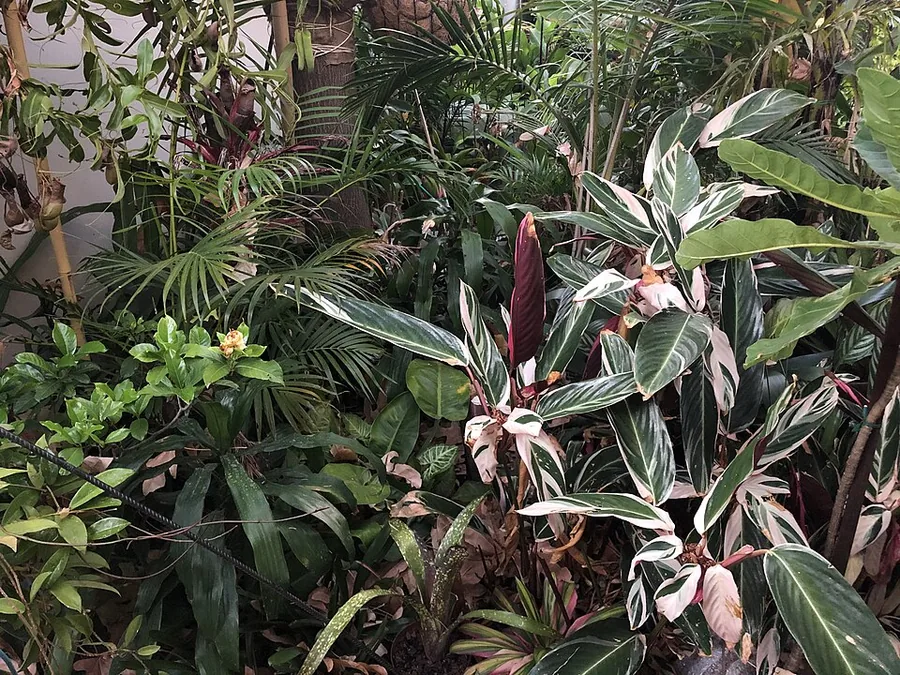
Every leaf of the Stromanthe Triostar reads like a brushed canvas: broad streaks of green, cream, white, and pink run the length of each blade, and each one carries its own arrangement of the color. Turn a leaf over and the reverse is a single deep burgundy, so the plant flashes rose-red backs whenever a leaf tips. It sits in the prayer plant family, and each evening the whole crown folds upward, then eases flat again by morning.
The coloring comes at a cost, and the plant shows every misstep on its own surface. The pale cream and pink zones hold little chlorophyll, so direct sun bleaches them to crisp, faded patches. Hard tap water leaves a brown scorch creeping along the leaf margins and tips, and dry air deepens that browning. It grew up on the warm, humid floor of Brazilian forests, and the leaves stay full and unmarked only when that warmth and moisture hold.
The plant grows as a clump of upright stems, each holding its striped leaves aloft, and the mass thickens year by year. As new leaves rise and unfurl, they open into the same tricolor as the rest, cream and pink laid over green. Divide the clump every year or two, and each piece rebuilds that crown of painted, burgundy-backed foliage.
Care
The short version: bright indirect light and no direct sun keep the pale cream and pink from bleaching, while soft filtered water on evenly moist soil keeps the leaf edges clean. Humidity above 60%, steady warmth, and light feeding through the growing season hold the color true.
Light
Bright indirect light brings out the fullest color, the kind found near an east or north window. Direct sun bleaches the pale cream and pink to crisp patches, while deep shade mutes the whole leaf. Dappled light or a sheer curtain holds the variegation bright.
Water
The soil stays evenly moist but never soggy, wetter through active growth and drier in winter. Fluoride, chlorine, and salts in tap water burn a brown line along the leaf edges, so filtered, distilled, or rainwater keeps them clean.
Soil
A fertile, organic-rich mix that holds water yet drains suits the roots, which rot in a soggy pot and crisp in a dry one. The plant takes a wide pH range, anywhere from 6.0 to 8.0.
Temperature
Warmth suits it, no colder than about 59°F (15°C). This is tropical foliage with no tolerance for cold drafts, so chilly windows and doorways in winter mark and damage the leaves.
Humidity
Moist air matters most to this plant. It wants humidity of 60% or more, and dry indoor air is what browns the leaf edges. A humidifier, a pebble tray, or a cluster of plants keeps the air damp around the foliage.
Feeding
Light feeding runs through the spring and summer growing season, about every 2 to 3 weeks. A low-nitrogen liquid fertilizer is enough, and feeding stops through the colder months as growth slows.
Pruning
The plant asks for no real pruning. Spent or damaged leaves are cut away at the base as they appear, keeping the striped clump clean.
Repotting
Repotting comes every 1 to 2 years in spring, once roots circle the pot, water runs straight through, or the clump crowds itself. The plant is divided at the same time, already lifted from its pot.
Size & spacing
Indoors the clump of upright stems stands 2 to 5 feet (60 to 150 cm) tall and spreads 2 to 3 feet (60 to 90 cm) wide. Space on the shelf lets air pass around the leaves and keeps the striped foliage off the wall.
Troubleshooting
Nearly every sign of trouble on this plant surfaces on the leaves themselves, written in browned edges, bleached patches, fine webbing, or a dusty speckle. The variegation and the soil read like a status report up close. Match the marking you see below to its cause.
A limp plant with soft stem bases and sour soil
Soggy, airless soil rots the roots and stem bases to soft brown, and a sour smell rises from the pot. The plant is lifted, every soft, brown root and stem is cut away, and it goes into fresh, well-draining mix. From then on the soil stays only evenly moist, and the pot drains freely.
Fix:
- Unpot and remove all soft, rotten roots and stems
- Repot into fresh, well-draining mix
- Water only to keep evenly moist, never soggy, and ensure drainage
Fine webbing and a dusty, stippled surface on the leaves
Hot, dry air draws spider mites, which crowd the leaf undersides and joints and leave a stippled, dusty film across the surface. A rinse of the foliage and a wipe of the undersides clears many, and higher humidity turns the rest away. Insecticidal soap or horticultural oil treats them, repeated as the label states.
Fix:
- Rinse foliage and wipe undersides
- Raise humidity, which discourages mites
- Treat with insecticidal soap or horticultural oil and repeat per label
Cottony white masses lodged in the leaf joints and stems
The fluffy white specks packed into the leaf joints are mealybugs, often with a sticky film nearby. A cotton swab dipped in isopropyl alcohol lifts each one, and insecticidal soap or horticultural oil follows. The plant stays apart and gets a second round, since a few survivors rebuild the colony.
Fix:
- Dab insects with isopropyl-alcohol-moistened swab
- Treat with insecticidal soap or horticultural oil
- Isolate the plant and repeat treatments
Brown, crisp scorching along the leaf edges and tips
The plant reacts to its water, and the reaction shows on the leaf. Fluoride, chlorine, and salts from tap water gather in the tissue and burn a dry brown line along the margins and tips, while the centers keep their green. Filtered, distilled, or rainwater, humidity above 60%, and soil that never dries out hold the browning back, since dry air and dry roots deepen it.
Fix:
- Switch to filtered, distilled, or rainwater
- Raise humidity to 60%+ with a humidifier or pebble tray
- Keep soil consistently moist, never bone-dry
- Trim badly browned edges for appearance only
Bleached, faded blotches across the cream and pink
The bright cream and pink patches carry little chlorophyll, so direct sun scorches them first. Pale, crisp spots appear on any leaf sitting in the midday glare. Bright indirect light or an east or north window spares the color, and a sheer curtain filters the harshest sun.
Fix:
- Move to bright indirect light or an east/north-facing aspect
- Filter harsh direct sun with a sheer curtain
Toxicity
This is a non-toxic prayer plant, with no poison recorded in its striped leaves or upright stems. NC State Extension lists the species as pet friendly, so a nibble from a cat, dog, or rabbit is no cause for worry. It is not grown to be eaten, and a large mouthful of leaf fibre may bring a passing stomach upset, but nothing in the plant is harmful.
Safe for
People · Cats · Dogs · Horses · Rabbits · Livestock · Birds
Cats None
Cats are safe with the plant. NC State tags this prayer plant as pet friendly and no toxin is recorded in the leaves, so a curious nibble means nothing.
Dogs None
Dogs are safe near it. No poison sits in the foliage, though a dog that eats a lot of any houseplant may get a brief upset stomach from the fibre.
Horses Safe
Horses have no toxicity on record against it. The plant grows indoors rather than in a paddock, and a stray leaf does no harm.
Rabbits Safe
Rabbits are safe around it. The leaves hold no toxin, so a stolen bite leaves them unharmed.
Livestock Safe
Livestock meet nothing toxic in it, and as an indoor plant it seldom crosses a grazing animal's path.
Birds Safe
Pet birds are safe beside the foliage. No harmful compound is recorded in the leaves or stems.
People Safe
People are safe with it in any room. It is not grown for eating, but it holds no toxin, so children are in no danger near it.
As with any houseplant, discourage pets from chewing foliage; ingestion of plant fibre can still cause mild, transient GI upset
Varieties
Triostar is the familiar one, but it is not the only painted-leaf Stromanthe around. Two are worth telling apart by their coloring.
'Triostar' (syn. 'Tricolor')
Green leaves run with bold streaks of white, cream, and pink, and the underside of each is a solid wash of pink to burgundy.
'Magic Star'
Magic Star scatters creamy white speckles over its green leaves in place of pink, and turns a deep maroon on the undersides.
How to propagate
One route makes more of this plant, and it arrives at the same moment a crowded clump needs repotting.
DivisionModerate
Spring, before new growth starts · Several weeks to a few months
The plant multiplies when the rhizome clump is split in spring, just before new growth breaks. Each division goes into its own pot and holds warm, humid, and evenly moist while it settles. A single division needs several weeks to a few months to root down and grow on its own.
Myths
Stromanthe Triostar is only a kind of Calathea.
It is often sold and labelled as 'Calathea Triostar', though it sits in its own genus, Stromanthe. The accepted name is Stromanthe thalia, with Stromanthe sanguinea as a synonym, which is why the RHS lists it as Stromanthe sanguinea 'Triostar'.