Houseplant · Marantaceae
Rattlesnake Plant
Goeppertia insignis
Long, wavy leaves marked like a snake's back that fold up at night and reward steady water and humidity.
Partial shade
64–75°F · 18–24°C
USDA 11–12
9–30 in · 23–76 cm
Overview
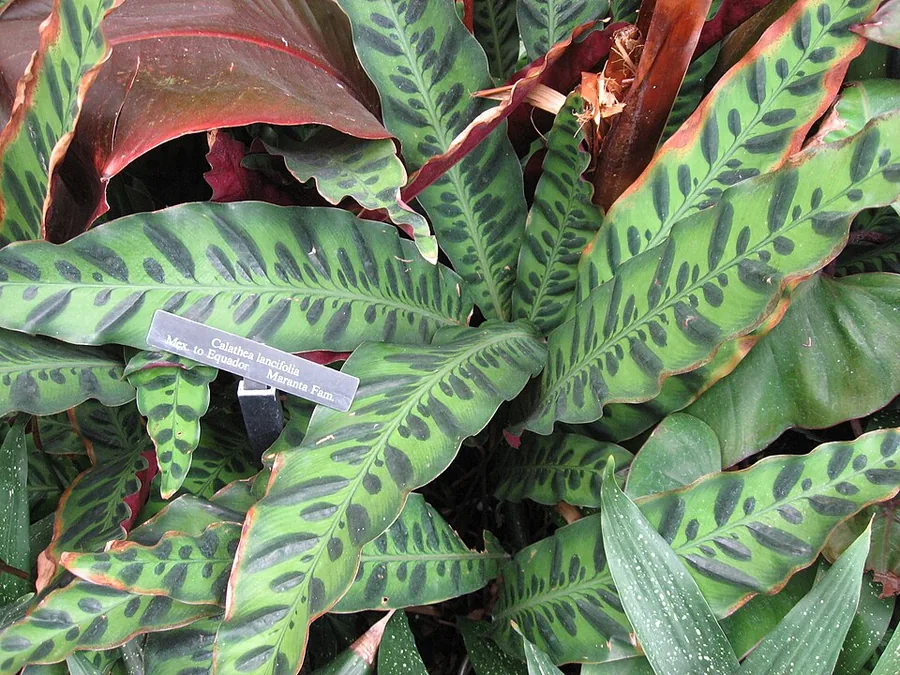
Up close, the rattlesnake plant is all pattern: each long leaf ripples along its wavy edges and carries dark green blotches spaced down a bright green blade, the very markings that recall a snake's back. Turn a leaf and the whole underside is a deep purple-red, a flush of color hidden until it lifts. It sits within the prayer plant family and comes from the rainforests of Brazil, grown low on the shaded floor in warm, damp air.
The leaves move as much as they mark. Through the day each blade holds flat and open, then folds upward at dusk and eases open again by morning, so the plant's whole silhouette shifts on a slow daily cycle. The blades stack into an upright, leafy clump that reaches 9 to 30 inches (23 to 76 cm) tall, dense enough to fill the pot with layered foliage.
Every bit of that patterned color depends on the conditions the plant gets. It leans on soft water, steady moisture, and humid air, and any shortfall reads straight off the leaf as browning that creeps in along the edges. Give it the warm, shaded, damp air of the forest floor and the blades come in fast and full, spots crisp against the green.
Care
The short version: bright shade with no direct sun, soil kept evenly moist with rainwater or distilled water, warm rooms, and humidity as high as you can hold it, all to keep the marked leaves at their best.
Light
It wants bright but indirect light or partial shade, the broken light that falls through a rainforest canopy. It holds its color even in fairly deep shade. Direct sun does the damage, bleaching the dark markings pale and drying brown scorch into the blades.
Water
Keep the soil evenly moist but never soggy from April to August, then let it run drier through winter. The water itself shows on the leaf: use rainwater or distilled water, since the fluoride in tap water gathers in the foliage and burns a brown line along every edge.
Soil
Root it in a well-drained, peaty mix thick with organic matter, damp around the roots but never standing in water. It reads pH loosely, holding steady anywhere from 6.0 to 8.0, acidic through slightly alkaline.
Temperature
Warm air keeps the blades firm, ideally 64°F to 75°F (18°C to 24°C). Cold does not sit well with it, so keep it clear of drafty windows and chilly corners that can mark the leaves.
Humidity
Humidity is what the foliage lives on. It needs high humidity, well past a dry living room, delivered by a wet pebble tray, misting, or a steamy room. Let the air go dry and the edges of each blade turn crisp and brown.
Feeding
Feed it monthly with a balanced fertilizer through spring and summer while new blades are unfurling. Pull the feeding back through winter as growth slows to a stop.
Pruning
There is no shaping to do on this leafy clump. Simply cut away any dead, damaged, or browned leaves at the base so only clean, marked blades remain.
Repotting
Repot it every 1 to 2 years in spring, or sooner once roots coil around the rootball or push out the drainage holes. That same lift is the moment to split the rhizome clump into new plants.
Size & spacing
The clump stays compact indoors, 9 to 30 inches (23 to 76 cm) tall with a 9 to 18 inches (23 to 46 cm) spread of layered blades. One plant packs its pot on its own, so give it a container with a little room around the roots.
Troubleshooting
Trouble shows up written on the leaf, in faded markings, browned edges, or a dulled surface, and it nearly always traces to water quality, light, or dry air. Look closely at the blade and the change usually names the cause. Match what you see below, then correct the condition behind it.
Yellowing, limp leaves with soft rot at the base
When the blades yellow and go limp with soft rot at the base, the cause is usually waterlogged soil and root rot from overwatering, though bone-dry soil can yellow them as well. Feel the mix and the roots: dark and mushy means rot, while dust-dry means the opposite. Water to keep the soil evenly moist but never wet, make the pot drain, and repot into fresh mix while cutting away the rotted roots.
Fix:
- Adjust watering so soil stays evenly moist but never soggy
- Ensure the pot and mix drain freely
- Repot into fresh well-drained mix and trim rotted roots if rot is present
Fine webbing over a dull, stippled surface
A blade gone dull and finely stippled, laced with faint webbing, points to spider mites that move in as the air dries. Turn the leaves to find the tiny mites and threads clinging to the undersides. Rinse the foliage, raise the humidity, treat with insecticidal soap or horticultural oil, and keep the plant apart until the surface clears.
Fix:
- Rinse foliage and raise humidity
- Treat with insecticidal soap or horticultural oil
- Isolate the plant to limit spread
Crisp brown edges rimming the leaves
That brown rim is fluoride and salt buildup from tap water, gathering in the blade and scorching the thin margin while the broad green center holds. Dry air sharpens the line. Move to rainwater, distilled, or filtered water, lift the humidity, and trim the crisped edges back to clean tissue.
Fix:
- Switch to rainwater, distilled, or filtered water
- Raise humidity using a wet-pebble tray, regular misting, or a humidified room
- Trim badly browned edges for appearance only
Bleached, washed-out markings and scorched patches
Strong light is draining the pattern. Direct sun washes the dark spots pale and dries hard brown scorch into the blade, punishing foliage shaped for the dim forest floor. Move it into partial or full shade under bright indirect light, and let nothing but soft early-morning sun touch the leaves.
Fix:
- Move the plant out of direct sun to a partial- or full-shade location with bright indirect light only
- Provide diffused or early-morning sun at most
Toxicity
Behind the striking foliage there is nothing harmful: this is a safe, non-toxic houseplant. The ASPCA and NC State Extension both clear it for cats, dogs, and horses, and nothing in the leaves will harm rabbits, birds, livestock, or children. The patterned blades can sit at floor level beside a curious pet with no concern.
Safe for
People · Cats · Dogs · Horses · Rabbits · Livestock · Birds
Cats None
Both the ASPCA and NC State Extension list the spotted foliage as non-toxic to cats, so a curious nibble is nothing to worry about. A cat that eats a lot of any leaf may still get a mild, passing stomach upset.
Dogs None
Dogs are safe on the same two listings, with no poisonous compounds in the blades. The most a big mouthful brings is a little drool or a soft stool that clears on its own.
Horses None
The ASPCA clears it for horses too. As an indoor tropical it rarely crosses a horse's path, and a stray taste of the leaves does no harm.
Rabbits None
Nothing in the foliage is toxic to rabbits. Keep it as a houseplant rather than forage, though, since a steady diet of any ornamental leaf can throw off a rabbit's digestion.
Livestock None
No toxins in the blades mean grazing animals face no real risk. This tropical houseplant almost never reaches a pasture in the first place.
Birds None
Pet birds can share a room with the foliage safely, with no poisonous parts to worry about if one takes a curious peck.
People None
The leaves are harmless around children, and handling them causes no irritation. It is not grown as food, so no part of the plant is meant for the plate.
How to propagate
Only one method reliably makes more of these patterned clumps, and it comes at the moment you would already be repotting.
DivisionModerate
Spring, at repotting · Several weeks to a few months
This plant spreads by division of its rhizome clump, not by cuttings, so spring repotting is the natural time. Lift the leafy clump, ease the rhizomes apart into sections that each keep sound roots and a few marked blades, and set each one in its own pot. Held warm and humid, the divisions root down and push new leaves over several weeks to a few months.
Myths
The rattlesnake plant's real botanical name is Calathea lancifolia.
The label has been overtaken. Kew's Plants of the World Online now records Goeppertia insignis as the accepted name, holding Calathea lancifolia, Calathea insignis, Goeppertia lancifolia, and Maranta insignis as synonyms. The genus Goeppertia was carved out of Calathea, which is why so many long-standing Calathea plants now bear Goeppertia names. A pot still marked Calathea carries the very same spotted, wavy-leaved plant.
Like most tropical houseplants, the rattlesnake plant is toxic to pets.
It is not. Both the ASPCA and NC State Extension list Calathea and Goeppertia insignis as non-toxic to cats, dogs, and horses. The patterned leaves can rest at floor level beside a curious pet with nothing to fear.