Houseplant · Marantaceae
Prayer Plant
Maranta leuconeura
Look closely and the prayer plant reveals red veins in a herringbone across green leaves that fold upright at nightfall.
Bright indirect
USDA 11–12
6–18 in · 15–46 cm
Overview
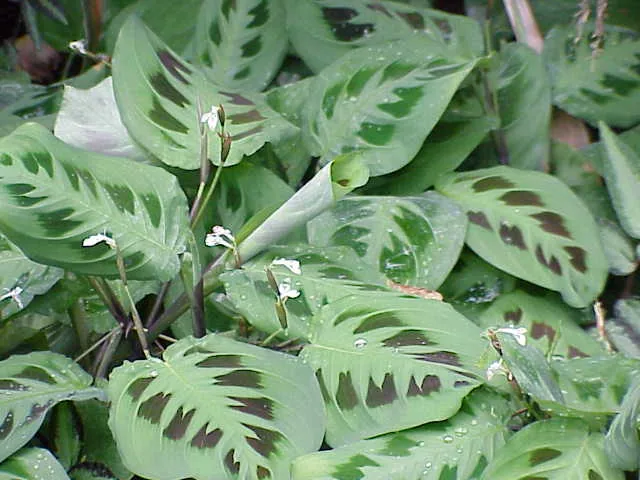
Up close, the prayer plant is a study in patterned leaves. Through the day they spread flat and open, each blade laid out to catch the light, and after dark they lift and fold upright, pressing together in the shape that reads as praying hands. It sits within the Marantaceae family and comes from the shaded floor of Brazil's rainforests, and the leaves carry that shade-grown look in their coloring.
The color is the whole story. Each leaf sets bold markings against a base of green, deep on some plants and pale on others, whether the fine red veins running out from a central rib or the dark blotches ranged in rows. The plant itself is small, its leaves held on a compact form no taller than 18 inches (46 cm).
Run through its features and one thing stands out: this is a leaf plant, marked and moving. The red-and-green variegation gives it its color, the herringbone veining gives it its texture and line, and the nightly fold gives it motion. Keep it in soft water and humid air, or the crisp brown edges will spoil those leaves, and it stays a pet-safe houseplant worth studying leaf by leaf.
Care
The short version: the prayer plant keeps its leaf color in bright indirect light out of direct sun, its leaves firm in soil kept evenly moist with rainwater or filtered water, and its edges clean in high humidity above 60°F (15.6°C).
Light
Set it in bright, indirect light and away from direct sun, which drains the red-and-green markings to a washed pale and scorches the blades. It holds in medium or low light, but the veining and color stay deepest and most defined where the light is bright and filtered.
Water
Keep the soil evenly moist through spring and summer, then let it dry a little from autumn into late winter. The leaves are sensitive to fluoride, chlorine, and salts in tap water, which burn the thin edges to brown first. Rainwater, distilled, or filtered water keeps the blades clean to the margin.
Soil
Grow it in a moist, humusy, well-drained mix on a soil base. The medium should stay damp yet drain, since roots left in standing water turn soft and rotten rather than firm and pale.
Temperature
Keep it warm and above 60°F (15.6°C). Cold drafts and chilled glass mark the leaves, so through winter it belongs away from doors and vents.
Humidity
Its leaves want high humidity and show dry air quickly, crisping and browning along the fine edges. A tray of wet pebbles, a humidifier, or nearby plants raise the moisture and keep the blades whole.
Feeding
Feed it a balanced houseplant fertilizer monthly through spring and summer, then cut back sharply from autumn to late winter. Keep the dose small, since excess feed scorches the leaf tissue much as hard water does.
Pruning
It needs little pruning. Any leaf that has gone damaged, faded, or brown at the tip can be cut away, leaving the clean, marked blades behind.
Repotting
Repot in spring once the roots crowd the pot or push out through the drainage holes. That is also when the clump can be split, the roots and leafy shoots coming apart into separate plants.
Size & spacing
The plant is low and broad, 6 to 18 inches (15 to 46 cm) tall and 6 to 24 inches (15 to 61 cm) across. Its leaves spread outward and trail past the pot rim, so the plant grows wider than it stands tall.
Troubleshooting
Nearly every prayer plant problem writes itself onto the leaves, in browned edges, washed-out color, or blades that will not fold, and most come from water, light, or humidity rather than disease. Look closely at what the leaf is showing and the cause is usually plain. Match the appearance below, then adjust.
Wilting leaves over soft, mushy stems
Below wilting, yellowing leaves, soggy soil brings root rot, and the roots turn brown and soft in place of firm and pale. Cutting away the rotted roots and repotting into fresh, well-drained mix saves the plant. From there it takes water only when it needs it, never left standing in a full saucer.
Fix:
- Remove from soggy soil and trim rotted roots
- Repot into fresh well-drained mix
- Water only when appropriate and ensure drainage
Fine webbing and pale stippling across the leaves
Fine webbing strung across the leaf undersides and pinprick yellow stipples on the surface mark spider mites, which multiply in hot, dry air. Rinsing the blades, raising the humidity, and treating with insecticidal soap or horticultural oil clears them. Keep the plant apart from the others until it is clean.
Fix:
- Rinse foliage and raise humidity
- Treat with insecticidal soap or horticultural oil
- Isolate affected plant
Brown, crisp edges rimming the leaves
The brown, brittle rim is leaf burn, set off by fluoride, chlorine, and salt in tap water that gather at the thin leaf margins, with heavy feeding in dry air deepening it. The browning stays at the tips and edges while the middle holds green. Rainwater, distilled, or filtered water, lighter feeding, and higher humidity keep the next leaves clean.
Fix:
- Use rainwater, distilled or filtered/dechlorinated water
- Reduce fertilizer frequency and strength
- Raise humidity (humidified room or pot on a tray of wet pebbles)
- Trim damaged tips for appearance
Washed-out color and pale, scorched blades
When the red and green fades to a bleached pale and scorched patches open on the blade, too much direct sun has done it. The pigment breaks down and the tissue burns where hard light strikes a leaf built for shade. Bright indirect light and a filtered window let the color return on new growth.
Fix:
- Move to bright indirect light out of direct sun
- Filter strong window light
Leaves left lying flat after nightfall
A healthy prayer plant lifts and folds its blades upright at night like praying hands, so leaves left flat after dark signal poor light or stress rather than disease, and the color usually holds. Bright indirect light through the day, real darkness at night, and steady water, humidity, and warmth bring the fold back.
Fix:
- Provide adequate bright indirect light during the day and natural darkness at night
- Correct watering, humidity and temperature to reduce stress
Toxicity
For all its markings, the prayer plant carries nothing harmful: it is non-toxic and safe in the home. The ASPCA lists it as harmless to cats, dogs, and horses, with no toxic compounds anywhere in those patterned leaves. A pet that eats a mouthful may feel briefly unsettled, but there is no real poisoning to fear.
Safe for
People · Cats · Dogs · Horses · Rabbits · Livestock · Birds
Cats None
Cats are safe with it. The ASPCA finds no toxic principle in the leaves, so a cat that chews the foliage risks only a brief, mild stomach upset.
Dogs None
Dogs are safe too, since nothing in the blades is toxic. A large mouthful may leave a dog briefly queasy and no worse.
Horses Safe
Horses are cleared by the ASPCA as well. The leaves hold no poison, so a curious bite does no harm.
Rabbits Safe
No toxic compounds sit in the foliage, so a rabbit stays safe near the plant, though the leaves are no replacement for its usual forage.
Livestock Safe
The leaves pose no poisoning risk to grazing animals, and as a tropical houseplant it seldom reaches them.
Birds Safe
Pet birds are safe around it. The leaves carry no toxins, so perching or a peck at a blade does no harm.
People Safe
The plant is safe around children. No part of it is poisonous, though the leaves are grown to be looked at rather than eaten.
Although non-toxic, ingestion of plant material can still cause mild gastrointestinal upset in pets
Varieties
Two named forms turn up most often, and the leaves alone tell them apart. Look at the veins and the blotches.
var. erythroneura (Herringbone / red-veined prayer plant)
The most striking form, a bright red midrib running the length of each dark green leaf with red veins branching off it in a herringbone.
var. kerchoveana (Rabbit's-foot / rabbit tracks)
A paler green form, its leaves marked by two rows of dark blotches down each blade that gardeners read as rabbit tracks.
How to propagate
The plant is easy to multiply, and spring is the season for it, whether the clump is divided at the roots or a length of leafy stem is set to root.
DivisionEasy
Spring, at repotting · Several weeks
The simplest increase is division in spring at repotting. The clump pulls apart into sections, each holding its own roots and leafy shoots, and the sections go into separate pots. Each takes several weeks to settle before new leaves appear.
Stem cuttingsModerate
Spring to summer · Several weeks to root
The plant also roots from a stem cutting taken just below a node in spring or summer. The cutting sits in moist mix under warmth and humidity while it forms roots. Expect several weeks before roots appear.
Myths
The prayer plant is toxic to cats and dogs.
The ASPCA lists the prayer plant and the wider Maranta group as non-toxic to cats, dogs, and horses, with no toxic principles in those patterned leaves. Nothing in the plant poisons a pet, though a large mouthful of foliage may bring a short, mild stomach upset.
The leaves fold at night for religious reasons.
The fold is nyctinasty, a natural day and night sleep movement, not a ritual. After dark each leaf swings upward and closes against its neighbor into a praying-hands shape, and that pose is where the name comes from.