Houseplant · Marantaceae
Calathea Orbifolia
Goeppertia orbifolia
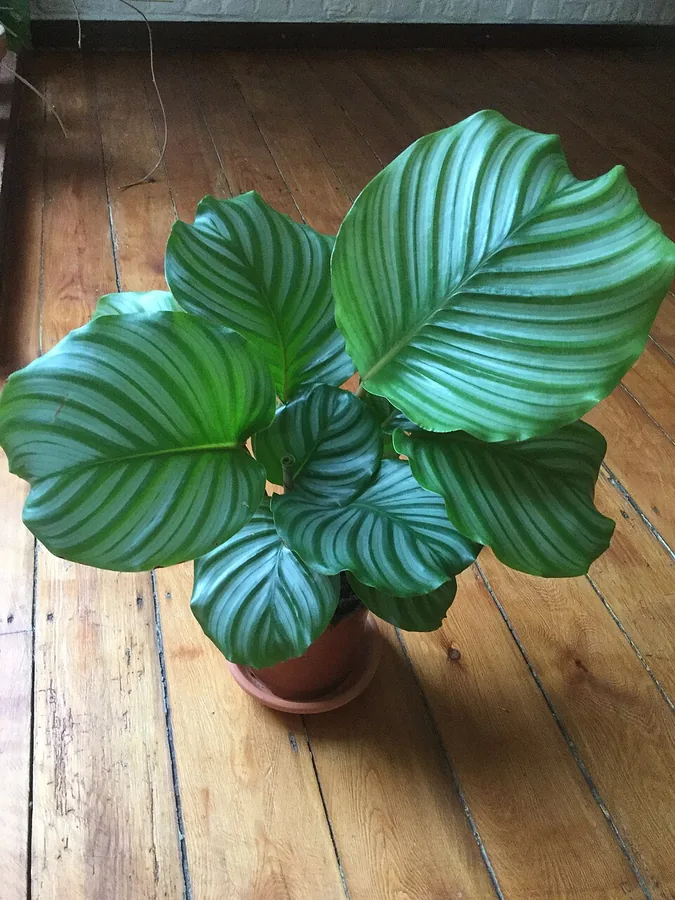
Wide, rounded blades banded in silver and green ribbon stripes that lift and press together as night falls.
Bright indirect
65–75°F · 18–24°C
USDA 11–12
2–3 ft · 0.6–0.9 m
Overview
On this plant the leaf is everything. Each blade is broad and so nearly circular it looks drawn with a compass, a smooth orbicular surface that can stretch up to 12 inches across. The ground color is a soft silver-green, and over it runs a pattern of fine ribbon stripes that fan out from the midrib toward the rounded edge. As the light fades, the whole crown lifts and folds those rounded leaves together, the slow vertical movement that names the prayer plant.
It sits in the prayer plant family, the Marantaceae, and now wears the accepted name Goeppertia orbifolia after the 2012 reshuffle that moved many Calathea species into the genus Goeppertia. Only the name on the plant changed, and growers and shops still reach for the familiar Calathea when they describe these rounded, silvered leaves.
This is a demanding plant, and its appetite for clean water and damp air leaves marks you can read on the foliage itself. Starve it of either and the broad blades crisp and curl at the edge. Keep the light, water, and humidity steady, though, and it pushes out leaf after leaf at a fast clip, each one rounder and more boldly striped, building to a plant that stands 2 to 3 feet (61 to 91 cm) tall. Indoors it rarely flowers, but when it does the blooms are small and white, tucked low against the foliage.
Care
The short version: bright indirect light and no direct sun, distilled water or rainwater to keep the soil evenly moist, a warm room at 65°F to 75°F (18°C to 24°C), and humidity of at least 60%.
Light
Set it in bright, indirect light and keep direct sun off the blades, since strong rays drain the silver-green color and burn the broad surfaces. It holds on in partial shade, but the leaves come in smaller and the stripes flatter in a dim corner. Early-morning or well-diffused sun is the most those leaves should meet.
Water
Keep the soil evenly moist but never soggy, and ease back through winter as new leaves slow. What touches the blades matters too, so water with distilled water or rainwater. The fluoride and salts in tap water etch brown right onto the rounded edges and tips of the foliage.
Soil
Root it in a moist but well-drained mix, loamy or peaty, that holds water without packing into mud. A slightly acidic to neutral pH of 5.5 to 7.0 suits it. The aim is soil that stays damp around the roots between waterings while still draining freely.
Temperature
Warm, steady rooms of 65°F to 75°F (18°C to 24°C) keep the leaves firm and unblemished. The plant has no tolerance for cold drafts or sudden chills, so keep the foliage clear of doorways, vents, and cold winter glass.
Humidity
This is what the leaves react to most. Aim for at least 60% humidity, well above most rooms, with a humidifier doing the work, because in dry air the broad blades are the first to crisp at the edge and roll inward. A pebble tray and a huddle of other plants raise the moisture around the foliage and keep those rounded leaves smooth.
Feeding
Across the growing season, spring into summer, feed it monthly with a balanced houseplant fertilizer at the usual strength, then stop through winter while growth pauses. It is a light feeder, and too much fertilizer leaves a salt residue that scorches the leaf edges brown.
Pruning
There is little to cut. Just remove damaged, browned, or yellowing leaves at the base as they show, which clears the tired blades and pushes the plant's energy into the round, freshly striped leaves coming up.
Repotting
Repot every 1 to 2 years in spring, or sooner if roots circle the pot, water runs straight through, or new leaves slow. Step up just one pot size into fresh mix, since this plant resents a root zone lost in too much soil.
Size & spacing
Indoors the clump rises to 2 to 3 feet (61 to 91 cm) tall and fans out 12 to 24 inches (30 to 61 cm) wide. Give it room so the wide, rounded leaves can open flat and air can pass between them.
Troubleshooting
Nearly everything that goes wrong here writes itself onto the leaf surface, in browned edges, faded stripes, rolled blades, or speckled patches, and nearly every one traces to water quality, humidity, or light. Look closely at the foliage and it shows you the cause. Match what you see below, then fix the source rather than the mark it left.
Limp yellow leaves and brown, mushy roots
When the blades go limp and yellow and the roots turn brown and mushy instead of firm and pale, soil left wet has brought on root rot. Lift the plant, cut away every soft root, and repot into fresh, well-drained mix. From there, water only enough to keep the soil evenly moist and never let the roots sit soggy.
Fix:
- Remove plant and cut away rotted roots
- Repot into fresh well-drained mix
- Water only to keep evenly moist, never soggy
Washed-pale stripes and burnt blotches
When the bold ribbon striping pales and dry burned patches appear on the most exposed blades, the plant has taken too much light, and direct afternoon sun is the usual cause. Move it into bright indirect light or partial shade, and the next leaves unfurl with their silver-green and stripes fully back.
Fix:
- Move to bright indirect light or partial shade
- Avoid direct afternoon sun
Silky webbing and dust-fine speckles
Dry air draws spider mites, which gather on the leaf undersides and leave faint webbing along with a fine pinprick stippling across the surface. Rinse the foliage, then treat with insecticidal soap or horticultural oil and repeat until they are gone. Keeping the air around the leaves humid is the surest way to keep them off.
Fix:
- Rinse foliage
- Treat with insecticidal soap or horticultural oil
- Raise humidity
Crisp brown rims around the leaves
When the rounded edges and tips turn brown and brittle while the leaf interior holds its silver-green, the cause is almost always the tap water. Fluoride, chlorine, and dissolved salts collect and scorch the leaf margins. Switch to distilled water or rainwater, lift the humidity to at least 60%, and trim the crisped edges if the brown bothers you.
Fix:
- Switch to distilled water or rainwater
- Raise humidity to at least 60% with a humidifier or wet-pebble tray
- Trim damaged edges if desired
Leaves curling or rolling inward
When the broad blades roll inward on themselves, often browning along the rounded edge, the air has gone too dry or the soil has run thirsty. Raise the humidity to at least 60% with a humidifier or pebble tray and keep the soil consistently moist. The leaves usually unroll and flatten again once the plant is comfortable.
Fix:
- Increase humidity to at least 60%
- Keep soil consistently moist
Brown or rusty spots dotting the leaves
Discrete brown or rusty spots scattered across the surface after watering come from water sitting on the foliage. Water at the soil rather than over the broad leaves, and skip the misting that leaves them wet. A little more air moving past the foliage dries the surface before spots can form.
Fix:
- Water at the soil level and avoid wetting leaves
- Improve air circulation
Toxicity
For a plant this striking up close, it is reassuring that it ranks among the safest you can keep around animals. The ASPCA lists Calathea and the prayer plant family as non-toxic to cats, dogs, and horses, and NC State Extension confirms the same for Goeppertia orbifolia by name. A bite from a curious cat or dog brings no poisoning.
Safe for
People · Cats · Dogs · Horses · Rabbits · Livestock · Birds
Cats None
The ASPCA lists this plant as non-toxic to cats, so a curious bite from a rounded leaf is nothing to worry about. A cat that eats a lot of any houseplant may bring it back up, but that is a full stomach, not poison.
Dogs None
It is safe for dogs, with both the ASPCA and NC State Extension placing it on the non-toxic list. There is no need to fence off the foliage or rush to the vet if a dog chews a leaf.
Horses None
A horse could mouth the broad, round leaves without harm, because the ASPCA marks prayer plants non-toxic to horses.
Rabbits None
Nothing in these leaves is toxic to a rabbit. Even so, leafy houseplants are not part of a rabbit's diet, so let any taste stay a stray nibble rather than a meal.
Livestock None
Goats and sheep can browse the wide, ribbon-striped foliage safely, because this plant holds none of the toxins that turn so many ornamentals into a field hazard.
Birds None
A pet bird that picks at a leaf is in no danger, since the foliage holds nothing toxic, though fertilizer or leaf-shine residue is best kept off any blade a bird can reach.
People None
Handling the leaves and the odd accidental taste pose no poisoning risk to children or adults. It is not grown to be eaten, but it sits firmly on the non-toxic list.
How to propagate
To get a second clump of these rounded, striped leaves, there is only one way: dividing the plant you have. It will not root from a cutting, so a spring division is the route to take.
DivisionModerate
Spring · Several weeks to establish after potting up divisions
Division is the only way to multiply this plant, since it will not grow from a leaf or stem cutting. Do it in spring, lifting the rootball and easing it into clumps that each keep their own roots and leaves before potting them up separately. Give the divisions a few weeks of warm, humid, evenly moist conditions and they take hold and push out their own rounded, striped leaves.
Myths
Calathea orbifolia remains the true, up-to-date botanical name.
That name is now a synonym. Kew's Plants of the World Online gives the accepted name as Goeppertia orbifolia, from the 2012 reshuffle that moved many Calathea species into the genus Goeppertia. The plant on the bench is unchanged; only its name was rewritten.
This prayer plant carries a toxin dangerous to pets.
They are not. The ASPCA lists Calathea and the wider prayer plant family as non-toxic to dogs and cats, and NC State Extension says the same for Goeppertia orbifolia by name. Those rounded, striped leaves are among the safest a pet could nibble.