Houseplant · Polypodiaceae
Staghorn Fern
Platycerium bifurcatum
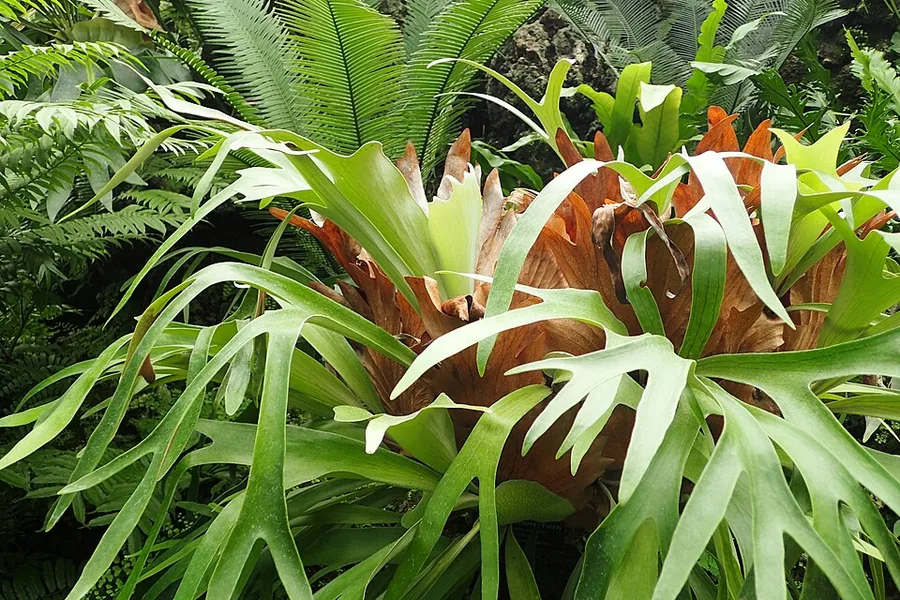
Anchored to a board in bright indirect light with a regular soak, the staghorn splits its green fronds into forked, antler-shaped tips.
Bright indirect
Every 7–14 days
55–75°F · 13–24°C
USDA 9–12
Overview
The staghorn's signature is the forked frond that branches and splits at its tips like the antlers of a stag, arching out in green from the center of the plant. It is an epiphyte, gripping bark and branches in the wild rather than rooting in soil, which is why it sits on a mounted board with its root ball wrapped at the base. The whole plant reads as a bold, sculptural shape, its antler points reaching outward from a low, mossy root ball.
Look closely and two frond types stand apart. The antler fronds are the green, forking blades, and their surface carries a fine, felt-like coating that softens the light across them. Below them, the flat, papery shield fronds press against the base and age from green to a dry, papery brown. That brown is not decay, since the shields harden into a protective collar cupped around the root crown.
Everything about the plant moves slowly, with new antler fronds pushing out over time rather than in a rush. Given the right light, mount, and watering rhythm, the forked blades keep multiplying and the base thickens with overlapping shields for years. Up close, the layered contrast of soft green antlers over crisp brown shields is the plant's whole character.
Care
The short version: bright indirect light, a regular soak of the mounted root ball with a dry-down between, warm rooms, and humid air that keeps moving over the felt-covered fronds.
Light
Set it in bright indirect light, bright enough to wash across the fronds without direct sun striking the felted green blades. It holds up in partial shade or mild sun. Harsh direct rays scorch and brown the frond surface, while too little light leaves the antlers soft and drooping.
Water
Water every 7 to 14 days, letting the root ball dry a little at the base but never to a hard, crisp knot. Soak or immerse the mounted root ball, keeping the felted fertile fronds out of the water, for a few minutes and then let it drain. Water more through warm, active growth and far less in winter.
Soil
The roots do not sit in potting soil. They pack into an epiphytic mix of stringy sphagnum moss and chunky orchid bark, or into moss bound around the root ball on a board. A slightly acidic pH of 5.0 to 6.0 suits them, with sharp drainage and open air moving through the mossy mass.
Temperature
Hold it between 55°F to 75°F (13°C to 24°C), the range of most warm rooms. Frost has no place near it, so keep the fronds clear of cold drafts and icy winter glass.
Humidity
The fronds hold their color and firmness in humid air of 50% to 80%. A bathroom or kitchen usually reaches it, and clustered plants or a humidifier lift a dry room. Keep the moist air moving, since still dampness settles onto the blades as black spot.
Feeding
Feed monthly through spring and summer while new fronds are forming, using a balanced diluted liquid fertilizer. In the dark months, growth stalls and the plant takes no feeding.
Pruning
There is little to cut. Take off only antler fronds that have shriveled to a dead, brittle brown. Leave the brown shield fronds at the base in place, since the flat, papery layers are living tissue that guards the root crown, not spent leaves.
Repotting
The plant rarely needs remounting, roughly once every few years, once it overgrows its board. The signs are shield fronds curling past the edges, a swelling root ball prying the plant off its mount, and a top-heavy body that tips and sways. Until then the mount holds it steady.
Size & spacing
Indoors the fronds build to about 2 to 3 feet (61 to 91 cm) tall and spread nearly as far. Give the antlers open air on all sides so the forked blades can reach out without pressing on a wall or another plant.
Troubleshooting
Most staghorn trouble writes itself onto the fronds first, in spots, softening, or a dusting of pests, and it usually traces back to watering or the surrounding air. Read those changes on the blades early and the damage stays small. Match the look below to its cause.
Dark spots spreading across the green blades
Those darkening marks are black spot, a fungus that takes to the fronds where humid air sits still and water beads on the surface. Move air across the plant, send water to the root ball instead of the blades, and cut away any frond blotched dark. As the surface dries between waterings, new growth comes in clean.
Fix:
- Improve air circulation around the plant
- Reduce misting and avoid wetting the fronds when watering
- Remove badly affected fronds
Antler fronds gone soft with browning tips
When the forked blades sag and lose their firmness, the root ball has dried to the core, the mark of underwatering once the mount lifts feather-light. Sink the root ball in water for a few minutes, let it drain, and hold a steadier schedule so the fronds stay turgid. They stiffen again as they take up water.
Fix:
- Immerse the root ball (not the fertile fronds) in water for several minutes
- Drain thoroughly and resume regular watering before it fully dries
Webbing, cottony flecks, or brown bumps on the blades
Fine webbing, white cottony tufts, and hard brown bumps on the fronds mark spider mites, mealybugs, aphids, and scale, which settle in when dry air stresses the plant. Wipe them from the surface with a damp cloth, then treat with insecticidal soap, laid on lightly so it does not clog the felted fronds. Keep the plant apart from others until the blades are clear.
Fix:
- Wipe pests off with a damp cloth
- Treat with insecticidal soap, avoiding heavy coating of the felt-covered fronds
- Isolate the plant until controlled
Toxicity
For homes with pets or children, the staghorn is non-toxic from frond to root. The ASPCA lists it as safe for cats, dogs, and horses, and nothing in the green blades or the brown shields harms people or other animals. Eating a large amount of any plant can bring a mild, brief stomach upset, and that is the extent of it.
Safe for
People · Cats · Dogs · Horses · Rabbits · Livestock · Birds
Cats None
Nothing in the green fronds is toxic to cats, so a curious nibbler comes to no harm. A cat that eats a good deal of frond may have a brief, mild stomach upset, the same as with any houseplant.
Dogs None
The fronds hold no toxins, so a dog can strip and chew a blade without real risk. Bolting down a lot of plant matter might bring a passing bout of vomiting, but nothing worse.
Horses Safe
The fronds carry no compounds that trouble horses. A mouthful of the green blades does no harm.
Rabbits Safe
Rabbits can nibble the soft fronds without harm. A large helping of unfamiliar greenery may loosen the gut for a day, so keep the tastes small.
Livestock Safe
Grazing animals take no harm from the fern, which holds none of the toxins that make some ornamentals risky in a pasture or barn.
Birds Safe
The fronds contain nothing poisonous, so pet birds stay safe near the plant. A curious peck at a blade does no harm.
People Safe
The fern is safe for adults and children to handle, even with the felted fronds against bare skin. It is not grown for eating, but a stray taste causes no trouble.
No special handling needed; non-toxic if nibbled, though eating large amounts of any plant may cause mild, temporary stomach upset.
Varieties
The plain species accounts for most staghorns, though one named selection with a distinct frond shape shows up often in shops.
Platycerium bifurcatum 'Netherlands'
The 'Netherlands' selection is a compact, sturdy plant whose forked fronds grow broader and stand more upright than the wild form, and it is the staghorn most often grown indoors.
How to propagate
The staghorn builds slowly, but a mature plant sends up small pups at its base that give one reliable way to grow another.
Offsets & pupsModerate
Spring · Several months to about a year
New plants come from offsets, the small pups that push up from the rhizome at the base. In spring, ease off a pup carrying a few of its own roots and bind it to its own board, then wait, since a young plant needs several months to about a year to knit in and firm up. Spores form on the fertile fronds too, but growing from them runs slow and fiddly.
Myths
The flat, brown, papery shields at the base are dead and should be peeled away.
Those browning shields are living tissue, dry and papery on the surface but active underneath. They clasp the root crown, catch water and fallen leaf litter in their overlapping layers, and hold moisture against the root ball. Leave them in place, because peeling the papery brown layers rips the roots knitted beneath them.