Herb · Lamiaceae
Spearmint
Mentha spicata
Spearmint carries crisp, toothed green leaves on upright stems, cool and sharp-scented at the lightest touch.
Full sun
Every 2–4 days
59–77°F · 15–25°C
80–90 days
Overview
Spearmint grows as a leafy perennial whose stems rise upright and carry bright green, sharply toothed leaves. The foliage feels crisp and a little bumpy, and a light crush releases the cool, sweet scent that gives the plant away at once. It dies back to nothing in winter, then pushes up fresh, tender shoots again each spring.
Below the soil the plant runs on underground runners that snake outward just below the surface and send up new shoots as they travel. Each shoot repeats the same upright stem and toothed leaves, so one plant thickens into a low, dense mat of green. That creeping habit is why it is kept in a sunken pot, a bed of its own, or behind a deep root barrier.
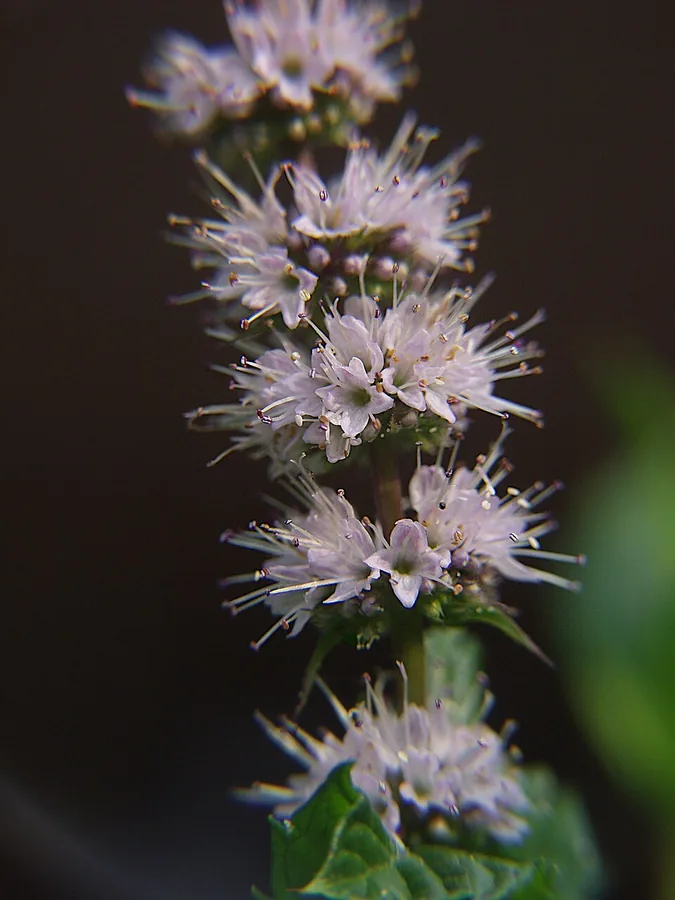
Cut often, spearmint stays short, full, and thick with tender young leaves. Left uncut, the stems stretch tall and bare and finally lift slender flower spikes into the summer air, at which point the leaves turn tougher and lose their edge. Picking the tips early and often keeps the plant leafy and fresh right up to the first hard frost.
Care
The short version: spearmint takes full sun to light shade, wants soil kept evenly moist and never bone dry, and stays contained so its runners cannot spread. Pinch the growing tips often to hold its low, leafy shape.
Light
Spearmint colors up and stays compact in full sun, which packs its leaves with the aromatic oils behind the scent. It also holds up in partial shade, useful in hot regions where afternoon cover keeps the leaves from wilting and drooping.
Water
Keep the soil evenly moist and never let it dry out, since the leaves flag and go limp the moment the plant is thirsty. Watering every 2 to 4 days keeps the foliage firm, with more in a heat wave or in a container, which dries out fast.
Soil
Spearmint roots into rich, loamy soil thick with organic matter that stays damp without turning to mud. A pH of 6.0 to 7.0 suits it, right around neutral.
Temperature
The plant grows fastest and greenest between 59°F and 77°F (15°C to 25°C). When the cold sets in, the top growth withers and dies back to the roots, and fresh shoots break the soil again in spring.
Humidity
Air of 40% to 70% keeps the leaves plump and healthy. In dry air spider mites move in and stipple the foliage pale, so a moist root zone and the odd misting keep the leaves fresh in a hot, dry spell.
Feeding
A single feed of balanced fertilizer or compost in spring keeps the foliage deep and full. Hold back on nitrogen, though, since an excess pushes soft, sappy growth and thins the oils that scent and flavor the leaves.
Pruning
Pinching and harvesting the tips keeps the plant low, dense, and thick with leaves instead of tall and bare, and a hard cut after flowering forces a flush of new shoots. Nip off the flower spikes as they rise, because once a stem blooms its leaves coarsen and fade in flavor.
Repotting
In a pot, spearmint is moved on every 1 to 2 years, or sooner once rootbound, with the clump split as you go. Roots winding tight around the pot edge, soil that drains almost instantly, and leaves shrinking in size all show it has outgrown the container.
Size & spacing
Spearmint stands 12 to 24 inches (30 to 60 cm) tall in a leafy column, but the runners carry it wider, spreading 24 to 35 inches (60 to 90 cm) across. Give it that width, or a container, so the spreading stems do not lean into nearby plants.
When to plant
Spearmint is a hardy perennial that endures the cold of zones 5 through 9, vanishing to bare soil in winter and re-emerging as green shoots each spring. Set plants out in spring once hard frost has passed, pick the leaves through the season, and pinch off the summer flower spikes to keep the foliage sweet.
Northern hemisphere
Southern hemisphere
Typical months for a temperate climate: start earlier in warm zones, later where spring frosts linger.
- Sow: Late winter to early spring (though division/cuttings are more reliable than seed)
- Plant: Spring, after danger of hard frost
- Harvest: Harvest leaves throughout the growing season; pinch off flower spikes in summer to preserve leaf quality
Hardiness
USDA hardiness zones: 5–9
Temperature: down to -29°C
Troubleshooting
For all its vigor, spearmint shows only a few troubles, marked on the leaves and stems themselves: a rust disease, a couple of hot-weather pests, and the runners that carry it too far. Match what you see below and step in early, while the fix is still simple.
Orange, rusty pustules speckling the leaf undersides
Those raised orange-brown specks are mint rust, a fungus that erupts on the undersides of leaves and along the stems when the foliage stays wet and crowded. Pick off every spotted leaf and bin it rather than composting, then thin the growth so air moves through. A leaf-covered clump cut back to the ground pushes up clean, unmarked shoots.
Fix:
- Remove and destroy infected foliage (do not compost)
- Improve air circulation by thinning crowded growth
- Avoid overhead watering to keep foliage dry
- Cut back severely affected plants to ground level
Dusty, stippled leaves wrapped in fine webbing
The pale flecking and the thin webbing across the leaves are the work of spider mites, which swarm the foliage in hot, dry air and suck it dry until it looks bleached. A hard jet of water strips them off, and moist soil with raised humidity leaves them nowhere comfortable to feed. A heavy infestation gives way to insecticidal soap.
Fix:
- Rinse foliage with a strong spray of water
- Raise humidity and keep soil moist
- Apply insecticidal soap if severe
New shoots breaking ground far from the parent plant
Fresh green shoots surfacing well away from the clump trace back to underground runners threading out beneath the soil. Hemming them in is the only lasting fix, whether a sunken bottomless pot, a bed of its own, or a root barrier sunk at least 30 cm deep. Any escaped runner is dug out before it takes root.
Fix:
- Grow in a buried bottomless container or dedicated bed
- Sink physical root barriers 30+ cm deep
- Dig out and remove escaped runners promptly
Small, sparse leaves rising from a matted clump
Leaves that shrink and thin out point to a clump packed solid with tangled roots and runners that has worn out its center. Lift the mat, tear off the vigorous outer pieces, replant them in fresh soil, and throw away the woody middle. Splitting it every two to three years keeps the leaves large and plentiful.
Fix:
- Divide the clump and replant healthy sections
- Refresh soil and discard the woody center
Toxicity
Spearmint is a culinary herb people eat without concern, so the leaves are safe at the table. What makes them potent is the essential oils packed into the foliage, which can give cats, dogs, and horses a mild stomach upset if they eat a large amount, so keep grazing pets away from a whole plant.
Toxic to
Cats · Dogs · Horses · Rabbits · Livestock · Birds
Safe for
People
Cats Mild
A cat nibbling a leaf or two comes to little harm, but a big mouthful of the oil-rich foliage can bring on drooling, vomiting, and loose stools.
Dogs Mild
A dog that chews down a quantity of the leaves may get an upset stomach, some vomiting, and diarrhea that clears on its own.
Horses Mild
A horse grazing a large amount can pick up a mild bellyache and soft droppings from the concentrated oils in the leaves.
Rabbits Caution
A rabbit can take a few leaves now and then, but the strong oils packed in the foliage rule it out as a full meal.
Livestock Caution
Goats, sheep, and cattle seldom seek the pungent leaves out, and a light browse does little harm, though a gut full of them loosens digestion.
Birds Caution
Most birds pass over the strongly scented leaves, so only a token amount suits them, since the oils are stronger than a small body wants.
People Safe
For people the leaves are a familiar kitchen herb eaten for centuries, safe in teas, sauces, and salads at everyday culinary amounts.
Normal culinary amounts of spearmint leaf used in food are not a concern; the risk relates to ingestion of large quantities of the plant or concentrated essential oils.
Helpline numbers

United States
ASPCA Animal Poison Control: (888) 426-4435 (fee applies)

United Kingdom
Animal PoisonLine: 01202 509000 (fee applies)

Australia
Animal Poisons Helpline: 1300 869 738
Varieties
Most spearmint is the plain species, but a couple of named types stand apart in the look and texture of their leaves.
Mentha spicata 'Kentucky Colonel'
Its leaves are large and deeply crinkled, and they carry an unusually strong spearmint flavor that makes it the classic pick for juleps and the kitchen.
Mentha spicata var. crispa (Curly mint)
Its leaf edges are tightly ruffled and curled into a frilly, crimped texture, and the familiar clean spearmint aroma comes through undimmed.
How to propagate
Spearmint multiplies with almost no effort, and most growers ignore seed in favor of splitting a rooted clump or striking a leafy cutting.
DivisionEasy
Spring or autumn · 2 to 4 weeks
Division is the surest way to make more spearmint. In spring or autumn, an established clump is lifted to reveal its mat of runners, then pulled into sections that each hold a length of runner with its own roots and green shoots, and these are replanted at once. Each piece roots down and takes hold within 2 to 4 weeks.
Stem cuttingsEasy
Spring through summer · 1 to 2 weeks
A cut stem of spearmint roots almost on its own. From spring through summer, a healthy leafy tip is snipped and either stood in a glass of water or pressed into moist soil, where new roots push from the lower nodes within 1 to 2 weeks before it is potted on.
Myths
Mint stays harmless in the garden because it is only a small, leafy herb.
The size of the leaves says nothing about the reach of the roots. Spearmint spreads on runners hidden underground and can fill a whole bed in a season or two, so it belongs in a buried pot or behind a root barrier rather than loose in open soil.