Ornamental · Asparagaceae
Solomon's Seal
Polygonatum biflorum
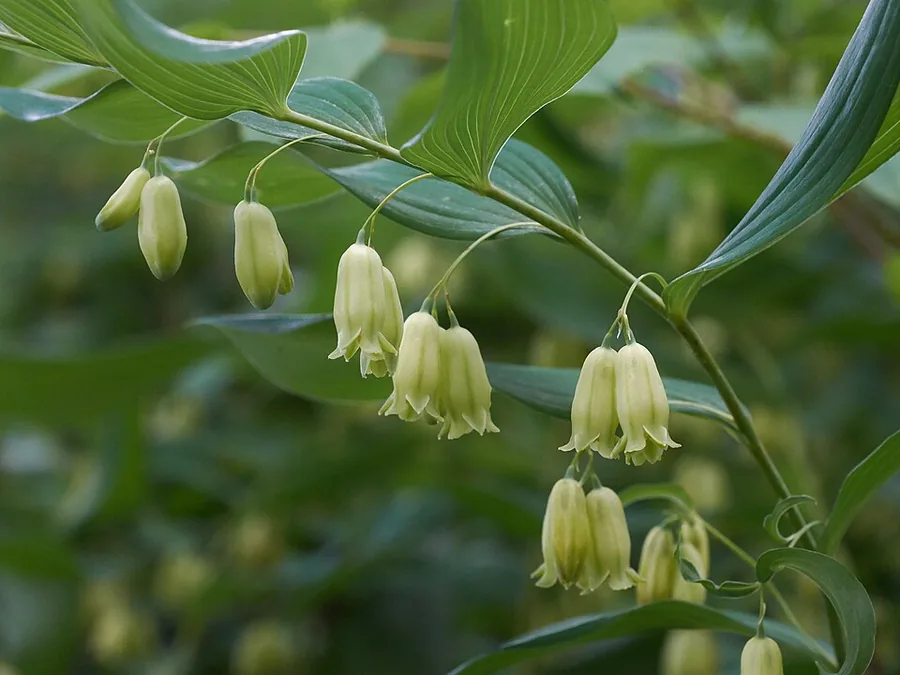
Each stem arches over in a long green curve, hanging paired, bell-shaped flowers in a row beneath it.
Full shade
Every 3–7 days
USDA 3–9
3–6 ft · 0.9–1.8 m
Overview
Solomon's seal grows as a run of long stems that rise and then bend into a smooth, arching green curve. Turn one over in spring and a row of small, bell-shaped flowers hangs from the underside in tidy pairs, one set after another down the length of the stem, held out of sight beneath the leaves. Underground, a thick rhizome creeps sideways, sending up more of these arching stems season by season.
The leaves run in a green line along the top of each arch, and it is their cover that keeps the flowers tucked below. Where the plant is happy, the stems stand shoulder to shoulder, and the whole clump reads as a series of matched green arches leaning the same way. It is a plant defined by that repeated curving shape more than by any single bloom.
After the flowers drop, small blue-black berries hang where the blooms once did, dark beads strung beneath the arching stems by late summer. Their deep, near-black color stands out against the green leaves above them. Only the young shoots are ever cooked and eaten, much as asparagus is, while the berries and the raw plant are left as they are.
Care
The short version: give it part to full shade and rich, humusy soil, keep that soil evenly moist, and let those green arches spread on their own.
Light
Solomon's seal is built for shade. In part to full shade its stems arch cleanly and its leaves hold a deep, even green, and it will take a little morning or filtered sun, but a hot, exposed spot leaves the stems thin and the leaves scorched.
Water
Keep the soil evenly moist, the way it stays under a layer of fallen leaves, and the stems arch full and firm. Water every 3 to 7 days in dry weather, more in heat. An established clump holds up through a short dry spell, though even moisture keeps the foliage from flagging.
Soil
Set it in rich, humusy, well-drained ground worked full of dark organic matter. It takes a pH anywhere from 5.5 to 7.0, so a loose, crumbly, compost-rich soil matters far more than the exact reading.
Temperature
This is a cold-hardy perennial to the core. The stems die back each year, but the rhizome below rides out winter lows near -40°F (-40°C) and summer highs up to about 86°F (30°C), then pushes up new arching shoots in spring.
Humidity
There is no humidity figure to chase. Everyday outdoor air suits it, and the plant simply looks its freshest in the cool, moist air of a shaded bed rather than in a dry, sun-baked corner.
Feeding
It feeds lightly. A balanced fertilizer in spring, or a dark top-dressing of compost worked in as the new shoots break ground, is all it needs, and in already rich woodland soil it may take nothing at all.
Pruning
There is little to cut. When the stems yellow at season's end, take them down to the ground in late fall or after frost, and leave the rhizome to send up fresh arches next spring.
Repotting
Solomon's seal is a long-lived clump that rarely needs lifting. Divide it only when the stems crowd together and thin out, or when the rhizomes start to surface and show above the soil.
Size & spacing
A full clump throws stems 3 to 6 feet (91 to 183 cm) tall that arch out to a spread of 2 to 4 feet (61 to 122 cm). Give each one that much room so the arches can spread their full length without tangling into the next.
When to plant
Solomon's seal is set out as divisions or plants rather than rushed from seed. Plant in spring or fall while the soil stays cool and damp, and by April and May the new stems arch up and hang their paired flowers underneath.
Northern hemisphere
Southern hemisphere
Typical months for a temperate climate: start earlier in warm zones, later where spring frosts linger.
- Plant: spring or fall
- Harvest: April to May
Hardiness
USDA hardiness zones: 3–9
Temperature: down to -40°C
Troubleshooting
Solomon's seal runs into few problems, and the two that show up leave clear marks on the plant itself. One chews visible holes in the leaves; the other shows in thin, stretched stems. Match the look of the damage below and trace it to its cause.
Thin, stretched stems with sparse leaves
Stems that grow thin and stretched, with sparse foliage, point to too much sun or dry, spent soil. In a hot, open spot the leaves scorch and yellow before their time. Move the plant into part to full shade, mulch and water for even moisture, and dig compost into the tired ground.
Fix:
- Move or plant in part to full shade
- Mulch and water to keep soil evenly moist
- Amend soil with compost or organic matter
Ragged holes eaten out of the leaves
The ragged holes are the feeding marks of slugs and snails, which come out at night into the cool, damp shade this plant grows in. Silvery slime trails across the leaves and soil confirm them. Pick them off after dark, put out iron phosphate bait, and clear the leaf litter and standing moisture where they shelter.
Fix:
- Hand-pick slugs in the evening
- Use iron phosphate slug bait
- Reduce excess moisture and remove debris near plants
Toxicity
This is a low-risk plant, though not a harmless one. Only the young shoots are cooked and eaten, while the blue-black berries and the raw plant hold saponins and anthraquinones that upset the stomach. Those dark berries are the real concern, so keep them away from children, cats, dogs, and grazing animals.
Toxic to
Cats · Dogs · Horses · Rabbits · Livestock · Birds · People
Cats Mild
A cat that bites the leaves or swallows one of the dark berries may drool, vomit, or pass loose stools. The plant is not on the ASPCA toxic list and the risk stays low, but the berries are the part to keep out of reach.
Dogs Mild
A dog that chews a leaf or picks up a fallen berry usually gets no more than mild stomach upset and a short bout of diarrhea. It seldom turns serious, though the saponins in the plant are reason enough to stop a repeat.
Horses Mild
Horses tend to pass over the bitter foliage, and a small mouthful usually settles with only mild gut upset. The dark berries hold the concentrated trouble and are best kept out of reach.
Rabbits Mild
A rabbit that nibbles the leaves or berries can end up with soft stools and a sour stomach. No part of this plant should go to a rabbit as forage.
Livestock Mild
Grazing animals usually walk past it, and the bitter taste holds their intake down. The saponins and anthraquinones can still bring on mild digestive upset if a hungry animal eats through a patch.
Birds Mild
Wild birds strip the ripe berries and scatter the seed, but a pet bird is far smaller and can react badly to the same fruit. Keep cage birds away from both the berries and the leaves.
People Caution
Only the young shoots are eaten, and only after cooking, the way some cuisines treat them like asparagus. The blue-black berries and the raw plant hold saponins and anthraquinones that bring on nausea and diarrhea, so the fruit is left alone and kept away from children.
Keep the ornamental berries away from pets and children; wash hands after handling.
Helpline numbers

United States
ASPCA Animal Poison Control: (888) 426-4435 (fee applies)
Poison Control: (800) 222-1222



Canada
Poison Centres: 1-844-764-7669
Varieties
Most gardens grow the plain green species, its stems and leaves an even green. A few named forms stand apart in their size or in the markings on their leaves.
Polygonatum biflorum var. commutatum
Giant or Great Solomon's seal is the tallest, its stout stems arching 3 to 7 feet tall and hanging up to 8 or more flowers together at each leaf joint.
Polygonatum odoratum var. pluriflorum Variegatum
This variegated form is grown for its leaves, each light green leaf cleanly edged in white, carried above fragrant flowers in the shade garden.
Polygonatum humile
Dwarf Solomon's seal is a low Asian species, its little arching stems reaching only about 8 to 12 inches, a miniature of the same form for a small shade bed or the front of a border.
Companions
Solomon's seal belongs in the shade garden, beside the moisture-loving woodland plants that share its cool, dappled corner.
Plant near
Ferns: Share the same moist, shady woodland conditions and contrast in texture.
Hostas: Thrive in the same rich, shaded soil and complement the arching habit.
Astilbe: Enjoys similar moist shade and adds flower color beneath the foliage.
Wild ginger: A low woodland groundcover that pairs well in cool, dappled shade.
How to propagate
Solomon's seal is simple to increase from the same creeping rhizome that builds its arching stems. Split a clump for quick results, or grow it slowly from the seed inside its ripe berries.
DivisionEasy
Spring or fall · 1 to 2 growing seasons
Division works off the creeping rhizome. In spring or fall, lift a clump and break or cut that thick rhizome into pieces, each carrying a growth bud. The new pieces root down and send up their own arching stems over 1 to 2 growing seasons.
SeedModerate
Fall (sown fresh) for cold stratification · 2 to 3 years or more
Seed comes from inside the ripe berries and asks for patience. Clean the seed out of the dark fruit and sow it outdoors in fall, so winter cold breaks its dormancy. Even then, the seedlings need 2 to 3 years or more to build into full arching stems.
Myths
True and False Solomon's seal look the same and are the same plant.
They are not. The two look close, but the flowers sit in different places. True Solomon's seal (Polygonatum) hangs its paired, bell-shaped flowers in a row beneath the arching stem, while False Solomon's seal (Maianthemum racemosum) carries its flowers, and later its berries, in a single plume at the very tip of the stem. That one difference in where the flowers sit tells them apart.
The dark berries of Solomon's seal are safe to eat.
They are not. The berries are inedible and mildly toxic, holding anthraquinone that brings on vomiting and diarrhea if swallowed. Their deep, near-black color catches a child's eye, so they are worth pointing out.