Ornamental · Plantaginaceae
Snapdragon
Antirrhinum majus
Each snapdragon bloom sits like a small hinged jaw on a tall, densely flowered spike.
Full sun
USDA 7–10
0–3 ft · 0.2–0.9 m
Overview
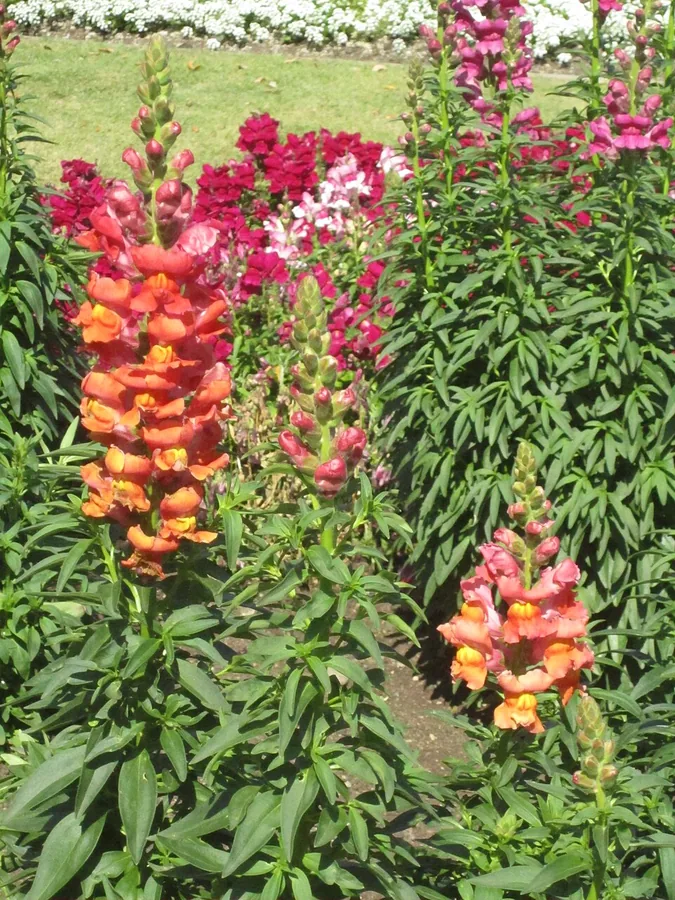
Run a finger up a snapdragon and the flowers crowd the stem in a tall, dense spike, each bloom a pouched shape with two lips that press together. Pinch a flower at the sides and those lips part and close like a small jaw, the movement that names the plant. The spike carries color in nearly every shade but true blue, stacked bloom above bloom.
The plants themselves range widely in scale, standing anywhere from ankle height to knee or waist height, on a narrow, upright frame. Low dwarf forms sit compact and close to the ground, while the tallest send up long, straight flowering stems well above the foliage. A trailing kind breaks the upright pattern, rising only a little before its stems tip over and spill downward.
Set against the flowers, the foliage stays green and upright along the stems. The blooms come in a broad sweep of color, from pale to deep and saturated, everything except a true blue. The flowers are edible and sometimes eaten fresh, though the taste runs bitter.
Care
The short version: snapdragon wants full sun, rich soil kept evenly moist and free-draining, and steady deadheading of the faded, browning blooms to keep new ones opening. It flowers in the cool of spring and fall, and heat halts the spike.
Light
In full sun the flowering spikes stand upright and stay densely packed with bloom. Grown in shade, the stems stretch pale and lanky and the flowers thin out, so an open, bright position holds the plant compact and colorful.
Water
Snapdragon roots want evenly moist soil and show drought quickly. Water poured at the base keeps the leaves dry, and dry leaves stay clear of the rust and Botrytis that spot and fuzz the foliage.
Soil
The plant roots into rich, well-drained soil near neutral pH. A loose, moisture-holding ground that never turns to muck keeps the stems firm and the foliage green.
Humidity
Average
Feeding
A single feeding of all-purpose fertilizer in spring, as the new shoots push up, carries the plant through. More feeding does little for a cool-weather grower like this one.
Pruning
Snipping off the spent, browning flowers clears the spike for fresh buds and keeps new blooms opening. Cutting away any spotted or blackened growth at the same time leaves the plant clean-stemmed.
Size & spacing
The stems rise 6 to 36 inches (15 to 91 cm) tall depending on the form, on a narrow upright frame. Set 6 to 10 inches (15 to 25 cm) between plants so air slips between the leaves and keeps them dry.
When to plant
Snapdragon colors up in cool weather, not heat. Set the plants out in early spring after the last frost, or in fall where winters stay mild around USDA zone 8 and warmer, and the spikes open through the cool of spring and autumn before the flowers thin out in summer heat.
Northern hemisphere
Southern hemisphere
Typical months for a temperate climate: start earlier in warm zones, later where spring frosts linger.
- Plant: Early spring after the last frost, or in fall in mild zones (about USDA zone 8 and warmer)
- Harvest: Blooms in cool weather of spring and fall (and summer in cool climates); flowering slows in summer heat
Hardiness
USDA hardiness zones: 7–10
Temperature: down to -18°C
Troubleshooting
Most of what goes wrong on a snapdragon shows on the leaves and stems, so look closely there first. The lowest foliage and the base of the stems tell the earliest story, in spots, pustules, and fuzzy growth. Match the marks you see below before they spread up the spike.
Yellow flecks on the leaf tops, dark dust beneath
These marks are snapdragon rust: pale yellow flecks scattered across the upper leaf, with dark brown, powdery pustules ringed in yellow massed on the undersides. It builds when leaves stay wet for 6 to 8 hours in cool 55°F to 70°F (13°C to 21°C) weather and fades once heat passes 80°F (27°C). Pick off and bag the spotted leaves, keep the foliage dry, and start with rust-resistant cultivars.
Fix:
- Remove and bag affected leaves
- Apply a labeled systemic fungicide if severe
Twisted, yellow leaves with gray fuzz below
Downy mildew shows as leaves gone distorted and yellow, their undersides coated in a grayish spore growth, usually carried in on infected plugs. A plant marked this way cannot be cleaned up and is best pulled and destroyed. Look closely at new plants before they go in, keep water off the leaves, and leave space for air.
Fix:
- Remove and destroy infected plants
Tan cankers and gray fuzz on the stems
This is Botrytis gray mold, seen as tan, sunken cankers on the stems and a soft gray fuzz over decaying tissue, worst where humid air sits still around packed plants. Cut out the cankered stems and any rotting growth, then open the planting so air moves through. Watering low at the base keeps the stems and leaves dry and holds the fuzz back.
Fix:
- Remove and destroy infected plant parts
- Improve air circulation
Blooms thin and drop off in the heat
This is not a mark of disease but the plant reading the weather: snapdragon is a cool-season grower with little tolerance for heat, so the spikes stop setting new flowers once temperatures hold above about 80°F (27°C). Cut the stems back and keep the soil moist. Many plants push fresh spikes again as autumn cools.
Fix:
- Cut plants back and keep them watered; they may rebloom as temperatures cool
Toxicity
Beyond its looks, snapdragon is safe to have close at hand: the ASPCA lists garden snapdragon as non-toxic to cats, dogs, and horses. The flowers are edible for people, if bitter. Nothing about the plant poses a risk to a curious pet or child.
Safe for
People · Cats · Dogs · Horses · Rabbits · Livestock · Birds
Cats Safe
The ASPCA lists garden snapdragon as non-toxic to cats, so a leaf taken in a curious bite does no harm.
Dogs Safe
For dogs the plant is safe, and a torn leaf or bitten flower is harmless, though a bellyful of any plant can turn a stomach for a day.
Horses Safe
Horses can crop the foliage without harm, since the ASPCA records no toxicity for them.
Rabbits Safe
A rabbit nibbling the leaves takes no harm, so a plant within reach is no threat.
Livestock Safe
Cattle, goats, and sheep can graze the plant safely, as it carries no known toxin for grazing animals.
Birds Safe
Birds pecking at the open blooms or ripening seed meet no toxin in snapdragon.
People Safe
The flowers are edible and turn up fresh as a garnish, though the flavor runs bitter, and the whole plant is safe around children.
Varieties
Snapdragons sort mostly by how tall the flowering spikes stand, from low and compact to long-stemmed. These are the main forms and the shapes they take.
Dwarf (such as Floral Showers, Snapshot)
Compact, ground-hugging plants that top out at 6 to 10 inches, their short spikes sitting low and tight.
Medium (such as Liberty Classic, Snaptastic)
Mid-height plants reaching roughly 12 to 22 inches, with spikes standing clear above the leaves.
Tall or Rocket (such as Rocket, Potomac, Madame Butterfly)
Long-stemmed forms rising 24 to 60 inches, sending up straight, tall flowering spikes cut for the vase.
Trailing (such as Candy Showers)
A spilling form that lifts only about 6 inches before its stems tip over and trail to roughly 12 inches.
How to propagate
Snapdragon grows almost entirely from seed, started in cool weather, with the seedlings rising slowly before they flower.
SeedModerate
Sow in cool weather for spring or fall display · Several weeks from germination to transplant size
Snapdragon comes almost entirely from seed sown in cool weather, and the seedlings inch up slowly, needing several weeks to reach transplant size. Pinching out the soft growing tips of the young plants forces them to branch, so more flowering stems rise from each plant. The result is a fuller, more many-spiked plant.
Myths
Snapdragons stand in the garden as perennials year after year.
Antirrhinum majus is a short-lived tender perennial, and most growers replant it each year as an annual. The crown survives only in mild climates, roughly USDA zone 7 and warmer, where winters stay gentle enough to leave it intact.
Snapdragon blooms are poisonous to pets.
The ASPCA lists garden snapdragon as non-toxic to cats, dogs, and horses, so a chewed leaf or flower brings no harm. The same blooms are edible for people, if on the bitter side.
Snapdragon spikes flower thickest in summer heat.
The spikes fill in during the cool of spring and fall, not the heat. Once summer sets in, fewer and fewer flowers open until milder weather returns.