Herb · Lamiaceae
Shiso
Perilla frutescens
Broad, fragrant leaves in deep red-purple or bright green keep coming all summer for pickles, garnishes, and wraps.
Full sun
Every 2–4 days
59–86°F · 15–30°C
70–90 days
Overview
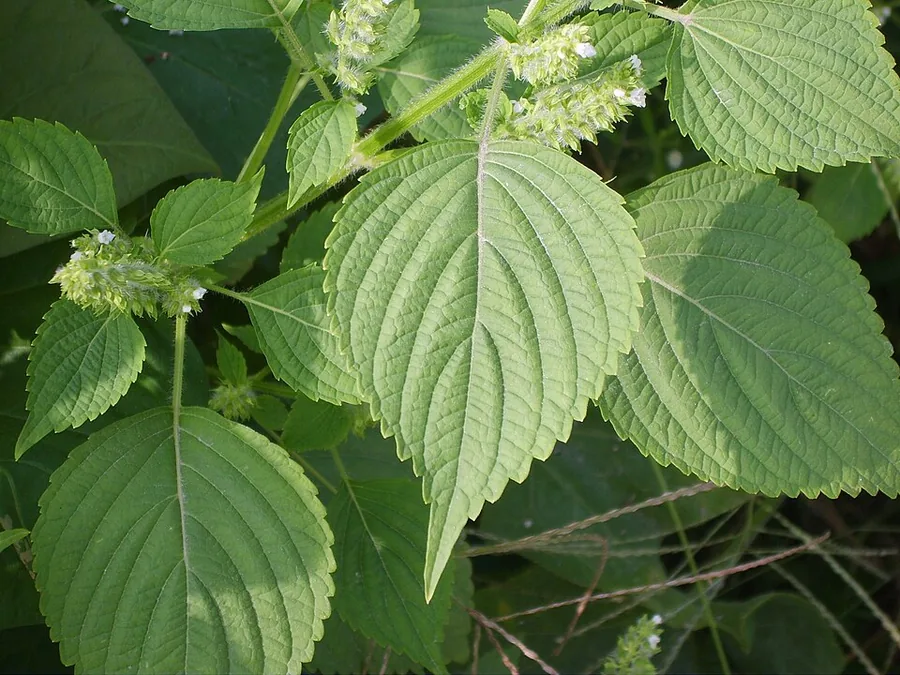
Shiso is a leafy member of the mint family, and up close its broad, fragrant leaves are the whole point rather than the flowers. Over a single warm season it grows from seed into a bushy, knee-high plant thick with foliage. Those aromatic leaves fill kitchens across Japan, Korea, and Vietnam, used fresh, pickled, and folded around food.
The leaves themselves vary sharply from form to form. Red shiso carries deep red-purple leaves heavy with anthocyanins, the green kind shows flat, bright green blades, and the ruffled types crinkle into two-toned leaves that run green above and purple beneath. Each looks distinct, yet all of them grow the same way.
Two changes in the plant's look tell you what it is doing. As it bolts, slim flower spikes rise at the tips and the fresh leaves come in small and tough instead of broad and tender. Left to seed, those spikes scatter offspring far and wide, and the same fragrant plant holds a documented poison to grazing cattle and horses.
Care
The short version: full sun to light shade, soil kept evenly moist, and steady pinching so the plant stays leafy and tender instead of running up flower spikes.
Light
Shiso colors up best in full sun, where the red forms deepen to their fullest red-purple and every leaf carries its strongest aroma. It holds up in partial shade too, useful where hot afternoon light would scorch and brown the foliage.
Water
Keep the soil evenly moist but never waterlogged, roughly every 2 to 4 days in warm weather, because the broad thin leaves go limp fast in dry heat. Let it dry to the point of stress and the plant runs up flower spikes early, and the new leaves shrink and toughen.
Soil
Set shiso in rich, well-drained loam dark with organic matter, the kind of crumbly, moisture-holding ground its fast leafy growth draws on. A slightly acidic pH between 5.5 and 6.5 keeps it feeding well.
Temperature
Shiso holds its lush, broad-leaved form across 59°F to 86°F (15°C to 30°C) and fills out fastest in real summer heat. Frost blackens and kills it outright, so it waits indoors until the cold is fully gone.
Humidity
Ordinary humidity of 40% to 60% keeps the leaves plump and unblemished, close to what summer air already holds. Air moving freely over the foliage matters more than any exact figure, since still, damp air spots the leaves.
Feeding
A monthly feed through spring and summer, with a balanced fertilizer or diluted liquid feed, keeps the broad leaves coming in fresh and green. Hold back on nitrogen, since a heavy dose puffs the leaves soft and thins their aroma.
Pruning
Pinch the growing tips and shiso branches out low and bushy, pushing a flush of small tender leaves from every break. Snap off the slim flower spikes the moment they rise so the plant pours its energy back into broad leaves instead.
Repotting
Grown fresh from seed each year, shiso rarely sees a repot. In a pot, roots circling the walls, leaves wilting fast, and early flower spikes show the plant has filled its space and is ready to be replaced or moved up.
Size & spacing
A mature plant stands 18 to 35 inches (45 to 90 cm) tall in a leafy column and spreads 12 to 18 inches (30 to 45 cm) wide. Set each one that far apart so air slips between the dense foliage and the leaves stay clean.
When to plant
Shiso is a warm-season plant with no defense against frost. Its tiny seeds start indoors 6 to 8 weeks before the last frost, the young leafy plants move outdoors once the cold has passed and the soil has warmed, and the broad leaves come off all summer while the rising flower spikes are pinched away to keep them coming.
Northern hemisphere
Southern hemisphere
Typical months for a temperate climate: start earlier in warm zones, later where spring frosts linger.
- Sow: 6 to 8 weeks before the last spring frost; surface-sow and do not cover, as seed needs light to germinate
- Plant: After all danger of frost has passed and soil has warmed in late spring
- Harvest: Harvest leaves through summer once plants are established; pinch flower spikes to prolong harvest. Late-summer flowering and seeding is when perilla-ketone concentration and livestock-poisoning risk peak.
Hardiness
USDA hardiness zones: 2–11
Temperature: down to -46°C
Troubleshooting
Nearly everything that goes wrong with shiso is written on the leaves, whether they are pocked by pests or shrinking and toughening as the plant flowers. Reading those leaves early keeps the tender growth coming. Match the look of the damage below, then act on it.
Slim flower spikes at the tips as the leaves shrink and stiffen
This is bolting, and it shows as narrow flower spikes climbing from the growing tips while the new leaves arrive small, tough, and short on aroma. Shortening days, heat, or stress set it off. Pinch the spikes out the instant they rise, harvest more often to draw the plant back into leaf, and start a second sowing so broad tender leaves keep coming.
Fix:
- Pinch out flower spikes as soon as they appear
- Harvest leaves more frequently to encourage vegetative growth
- Make successional sowings for a continuous supply of tender leaves
Small seedlings unfurling all over, far from the parent plant
Once the flower spikes ripen into seed, shiso becomes a self-sowing weed, and fresh seedlings unfurl across the garden and well past its edges. In parts of the country it has spread into pastures and along woodland edges, so the seed travels far. Cut the flower spikes before they ripen, lift the young volunteers while their roots are shallow, and never compost or dump seeding plants where they can take hold in the wild.
Fix:
- Remove flower spikes before seed set
- Pull volunteer seedlings while young
- Do not compost or dump seeding plants where they can naturalize
A peppering of tiny round holes punched through the young leaves
Those clean little pits are flea beetle damage, chewed by small dark beetles that spring off the leaf the moment a hand nears. They work the softest, newest tissue, so the youngest leaves come up riddled first. Tent seedlings under a row cover until the foliage thickens and toughens, strip out nearby weeds, and keep growth fast so fresh leaves replace the pocked ones.
Fix:
- Cover young plants with floating row cover until established
- Remove nearby weed hosts
- Apply an approved insecticidal product only if damage is severe and the crop is not being harvested for food within the label interval
Leaf edges chewed into ragged scallops with a silver trail across them
The scalloped, ragged margins are the mark of slugs and snails, which crawl over the leaves at night and rasp away the soft edges. By morning a dried, silvery ribbon of slime glints across the foliage and soil. Go out after dark to lift them off, pull back thick mulch at the base, and water less so the ground dries between drinks.
Fix:
- Hand-pick at night
- Set out shallow traps and remove mulch harboring slugs
- Use iron-phosphate baits where appropriate
Toxicity
Those fragrant leaves are a safe, treasured kitchen herb for people, so the plate holds no danger. Inside the same tissue, though, Perilla frutescens carries perilla ketone, a lung toxin that brings severe, often fatal breathing trouble to horses and cattle that graze it, worst of all in late summer as the plant flowers and seeds. Keep it well away from pastures, hay, and grazing animals.
Toxic to
Cats · Dogs · Horses · Rabbits · Livestock · Birds
Safe for
People
Cats Mild
A cat that nips a leaf may leave a little drool on its chin or have a briefly unsettled stomach, but nothing worse is likely. Watch a cat that chews the foliage and keep fresh water within reach.
Dogs Mild
A dog that mouths a leaf might drool or pass a loose stool that clears on its own. Draw a curious dog away from the leaves and it should be fine.
Horses Toxic
A horse that grazes perilla can drop into severe respiratory distress, its sides heaving as it breathes fast and open-mouthed while fluid floods the lungs. The damage is swift and often fatal, so keep horses well away from the plant, above all once its flower spikes seed in late summer.
Rabbits Caution
Because perilla ketone strikes the lungs of grazing mammals, a rabbit that chews the leaves faces a real hazard, not a treat. Keep the foliage off its menu and offer greens known to be safe.
Livestock Severe
Cattle, goats, and sheep that graze perilla mint can heave into acute respiratory distress, panting open-mouthed as atypical interstitial pneumonia sets in and perilla ketone floods the lungs. The danger crests in late summer while the plant flowers and seeds, and the outcome is often fatal. Strip it from pastures and hay before animals reach it.
Birds Caution
Cases in birds are thin on record, but the same lung toxin runs through the foliage, making shiso a poor choice around poultry or pet birds. Keep them clear of the leaves and seed heads to be safe.
People Leaves safe
Shiso's fragrant leaves are a kitchen staple across East Asia, eaten fresh, pickled, and laid down as a garnish, and they are safe for people. The toxin that harms grazing animals stays a danger in the pasture, not on the plate.
Safe to handle and harvest for cooking; the concern is ingestion by grazing livestock, not skin contact.
Helpline numbers

United States
ASPCA Animal Poison Control: (888) 426-4435 (fee applies)

United Kingdom
Animal PoisonLine: 01202 509000 (fee applies)

Australia
Animal Poisons Helpline: 1300 869 738
Varieties
Shiso's forms are told apart mostly by the leaves themselves, from deep red-purple to flat green to crinkled bicolor, and which you grow depends on color for pickling or fresh leaves for the plate.
Red/Purple shiso (akajiso)
Its leaves are a deep red-purple all through, saturated with anthocyanins, the very pigment that lets it color and flavor pickles such as umeboshi.
Green shiso (aojiso)
Its leaves are flat and bright green with a milder citrus-anise scent, laid fresh on the plate as a herb and garnish.
Bicolor / ruffled (chirimen) types
Its leaves crinkle and ruffle into two tones, green across the top and purple underneath, at home in the kitchen and the ornamental bed alike.
How to propagate
Shiso rises easily from tiny seed, and once those first leafy plants mature they scatter seed that comes up on its own for years, often more thickly than expected.
SeedEasy
Start indoors 6 to 8 weeks before last frost, or direct-sow after the soil warms in late spring · 2 to 3 weeks to germinate and several more weeks to reach harvestable size
Shiso comes up readily from its tiny seed, started indoors 6 to 8 weeks before the last frost or dropped straight onto warm soil in late spring. Press the seed onto the surface and leave it bare, since light is what wakes it, and a cold spell beforehand rouses it more evenly. Give it 2 to 3 weeks to break the surface and a few weeks more to build broad pickable leaves, after which its own seed keeps it coming for years.
Myths
Because people eat the leaves, the whole plant must be harmless to every animal.
The fragrant leaves are safe on the plate, yet the same tissue in Perilla frutescens holds perilla ketone, a documented cause of fatal lung poisoning in grazing cattle and horses. What is safe to eat is not safe to graze.
Shiso keeps to the patch where it was set.
Its ripe seed says otherwise, and the plant has spread as an invasive weed across the southeastern and central United States, seeding into pastures and woodlands. Cutting the flower spikes before the seed sets keeps it from wandering.