Ornamental · Onocleaceae
Sensitive Fern
Onoclea sensibilis
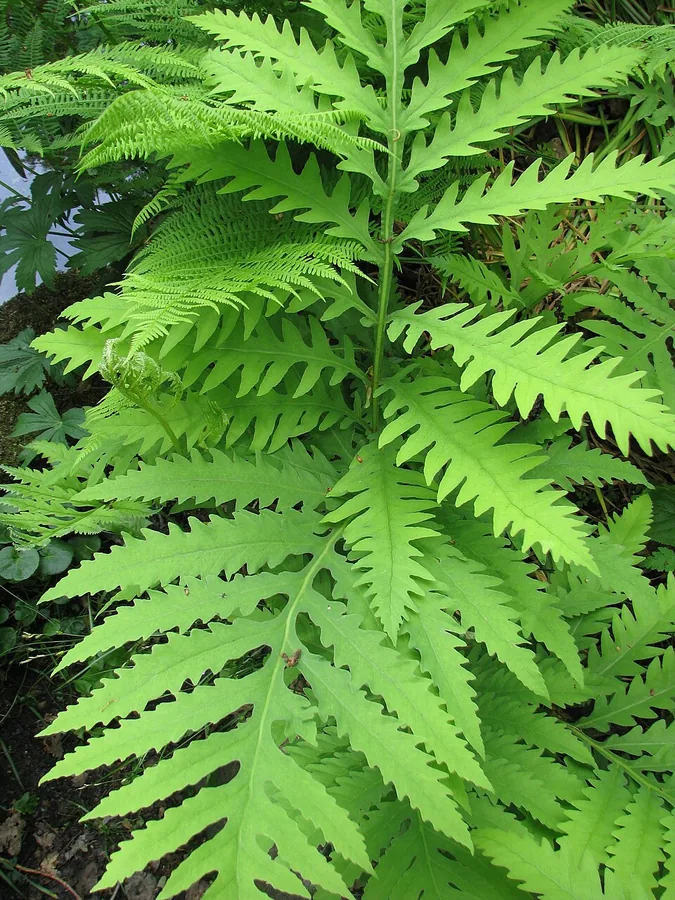
Broad, coarsely cut green fronds rise over stiff bead-like fertile stalks, the two faces of the sensitive fern.
Partial shade
Every 2–4 days
USDA 2–10
12–35 in · 30–90 cm
Overview
Two kinds of frond define the sensitive fern up close. The sterile fronds are broad and green, cut into wide, coarse segments that give the leaf a solid, almost sculpted weight instead of a fine, lacy edge. They are the green fronds that die back at the first autumn frost. Set among them, the fertile fronds tell a different story.
The fertile fronds are the source of the second name, bead fern. They stand stiff and upright, lined with tight, bead-like segments that hold their shape and persist through winter after the soft green fronds have gone. Together the two forms make a plant that reads as broad and leafy, fuller in texture than the delicate ferns it is often mistaken for.
Below the soil, creeping rhizomes run outward and push up fresh fronds at a distance from the parent clump, so a single plant becomes a spreading patch of the same broad, coarse foliage. In moist ground the colony fills in quickly, each new frond matching the same coarsely cut green as the last.
Care
The short version: the sensitive fern wants shade and rich, moist soil that never dries out, with enough water to keep the root zone damp, and either open ground for its rhizomes to run or a barrier to hold the coarse green colony in place.
Light
The broad green fronds hold their best color in partial to full shade. In full sun they only keep that look with the roots in constantly wet soil, and without it the coarse blades scorch and brown at the edges under hot afternoon light.
Water
As a wetland plant, it must never dry out at the root. Kept evenly moist to wet, with water every 2 to 4 days in ordinary garden soil, the fronds stay firm and green. On a pond edge or in a bog the ground itself supplies the water.
Soil
The roots take hold in rich, moist, organic ground, and the plant grows just as well in heavy clay or soil that floods now and then. A slightly acidic pH of 5.0 to 6.5 suits it, though the moisture in the soil counts for far more than the reading.
Temperature
The fronds and rhizome together span an extreme range, from -49°F to 86°F (-45°C to 30°C), hardy from zone 2 to zone 10. The soft green fronds blacken and fall at the first hard frost, while the rhizome sits unharmed below the surface through winter.
Humidity
The coarse fronds keep their fresh green in damp air, around 50% to 80%, the sort found in the shaded, moist places it grows. In dry, exposed air the margins crisp and curl and the whole frond looks tired.
Feeding
The plant needs almost no feeding to hold its full, leafy form. A light spring topdressing of compost or leaf mold is plenty, and in rich soil even that is skipped, since extra feeding only pushes more of the spreading growth to contain later.
Pruning
Little cutting is called for. The dead fronds are cut back once they collapse and blacken at the first hard frost, or left and cleared in early spring before new growth appears, and any tattered or scorched fronds come off through the season.
Repotting
This is not a container plant. The clump is lifted and divided in spring every few years, once the fronds crowd small and tight and the rhizomes push well past the original patch.
Size & spacing
A mature plant stands 12 to 35 inches (30 to 90 cm) tall, its broad fronds reaching a spread about as wide. Divisions go 24 to 35 inches (60 to 90 cm) apart, and the rhizomes carry the foliage steadily outward from there.
When to plant
As a hardy perennial, the fern returns each year from the rhizome rather than racing the frost. New plants go out in spring once the ground can be worked, and crowded clumps, their fronds growing smaller and packed together, are lifted and divided in spring or early fall.
Northern hemisphere
Southern hemisphere
Typical months for a temperate climate: start earlier in warm zones, later where spring frosts linger.
- Plant: spring
Hardiness
USDA hardiness zones: 2–10
Temperature: down to -46°C
Troubleshooting
Almost every problem shows on the fronds first, and almost all of it comes back to dry soil. Watch the color and the curl of the margins, and the reach of new fronds across the ground, and you can read the plant's state at a glance. Match what you see below.
Fronds yellowing, browning, and curling in summer
The color change signals drought stress, the one thing this wetland fern will not take. Starved of moisture, the frond margins curl inward and turn crisp and brown, worst where hot afternoon sun strikes them. Deep watering, a layer of organic mulch, and a move into shade in hot climates bring back the firm green.
Fix:
- Water deeply to keep soil consistently moist
- Apply organic mulch to conserve moisture
- Move to part or full shade in hot climates
- Remove withered fronds
New green fronds rising across the bed
Fresh fronds appearing well away from the parent are the mark of spread by creeping rhizomes, running unseen through the moist soil. Each new shoot brings up the same broad, coarse foliage and can close over gentler neighbors. A deep root barrier, division of the runners in spring, or a rain garden or pond edge each hold the colony in check.
Fix:
- Install a deep root barrier
- Dig and divide or remove spreading rhizomes in spring
- Confine to contained or naturalized areas
Fronds blackening and folding after the first frost
The sudden collapse is normal seasonal dieback, the trait that names the fern. The soft green sterile fronds blacken and fold the moment frost touches them, while the rhizome stays firm and alive below ground. The blackened fronds are cut away, and new green rises again in spring.
Fix:
- No action needed; cut back the dead fronds
- Rhizome regrows new fronds the following spring
Toxicity
For a household with pets and children, the plant is reassuring: a true fern with no toxin in its fronds or spores, safe to touch and to plant bare-handed. The one real point is its spread, not its chemistry, since the coarse foliage keeps pushing outward.
Safe for
People · Cats · Dogs · Horses · Rabbits · Livestock · Birds
Cats None
A true fern the ASPCA lists as non-toxic, so a cat mouthing the coarse green fronds takes no harm. A large bite of the fibrous blade may bring mild stomach upset, as any rough plant matter can.
Dogs None
The fronds hold no toxin, so dogs are safe around them. A determined chewer working at the tough, fibrous blades may get loose stool from the fiber, and nothing more.
Horses None
Nothing in the plant poisons a grazing horse. The broad fronds are coarse and stiff to the bite, unappealing enough that horses pass them by in normal pasture.
Rabbits None
Rabbits can nibble the fronds without harm. Only small amounts suit them, since a sudden pile of any fresh green can upset a sensitive gut.
Livestock None
No toxic compounds threaten cattle, goats, or sheep. The tough, fibrous fronds are hard, dry chewing with little appeal, so grazing animals rarely seek them out.
Birds None
Poultry and other birds peck at it safely. The stiff, bead-like fertile fronds hold spores through winter, and some wild birds work them apart to reach them.
People None
The fronds and spores carry no known hazard to the skin, so planting and dividing the plant bare-handed is safe. It is not a food plant, so there is no reason to eat the coarse foliage.
Handling the fronds and spores poses no known contact hazard to people; the risk is from ingestion by grazing animals, especially fern mixed into horse hay.
Helpline numbers

United States
ASPCA Animal Poison Control: (888) 426-4435 (fee applies)

United Kingdom
Animal PoisonLine: 01202 509000 (fee applies)

Australia
Animal Poisons Helpline: 1300 869 738
Varieties
There is little to choose from here, and no loss in that. The plain wild species, with its broad, coarsely cut green fronds, is the plant almost everyone grows.
Onoclea sensibilis (species)
This plain wild species is almost always the plant grown, valued for its broad, coarsely cut green fronds and the odd, stiff, bead-like fertile fronds that named cultivars rarely improve on.
How to propagate
The creeping rhizomes that carry the fern outward also make it simple to multiply, since each length of rhizome can be cut apart and grown on into a new clump of the same broad foliage.
DivisionEasy
Early spring or fall · 1 to 2 seasons
Division is the simplest route, best in early spring or fall. A crowded clump is lifted, and the creeping rhizomes are cut into lengths that each keep a growing point, then set straight back into moist soil. Held damp, the pieces root and push up fresh broad fronds over the next one to two seasons. Spores sown on a moist sterile mix will also grow the fern, but that route is slow and fiddly next to a clean split of the rhizomes.
Myths
The sensitive fern folds up when you touch it, like a Mimosa.
The broad green fronds stay completely still under a hand and show no movement at all. The name points to their sensitivity to frost, since the sterile fronds blacken and die back the moment the first autumn cold arrives, not to any response to touch.
A fern in the garden will take over and smother everything around it.
It does spread, but at a pace you can follow. The creeping rhizomes push the coarse foliage through moist soil and can close over neighbors in time, so a root barrier or a contained, naturalized patch holds the fronds in bounds without much work.