Ornamental · Plumbaginaceae
Sea Thrift
Armeria maritima
Slim bare stems lift round pink globes above a tight green cushion of grassy leaves.
Full sun
Every 7–14 days
USDA 4–8
6–12 in · 15–30 cm
Overview
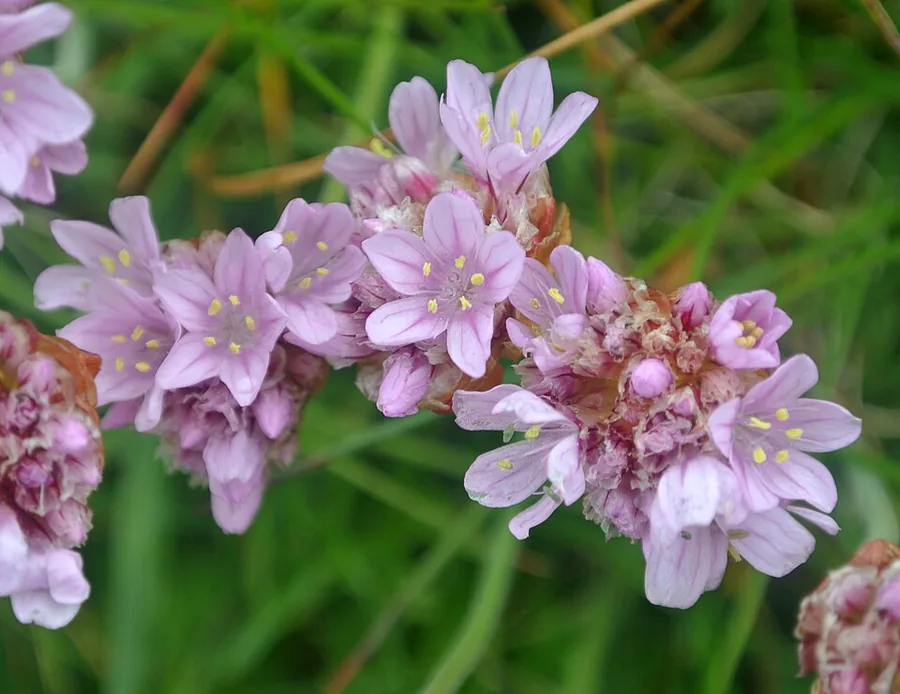
Up close, sea thrift is a dense little hummock of foliage. Its leaves are narrow and grassy, packed tight into a low green cushion that stays leafy the year round. From that mound, slender leafless stems shoot straight up in spring, each ending in a tight, rounded head of tiny flowers in pink to white. The whole plant stands only 6 to 12 inches, so the flower globes hover just above the foliage.
The flower heads are the eye-catcher. Each is a small, tightly rounded globe of bloom, lifted clear of the leaves on a slim bare stalk. In the wild pink form the color reads as a soft rose, while named kinds carry white or a deeper rose-red. Beneath them the grassy cushion keeps its neat, close-cropped mound rather than sprawling.
Its texture is what sets it apart at close range. The many narrow leaves overlap into a low, even carpet of green, fine and grassy, that holds its color straight through winter across much of its range. Season on season the mound broadens slowly, always staying compact and evenly rounded.
Care
The short version: full sun, lean sharply drained soil, and a sparing hand with water and feed keep the green cushion tight and the pink globes coming for years.
Light
Full sun brings the most flowers and keeps the cushion dense and tight. In partial sun or light shade the plant survives, but the green mound loosens and opens, and fewer of the pink globes rise above it.
Water
Once established, sea thrift stands up to drought and rots in wet ground. Water every 7 to 14 days, letting the soil dry out completely in between. Left too wet, the crown at the center of the cushion softens and rots.
Soil
The plant wants lean, gritty, fast-draining soil, sandy or stony to the touch. A pH of 6.0 to 7.5 suits it. Rich or heavy clay ground stays wet around the roots and destroys the plant.
Temperature
Sea thrift is hardy across -29°F to 86°F (-34°C to 30°C), and hard cold leaves the evergreen cushion untouched. Its true weakness is warm, damp air, which harms it far more than any frost.
Humidity
Sea thrift holds up best in dry, moving air and struggles in muggy, still conditions. No humidity figure applies, but stagnant damp settles on the leaves as mildew, so each cushion needs open space around it.
Feeding
Sea thrift takes almost no feeding. A light feed in spring is plenty, and rich ground rots the heart of the cushion, hollowing it from the center out. Poor, hungry soil keeps it firm and whole.
Pruning
Cutting away each spent flower stem in full can draw out a few later blooms. The evergreen leaves stay put through fall, though, since shearing the cushion to the ground thins the next spring's flowering.
Repotting
Sea thrift is renewed by division every 2 to 3 years, not by potting on. The sign to watch for is a woody, bare patch spreading at the center of the cushion as flowering thins. Lifting and splitting the clump brings back fresh, leafy growth.
Size & spacing
Grown out, the plant is a rounded mound near 6 to 12 inches (15 to 30 cm) tall and about as wide. Set individual plants close to that distance apart so the cushions grow together into an even sweep without packing tight and sealing in damp air.
When to plant
Sea thrift keeps a cool-season timing. Seed goes in during late winter, young plants set out in spring after frost, and the rounded pink heads open through April and May on their fresh stalks, with a scattered few appearing again into summer and fall.
Northern hemisphere
Southern hemisphere
Typical months for a temperate climate: start earlier in warm zones, later where spring frosts linger.
- Sow: late winter to early spring
- Plant: spring after last frost
- Harvest: mid to late spring (April-May) with sporadic summer/fall rebloom
Hardiness
USDA hardiness zones: 4–8
Temperature: down to -34°C
Troubleshooting
Almost every trouble with sea thrift starts with soil that stays too wet, and it shows on the plant itself. Sharp drainage heads off most of it. When a change appears in the leaves, stems, or crown, match what you see to the cause below and act before rot spreads into the center.
A browned, caved-in patch at the center of the mound
This is crown rot, the most common way sea thrift dies, and you can read it in the plant: the middle of the mound browns and sinks while the ring around it stays green. It comes from a wet core, held soggy by heavy clay, over-rich soil, or a long, damp fall. Lift the clump, cut out the dead heart, and replant the living green edge in gritty, lean soil that drains fast.
Fix:
- Lift and divide the clump, discarding the dead center
- Replant healthy outer divisions in lean, gritty, very well-drained soil
- Reduce watering
A slumping, wilted cushion in wet ground
Here the damage is root rot, and the plant droops even while the soil sits wet. Ease a clump out and the roots come away soft and darkened. Shift it into gritty soil that drains fast, hold back the water, and let the cushion firm up again.
Fix:
- Improve drainage
- Withhold water
- Move or replant in gritty, fast-draining soil
Sticky, curled shoot tips or leaves bitten full of holes
Two pests leave marks you can see. Aphids mass along the stems, leaving the young tips sticky and curled and glossy with residue, while slugs and snails bite ragged holes in the leaves and lay shining slime trails across them. Wash the aphids off with a hard jet of water or treat them with insecticidal soap, and handpick or trap the slugs once darkness falls.
Fix:
- Rinse aphids with a strong stream of water or use insecticidal soap
- Hand-pick or trap slugs and snails
A powdery white bloom filming the leaves
That dusty white film on the leaves is powdery mildew, a fungus that spreads when the air is humid and the plants sit crowded. Open the spacing so air passes over the foliage, strip the worst-coated leaves, and keep the leaves dry. Grown in full sun with fast drainage, the foliage usually stays clean.
Fix:
- Improve air circulation
- Remove affected foliage
- Avoid overhead watering
Toxicity
There is nothing hazardous hidden in sea thrift: it is not toxic. No reference marks its leaves, stems, or flowers as poisonous to people, animals, or livestock, so a stray nibble does no harm. A wash of the hands after handling is precaution enough.
Safe for
People · Cats · Dogs · Horses · Rabbits · Livestock · Birds
Cats None
Sea thrift carries no toxic rating for cats, so a curious mouthful of its grassy leaves does no harm. As with any plant, a large helping might bring a brief, mild bout of stomach upset.
Dogs None
No part of sea thrift, leaf, stem, or flower head, is poisonous to dogs. A dog that swallows a good deal of the foliage may get a passing stomach ache, and nothing more.
Horses Safe
Sea thrift is on no toxic list, so horses come to no harm from it. Its low tuft of narrow leaves offers little for a horse to graze in any case.
Rabbits Safe
Rabbits can nibble the grassy foliage of sea thrift safely, since it holds no toxins. Even so, no single garden plant should make up their whole diet.
Livestock Safe
Cattle, goats, and sheep are not poisoned by sea thrift, which has no toxic rating. Its low, grassy cushion barely rises off the ground and seldom tempts a grazer.
Birds Safe
Sea thrift is harmless to birds. Nothing in its narrow leaves, bare stems, or round flower heads can hurt them.
People Safe
Sea thrift is not rated poisonous to people, so its leaves and flowers are safe to handle. Rinse your hands after working the soil, as with any plant.
Generally safe to handle; wash hands after gardening as a routine precaution.
Varieties
Beyond the wild pink, a few named forms change what the plant shows off, the color of the flower globes or the tint of the leaves. You will find these few for sale most often.
Alba
Alba shows pure white globes in place of pink, the same rounded heads in a cleaner color.
Splendens
Splendens deepens the flower to a rich rose-pink, its rounded heads riding high over the green foliage.
Rubrifolia
Rubrifolia tints its narrow leaves a reddish-purple, a dark foliage that throws the pink flowers into relief.
Vindictive
Vindictive is compact and thick with rose-red flowers, long held to be one of the finest forms grown.
How to propagate
Sea thrift can be increased three ways. The choice comes down to what you are after: a quick result, plenty of extra plants, or an exact copy of one you like the look of.
DivisionEasy
Spring · One growing season
Dividing in spring is the most reliable increase, and it also rebuilds an old, hollowing clump. Throw away the woody dead center of an aged plant and reset the leafy outer pieces, which knit back into a full cushion over one growing season.
SeedEasy
Sow in spring or fall · Generally flowers in the second year
Seed sprouts readily whether sown in spring or fall. The young plants stay leafy without flowering at first, since most hold their first globes back until the second year.
Stem cuttingsModerate
Summer · Several weeks to a few months
Basal cuttings taken in summer reproduce a plant leaf for leaf and flower for flower. They are slower and more particular than division, striking over several weeks to a few months.
Myths
Sea thrift is short-lived and always dies back after a few years.
The look of a dying plant misleads. In lean, sharply drained soil and full sun, sea thrift holds its cushion for many years. What seems like a short life is nearly always crown rot hollowing the center from wet or over-rich ground, not a natural end. Keep the drainage sharp and the mound stays whole and green for years.