Ornamental · Poaceae
Northern Sea Oats
Chasmanthium latifolium
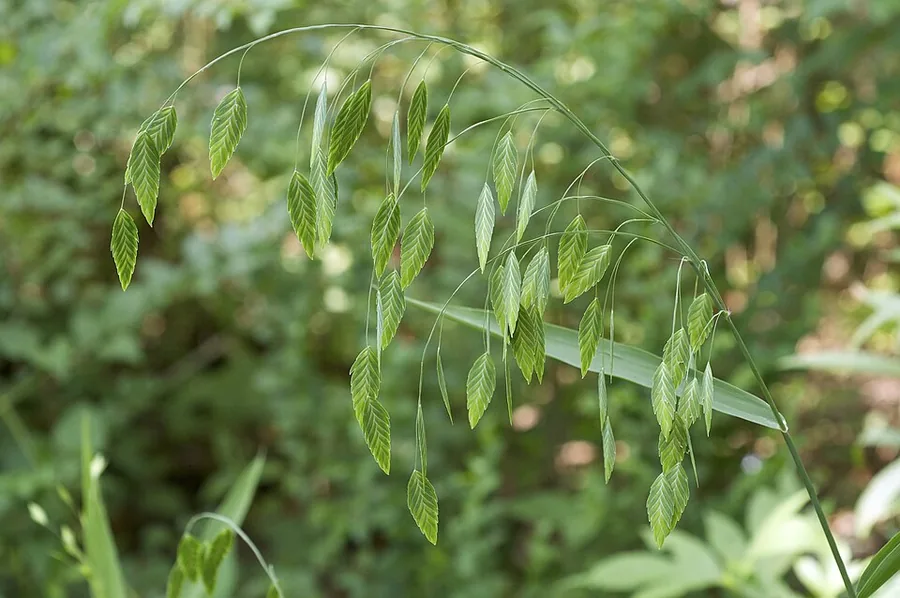
Broad blue-green blades and flat, layered oat-like seed heads that swing from arching stems, greening in summer and bronzing into winter.
Partial shade
Every 3–7 days
USDA 3–9
2–5 ft · 0.6–1.5 m
Overview
Northern sea oats is a clumping grass with broad, flat blades in a soft blue-green, arching outward from a dense tuft. Its standout feature hangs above the foliage: flat, layered seed heads shaped like plump oats, each one a stack of overlapping spikelets dangling from a slender arching stem. They sway at the lightest breath of air, held out and down from the plant on thin, wiry stalks.
The color shifts through the season. The seed heads open a fresh green in summer, then deepen to a coppery bronze as they mature, and finally dry to a pale tan. In that dried, papery state they cling to the arching stems and hold their shape well into winter, long after the blades have faded.
Up close, the plant reads as layers of flat, tiered detail: the wide green blades below, the arching stems above, and the flattened, scale-stacked heads catching the light at the tips. A clump builds to a rounded, arching mound, 2 to 5 feet (60 to 152 cm) tall, its outline all soft curves and drooping seed heads rather than stiff upright spikes.
Care
The short version: those broad blue-green blades and flat, layered seed heads look their best in part shade with steady moisture, though the plant tolerates most light and soil. The clump is cut to the ground in late winter, and the seed heads are removed before they drop to limit self-seeding.
Light
The broad blades run from full sun to full shade, a wide reach for a grass. In part shade they hold their deepest, greenest color and the clump looks fullest. Under hot full sun the same leaves pale and crisp at the edges unless the water keeps up.
Water
Those wide, flat blades want consistently moist soil, kept nearer wet than dry. The plant stands in wet ground and even short flooding without the leaves suffering. In full sun the blades dry and brown faster, so that soil should stay damper.
Soil
The roots take hold in clay, loam, sand, or heavy wet ground that turns other plants to mush. Average to moist, fertile, well-drained soil grows the lushest, broadest blades. No particular pH shapes the color or the growth.
Temperature
The clump endures a punishing span, from -40°F to 100°F (-40°C to 38°C). The top growth dies back to a pale, dry tuft in deep cold, then pushes fresh green blades again each spring.
Humidity
Plain outdoor air keeps the blades in good condition, so humidity is no factor here. What shows on the foliage is soil moisture, especially the dampness held at the roots through summer heat.
Feeding
As a light feeder, the plant needs little to color up its blades. An optional small feeding of balanced fertilizer or compost in spring is enough, and richer soil only pushes out more blades and more spreading growth.
Pruning
The whole clump is cut to the ground in late winter to early spring, clearing the faded tan blades and stems before new green appears. Cutting off the seed heads before they ripen strips away the ripe, seed-heavy stalks that would otherwise scatter.
Repotting
This grass lives in the ground, not a pot. The parallel task is dividing the clump every few years, once the tuft thickens and the center dies back to a bare, thinning patch.
Size & spacing
A mature clump forms an arching mound 2 to 5 feet (60 to 152 cm) tall and 12 to 30 inches (30 to 76 cm) across. The broad blades and dangling heads need room to arch, and the tuft creeps a little wider than that each year.
When to plant
Watch the plant change through the year. Sown in late winter to spring after a cold, moist chill, and set out in spring after frost or in fall, it saves its show for the seed heads, which emerge green in late summer and shift through bronze to tan as they persist across winter.
Northern hemisphere
Southern hemisphere
Typical months for a temperate climate: start earlier in warm zones, later where spring frosts linger.
- Sow: Late winter to early spring; seed benefits from cold-moist stratification before sowing
- Plant: Spring after frost, or fall
- Harvest: Flowers August to September; showy flat oat-like seed heads emerge green in summer, turn coppery-bronze then tan and persist into winter
Hardiness
USDA hardiness zones: 3–9
Temperature: down to -40°C
Troubleshooting
Northern sea oats stays clear of serious pests and diseases, so the visible troubles are two: the plant multiplies and crowds outward, and its broad blades brown and bleach in dry sun. Match the look you see below to its cause.
Fresh grassy seedlings dotting the soil
The flat, layered seed heads are the source: as a prolific self-seeder, the plant drops ripe grain well past the parent tuft, and short rhizomes push the clump wider, fastest in moist, fertile soil with some sun. Cut off the heavy seed heads before they ripen, lift the slim young volunteers while they slide out of the soil, and split the clump to shrink the spreading tuft.
Fix:
- Cut and remove the seed heads before they ripen and drop to stop new seed
- Pull or dig out unwanted volunteer seedlings while young; they pull easily
- Divide and reduce the clump to contain rhizomatous spread
- Keep stalks cut down low to gradually starve out an established colony
Broad blades browning and bleaching in midsummer
The pale, crisped edges are leaf scorch, drawn out of the wide blades by hot, dry, full sun with too little water at the roots. Blades in part shade with steady moisture stay green and firm. Water sun-grown clumps deeper and more often, mulch to hold the dampness in the soil, and move the most scorched tufts into dappled shade.
Fix:
- Provide more frequent, deeper watering for sun-grown plants
- Apply mulch to conserve soil moisture
- Site or transplant into part shade with moist soil for best appearance
Toxicity
For all its bold looks, this grass is not poisonous. Neither the broad blades nor the flat seed heads carry toxins that would harm cats, dogs, horses, livestock, birds, or people. Two small points remain: a pet that eats a lot of the foliage may have a brief stomach upset, as any grass can cause, and grass pollen can bother sensitive people.
Safe for
People · Cats · Dogs · Horses · Rabbits · Livestock · Birds
Cats None
Safe for cats to be near. A cat that chews down a lot of the broad blades may bring the green back up, the same harmless reaction any grass causes.
Dogs None
Not poisonous to dogs. A big mouthful of the flat blades can bring on a little vomiting, no worse than a chew of lawn grass.
Horses Safe
Safe for horses, the broad blades holding no toxins if they crop a little in the pasture.
Rabbits Safe
Rabbits can nibble the tender blades without harm. As with any new green, ease them onto it so their gut adjusts.
Livestock Safe
Cattle, goats, and sheep can graze the leaves and stems freely, with no compounds in them to cause trouble.
Birds Safe
Safe for birds, and many pick apart the ripe, flat seed heads for the small grain packed inside.
People Safe
The blades and seed heads pose no danger to people. Only the grass pollen matters, and it can set off allergies in sensitive noses.
As with any grass, pets that nibble a lot of foliage may vomit or have mild stomach upset, and grass pollen can be an allergen for sensitive people; the plant itself is not poisonous.
Varieties
The plain species carries solid blue-green blades, but one named selection wears a strikingly different coat.
River Mist
River Mist trades the plain species' solid blue-green for blades striped lengthwise in crisp white and green, and it carries whitish rather than green seed heads, a paler, frostier version of the same flat, layered form.
How to propagate
Two easy methods multiply the plant, and it starts the first for you by scattering its own seed.
SeedEasy
Sow in late winter to spring; cold-moist stratification improves germination · One to two growing seasons
The flat seed heads ripen a small grain that sows in late winter to spring, best after a cold, moist chill. The plant sheds so much viable seed that the easy route is to dig up the slender volunteer seedlings it raises on its own and move them, and a young tuft broadens to full size over one to two growing seasons.
DivisionEasy
Spring or early fall · One growing season
An established tuft is dug and pulled apart in spring or early fall, each piece a wedge of blades and roots. This makes new clumps and thins a spreading one, and every division roots down within a single growing season.
Myths
Northern sea oats is the protected dune grass it is illegal to pick at the beach.
The two look nothing alike and share only a name. This broad-bladed woodland grass is Chasmanthium latifolium, with its flat, oat-shaped heads on arching stems. The protected coastal plant is a separate, unrelated species, true sea oats (Uniola paniculata), a stiffer dune grass many coastal states make it illegal to collect. Growing the inland kind breaks no rule.