Shrub · Pittosporaceae
Japanese Pittosporum
Pittosporum tobira
An evergreen shrub of glossy leathery leaves and small creamy flowers that scents the spring like orange blossom.
Full sun
Every 7–14 days
USDA 8–10
8–13 ft · 2.4–4 m
Overview
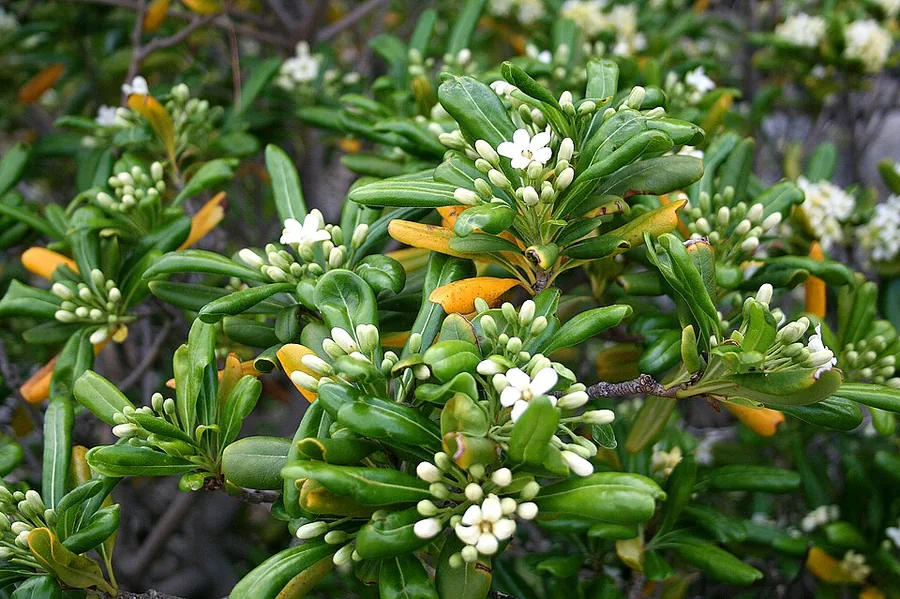
Japanese pittosporum builds itself from glossy, leathery leaves in a deep gray-green, each one firm and smooth to the touch, packed so thickly that the fast growth reads as a dense, rounded wall of foliage. In late spring the tips break into clusters of small creamy flowers, five little petals apiece, that pour out a strong orange-blossom scent. That fragrance is the whole reason for the name mock orange, though the plant has no tie to the true mock orange.
Up close the shrub is all texture and toughness. The same firm leaves that give it its polish also let it shrug off drought, heat, and salt spray once it settles in, whether the stems stand in full sun or deep shade, and it holds its glossy surface across most soils that drain. Sheared, the cut face knits back into a tight, even skin of leaves; left alone, the branches pile into a soft green mound.
Given its head it thickens into a large shrub, climbing toward 8 to 13 feet (2.4 to 4 m) with an even broader spread of packed foliage. Dwarf forms shrink the same leathery leaves onto low, compact frames. Later in the season the spent flowers give way to seed capsules that split to show sticky seeds, the one weakness underneath being roots that cannot bear to sit wet.
Care
The short version: those glossy leathery leaves hold up from full sun to shade, take deep but infrequent watering once established, and keep their shine in any soil that drains; the plant is sheared after flowering and kept out of soggy ground.
Light
Those firm leaves hold their color from full sun to full shade. The flowering is heaviest and the foliage packs densest in sun, yet even in a shady corner the glossy leaves stay put where thinner-leaved shrubs would grow gappy and bare.
Water
The shrub drinks deeply but infrequently, with the top half of the soil left to dry between soakings. Once established the thick, leathery leaves ride out drought with ease, and the real danger runs the other way, since soggy, poorly drained soil rots the roots fast and drops the whole plant.
Soil
Almost any well-drained soil keeps the leaves glossy, be it clay, sand, or loam, across a pH from 6.0 to 7.5. Drainage is the single hard rule, because standing water at the roots is what kills this plant.
Temperature
It holds its evergreen leaves across a wide range, from about 10°F to 100°F (-12°C to 38°C), so the foliage stays firm and green through mild winters and unscorched through summer heat.
Humidity
Plain outdoor air suits it and no target number applies. Air movement counts for more, since still, damp conditions around the packed leaves invite the leaf spot and sooty mold that mar their surface.
Feeding
One spring feed of a balanced general-purpose shrub fertilizer keeps the leaves deep and glossy. On high-pH soils, micronutrient shortfalls such as magnesium can show as yellowing between the leaf veins, and correcting them restores the even green.
Pruning
The shear comes right after the spring flowers fade, since next year's buds form on old growth and a late cut takes them off. The plant takes hard clipping without dieback, and the cut face soon closes back into a smooth, tight skin of leaves as a hedge or a trained small tree.
Repotting
A potted plant moves to a fresh, larger container every 2 to 3 years. The cues are roots circling the surface or pushing out the drainage holes, water running straight through, and growth stalling as the leaves lose their vigor.
Size & spacing
Left unpruned it builds to 8 to 13 feet (2.4 to 4 m) tall with a spread of 4 to 18 feet (1.2 to 5.5 m) of packed foliage, so it needs real room as a screen or hedge. Dwarf cultivars carry the same leathery leaves on far smaller frames for tight spots.
When to plant
Pittosporum is an evergreen for warmer gardens, hardy roughly in zones 8 to 10, so the leathery leaves stay on the branch year round. New plants go out in spring or fall while the weather is mild, and the small creamy flowers open in late spring, around April and May.
Northern hemisphere
Southern hemisphere
Typical months for a temperate climate: start earlier in warm zones, later where spring frosts linger.
- Plant: spring or fall in mild climates
- Harvest: late spring (April-May)
Hardiness
USDA hardiness zones: 8–10
Temperature: down to -12°C
Troubleshooting
Pittosporum is a tough, firm-leaved shrub, and most of its troubles show first on the foliage or in the roots, either as a dark film and sticky honeydew from pests or as slack, yellowing leaves over rotting roots. Read the close-up signs below against what the plant shows, and step in before the damage spreads.
Firm green leaves going slack and yellow all over
When the firm leathery leaves go slack and yellow all at once and the whole shrub sags, the cause underground is root rot in soil that stays too wet. Pittosporum will not stand wet feet, and once the roots turn dark and soft they seldom firm up again. Stop the water and open up the drainage, and lift out any plant whose roots have already gone to mush.
Fix:
- Improve drainage and stop overwatering immediately
- Remove and discard severely affected plants, as root rot is often lethal
- Replant healthy stock in a well-drained site where water does not accumulate
A black sooty crust dulling the glossy leaves and stems
A dull black crust spreading over the usually glossy leaves is sooty mold, and it grows only on the surface. Aphids, cottony cushion scale, or mealybugs feed above and leave the sticky honeydew the mold clings to. A full coat of horticultural oil smothers the insects, and once they are gone the black film rinses off to bare the leathery green shine underneath.
Fix:
- Spray plants thoroughly with horticultural oil to smother scale, mealybugs, and aphids
- Repeat applications as directed and wash off sooty mold once pests are controlled
- Hose off light aphid populations with a strong stream of water
Discrete spots breaking the smooth green leaf surface
Small spots and blotches that break the smooth green surface of the leaves are fungal or bacterial leaf spot, and they take hold where the foliage stays damp and packed close. Thinning the plant so air moves through, watering low at the base, and stripping the most marked leaves clears it up. The lesions stay skin-deep and cosmetic, never a threat to the shrub.
Fix:
- Improve air circulation by thinning and proper spacing
- Avoid overhead watering and keep foliage dry
- Remove and dispose of badly spotted leaves
Toxicity
Pittosporum is not on the list of seriously poisonous plants, but the plant is not a snack. The leathery leaves, the stems, and the sticky seeds all hold saponins that irritate the gut, so an animal that bites into them may drool and turn queasy. No part is grown to be eaten, so keep it clear of curious mouths.
Toxic to
Cats · Dogs · Horses · Rabbits · Livestock · Birds · People
Cats Mild
A cat that bites into the leathery leaves may drool, vomit, or turn from its food for a while. The saponins in the leaf are the cause, and the upset eases on its own once the plant sits out of reach.
Dogs Mild
A dog that chews the firm foliage or the sticky seed pods tends to drool and get an unsettled stomach. It seldom turns serious, though a large mouthful can bring on a rough day of vomiting.
Horses Caution
A horse rarely reaches for it, yet the same saponins packed in the leaves can unsettle the gut if a bored animal browses the shrub. Keeping it clear of paddocks avoids the risk.
Rabbits Caution
The leathery leaves are no rabbit forage. Their saponins can leave a rabbit with a sore stomach, so the plant is best kept off the menu.
Livestock Caution
Cattle, goats, and sheep usually pass over the tough foliage, but a hungry animal stripping the leaves would take on the same digestive irritation. A fence keeps it off grazing land.
Birds Caution
Wild birds pick out the sticky seeds without harm, but the saponins in the foliage make it a poor choice for pet birds, so it is not offered.
People Caution
No part of the plant is grown to be eaten, and the saponins in the leaves and seeds can leave a person queasy if swallowed. Small children are kept from putting any part in their mouths.
No part of the plant is meant to be eaten; the saponins make even a curious nibble unpleasant, though it is not life-threatening in small amounts.
Helpline numbers

United States
ASPCA Animal Poison Control: (888) 426-4435 (fee applies)
Poison Control: (800) 222-1222



Canada
Poison Centres: 1-844-764-7669
Varieties
A few named forms turn up far more than the plain species, set apart mostly by the color and edging of their leaves and by how tightly they pack onto a small frame. These are the ones worth a close look.
Variegata
Each gray-green leaf is bordered by an uneven band of creamy white, so the whole plant reads brighter and more marbled than the plain species.
Wheeler's Dwarf
A low, rounded mound of a dwarf that holds at about 2 to 3 feet (60 to 90 cm), needs almost no pruning, and packs its foliage tight for low borders and foundation plantings.
Cream de Mint
A dense little cultivar whose small mint-green leaves are outlined with a thin rim of creamy white.
How to propagate
Pittosporum is easy to multiply, and cuttings taken from its firm, partly ripened stems are the usual route since they root willingly and keep a cultivar true.
Stem cuttingsEasy
Mid-July to September · Several weeks to a few months to root
Firm, partly ripened stems make the easiest new pittosporum. Cut semi-hardwood pieces from mid-July through September, dip the raw ends in rooting hormone, and press them into a 50/50 blend of peat and perlite kept under high humidity. The cuttings root willingly, sending out new roots over several weeks to a few months.
SeedModerate
When ripe seed is available · Slow; weeks to germinate and longer to reach planting size
The sticky ripe seeds can also raise the species when they are on hand. It is the slower course, with the seeds taking weeks to germinate and far longer to swell into a plant of any size, and the seedlings will not hold a named cultivar true the way cuttings do.
Myths
Japanese pittosporum is the same plant as true mock orange.
The two share a name and nothing more. Pittosporum tobira picked up the label mock orange because its small creamy flowers give off an orange-blossom scent, yet it belongs to the family Pittosporaceae and has no relation to the true mock orange, Philadelphus. They are separate shrubs from separate families whose blooms simply happen to smell alike.