Ornamental · Polygonaceae
Mountain Fleece
Persicaria amplexicaulis
Give it steady moisture and room to spread, and mountain fleece lifts slim red bottlebrush spikes from June to frost.
Full sun
Every 3–7 days
USDA 4–7
3–4 ft · 0.9–1.2 m
Overview
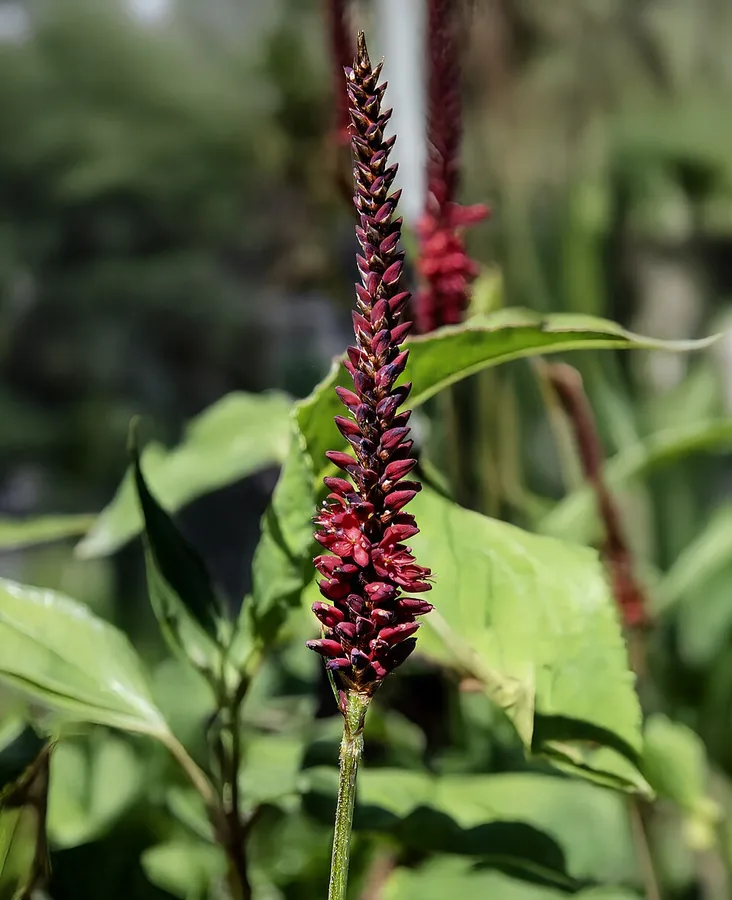
Mountain fleece is a tough, easygoing perennial built around one striking feature: from June into October it lifts slim, red bottlebrush spikes on tall stems above a low, tidy mound of green foliage, and the color barely lets up. Each spike is a narrow, upright column of tiny crowded flowers that reads crimson to rose-red from a distance. It belongs to the knotweed family yet grows into a restrained clump that broadens slowly rather than running.
The plant forms a dense green clump at the base, sending its flowering stems up to waist height at 3 to 4 feet, with the clump spreading just as wide. It roots into average to wet soil, holds up in full sun where the ground stays moist, and takes part shade in stride. Hardy to zone 4, the top growth dies away each winter and the crown pushes up fresh green shoots each spring.
The upkeep is light. The spent stems are cut to the ground in late winter, a tired clump is split every few years, and the tender new growth is worth checking for aphids and slugs. Deer and rabbits pass the tough spikes by, leaving the red-spiked stand to stand clean in a border or beside a pond.
Care
The short version: mountain fleece takes full sun to part shade in consistently moist soil. Cut the stems to the ground in late winter, split the clump every 3 to 4 years, and allow each plant 3 to 4 feet to fill out.
Light
Mountain fleece colors up best in full sun but takes partial shade or partial sun without complaint. Moisture is the one catch, since under full sun the soil must stay damp or the green foliage wilts through the heat of summer.
Water
This is a plant that wants water. Keep the soil consistently moist, watering roughly every 3 to 7 days and more often in hot weather or strong sun. It even holds its stand in wet ground and along the muddy margins of a pond.
Soil
Root it in average, medium to wet but well-drained clay or loam. It thrives in steadily damp ground that would rot fussier plants, and it is unfussy about pH, growing across a wide band from 6.0 to 8.0.
Temperature
Mountain fleece is strikingly cold-hardy, down to -29°F (-34°C), and comfortable up to about 86°F (30°C). The green top growth dies away in winter and pushes up fresh in spring, so a hard freeze is no threat to an established clump.
Humidity
Outdoor air brings whatever humidity the day holds, and the plant is untroubled by it. What it wants is moist roots under the clump, not damp air around the spikes.
Feeding
Feed with a light hand. A balanced general-purpose fertilizer or some compost worked into the soil at the start of the growing season in spring is usually plenty. Go easy, since too much nitrogen pushes out soft, floppy growth that aphids crowd onto.
Pruning
The whole plant is cut back to the ground in late winter or early spring to clear the way for fresh green shoots. Through summer, the spent brown spikes are snipped off to draw out more bloom and curb self-seeding.
Repotting
Mountain fleece is not a container plant, but the clump wants dividing every 3 to 4 years. Lift and split it when it loses vigor, hollows out and goes bare in the center, or throws fewer and smaller flower spikes.
Size & spacing
The flowering stems rise to 3 to 4 feet (91 to 122 cm) tall over a clump that spreads just as wide. Give each plant a matching 3 to 4 feet (91 to 122 cm) of room so the mound fills out without crowding its neighbors.
When to plant
Mountain fleece keeps a plain seasonal rhythm. Seed starts indoors in late winter, young plants go out in spring after the frost or again in early fall, and the red spikes rise and hold from June all the way to October.
Northern hemisphere
Southern hemisphere
Typical months for a temperate climate: start earlier in warm zones, later where spring frosts linger.
- Sow: Late winter to early spring (about 6-8 weeks before last frost)
- Plant: Spring after the last frost, or early fall
- Harvest: June to October
Hardiness
USDA hardiness zones: 4–7
Temperature: down to -34°C
Troubleshooting
Mountain fleece is a healthy plant with few real problems, so most of what shows up is a chewed leaf or a stem bent flat by a storm. Match the look of the damage below and step in early, while the fix is still simple.
Young leaves puckering and twisting beneath specks of soft insects
When the fresh shoots twist and pucker, tiny soft-bodied aphids are packed along the stems and leaf undersides, the pest this plant draws most. They cluster in green, black or gray masses, siphon the sap, and glaze the leaves below with sticky honeydew. A hard jet of water strips them off, insecticidal soap dissolves the thicker knots, and lady beetles and lacewings pick over what stays.
Fix:
- Spray plants with a strong jet of water to dislodge aphids
- Apply insecticidal soap or horticultural oil to affected growth
- Encourage natural predators such as lady beetles and lacewings
Leaf blades chewed down to a lattice of bare veins
Ragged holes and lacy, skeletonized patches mark two feeders at work. Japanese beetles gleam metallic copper-and-green as they graze the leaf between the veins in daylight, while slugs and snails rasp overnight and streak the soil with silvery slime. Drop the beetles into soapy water at first light, lay iron-phosphate bait for the slugs, and rake off the damp litter they hide beneath.
Fix:
- Hand-pick Japanese beetles in early morning and drop them into soapy water
- Set out slug and snail traps or iron-phosphate baits
- Remove debris and mulch that shelter slugs and snails
Slender flower stalks sprawled flat or cracked by storm winds
The slim, upright flowering stems stand tall enough that wind and heavy rain bow and snap them, and a broad clump splays worst of all. Broken stems trimmed off at a clean cut push fresh shoots. Grow-through supports or stakes hold an exposed clump upright, and a spot out of the strongest wind spares the stems the worst battering.
Fix:
- Remove broken stems with a clean cut
- Provide staking or grow-through supports for tall clumps
- Site plants in a location sheltered from strong wind
Fresh green seedlings dotting the soil around a broadening clump
Where the ground suits it, mountain fleece self-seeds and creeps outward slowly on thickening rhizomes, so small seedlings surface around the parent and the green clump swells wider each season. The advance is slow and even, and the plant is not invasive. Spent spikes snipped before they shed seed, seedlings lifted young, and an overgrown clump split apart all rein the spread back in.
Fix:
- Deadhead spent flower spikes before seed sets
- Pull or transplant unwanted seedlings while young
- Divide and reduce clumps that have spread beyond their space
Toxicity
For a home with pets or children, the answer is easy: mountain fleece is non-toxic. The ASPCA does not list it, and horticultural references report no serious toxicity, so the red-spiked clumps can stand freely in a garden full of paws and small hands.
Safe for
People · Cats · Dogs · Horses · Rabbits · Livestock · Birds
Cats None
A cat that mouths a leaf of mountain fleece is safe, since the plant is absent from the ASPCA toxic list. The fibrous foliage might bring a brief spell of stomach upset and nothing worse.
Dogs None
Dogs are safe around this plant. A chewed mouthful of the coarse leaves may loosen the stomach for an hour, as any garden greenery can, yet no true poison sits in the tissue.
Horses Safe
No toxicity is documented for horses, and they graze it unharmed. The tough, coarse spikes hold little appeal, so most animals leave them standing.
Rabbits Safe
Rabbits can browse the foliage without harm. The plant is noted as rabbit-resistant, so they usually pass it over for softer, more tender leaves nearby.
Livestock Safe
Cattle, goats, and sheep face no known danger from mountain fleece, and no case of it poisoning farm animals has been recorded.
Birds Safe
Birds are safe among the stems. Neither the small seeds nor the green foliage carry anything harmful, and the plant is a benign part of a wildlife border.
People Safe
Mountain fleece is safe around children. It is grown purely as an ornamental and poses no poisoning risk if a curious child handles the leaves or tastes them.
No special handling precautions are documented; as with any plant, discourage pets from chewing ornamental foliage to avoid mild stomach upset.
Varieties
Mountain fleece comes in a handful of named selections that differ mainly in size and in the exact shade of the flower spikes. These two turn up most often.
Firetail
A popular cultivar whose showy bottlebrush spikes burn crimson to rose-red from June into October.
Golden Arrow
A compact selection reaching only 18 to 24 inches tall and wide, its golden-green leaves set beneath slender cardinal-red summer flowers.
Companions
Mountain fleece pairs best with plants that share its love of moist ground, and worst with anything that wants to stay dry.
Plant near
Ornamental grasses: Their upright vertical texture contrasts with the fleece flower spikes in borders and meadow plantings with similar moisture needs.
Astilbe: Shares a preference for moist soil and part shade, providing complementary plume-shaped blooms in similar conditions.
Keep apart
Drought-loving Mediterranean herbs such as lavender: These prefer dry, lean soil, which conflicts with the consistent moisture mountain fleece requires.
How to propagate
New plants of mountain fleece come readily: cut the rhizomatous clump into rooted pieces, let the small seeds drop and sprout where they land, or root a soft green shoot.
DivisionEasy
Spring or fall · One growing season
Division is the easiest and most reliable way to raise more mountain fleece. In spring or fall, the thick rhizomatous clump is lifted, pulled apart into healthy pieces, and set back at its original depth. Each piece takes hold and swells into a full clump within a single growing season.
SeedModerate
Late winter to spring indoors, or self-sown outdoors · One to two growing seasons to reach flowering size
The plant scatters its own seed freely, and collected seed can be sown indoors from late winter into spring. The wait is long, since seedlings need one to two growing seasons to reach flowering size. They may not come true either, so seed-grown plants can stray from the look of a named cultivar.
Stem cuttingsModerate
Late spring to early summer · Several weeks to root, one season to establish
Softwood basal cuttings can be taken from the non-flowering shoots in late spring or early summer. They put out roots over several weeks and need a full season to settle, though most gardeners reach for division first.
Myths
The plant carries knotweed ancestry, so it will inevitably carpet every corner of the garden.
Mountain fleece does self-seed and inch its clump wider where it settles, yet it is plainly described as not invasive. It behaves nothing like its aggressive cousin Japanese knotweed, and a snip of the spent spikes or a division holds it where it stands.
A toxin lurks in the bright spikes and leaves, endangering any pet or child that brushes against them.
The ASPCA does not list it as toxic, and horticultural references note no serious toxicity concerns. It is a fully non-toxic ornamental, safe among the paws and small hands of a shared garden.