Ornamental · Poaceae
Pink Muhly Grass
Muhlenbergia capillaris
Given full sun and lean, dry ground, pink muhly grass lifts a rose-pink haze of fine plumes each fall.
Full sun
Every 7–14 days
USDA 6–10
2–3 ft · 0.6–0.9 m
Overview
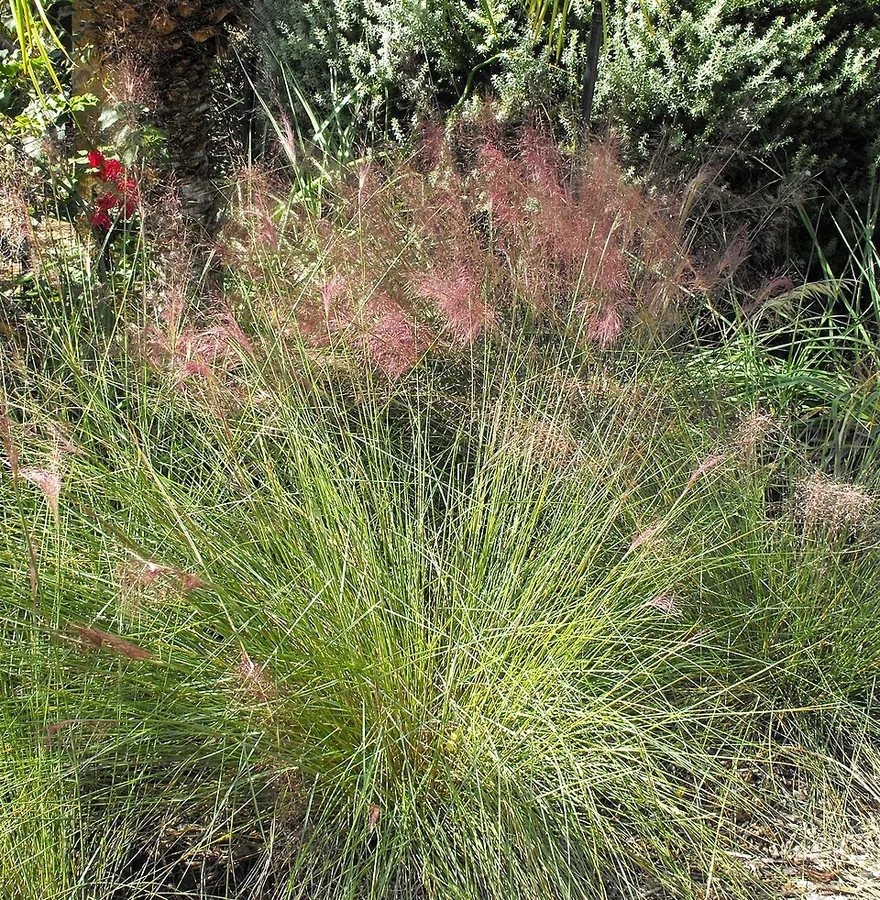
Pink muhly grass is a clump-forming native of the eastern and southern United States, built from a dense tuft of narrow, fine-textured green blades that arch outward into a soft mound. For most of the year the plant reads as this quiet green fountain, thin blade over thin blade, until fall lifts a haze of airy rose-pink plumes on wiry stems held just above the leaves. It belongs to the grass family, its flower heads so fine they blur into a cloud rather than a stalk.
Look closely at those autumn plumes and the color is not solid but a scatter of countless hair-thin pink flower branches, catching low light so the whole clump seems to glow from within. The blades themselves stay slender and firm when the plant grows lean and dry, standing crisp and upright. In rich, wet ground those same blades swell soft and floppy, and the plumes thin to almost nothing, so the look depends on full sun and lean, fast-draining soil.
Set several together and the pink haze deepens into a broad, weightless drift, hovering for weeks before the whole planting bleaches to a warm tan for winter. The clump holds its rounded shape and its place instead of running, so its form stays clean, and a single late-winter cut-back is nearly all the season asks.
Care
The short version: full sun, lean and well-drained soil, and very little water once the roots are down. Leave off the fertilizer, let the tan winter blades stand, and cut the whole clump back hard in late winter before fresh green shows.
Light
Give it full sun, 6 or more hours a day. That light packs the blades into a dense, upright clump and draws out the heavy pink flowering, and it decides more than anything how the plant looks. In shade the thin stems weaken and lean, the plumes grow sparse, and the clump splays open at the center.
Water
Water it regularly through the first season while the roots knit into the soil, and after that it asks for almost nothing. Mature clumps are highly drought tolerant and live on rainfall in most spots. Wet, soggy ground is the true danger, since it softens and rots the crown.
Soil
It belongs in lean, dry, well-drained soil, the gritty sandy or rocky ground that starves fussier plants. Any pH from 5.5 to 8.0 suits it, and it even holds in clay where the drainage stays sharp. Rich, amended beds only swell the blades soft and floppy.
Temperature
This is a hardy, adaptable grass, at ease across a wide swing of roughly -9°F to 104°F (-23°C to 40°C). The blades take summer heat without scorching and come back after hard winters down to zone 6.
Humidity
Ordinary outdoor humidity is plenty, with no number to track. Far more telling is good drainage and air moving through the crown, since damp settling into the tight tuft of blades is the one thing it cannot bear.
Feeding
Leave it unfed. This native colors and flowers best in lean, low-fertility soil, and fertilizer backfires by swelling soft, leafy growth and thinning the plumes. Lean ground keeps the blades firm, upright, and covered in pink.
Pruning
One job a year does it. Cut the whole clump of blades back to about 6 to 8 inches (15 to 20 cm) in late winter or early spring, before the fresh green pushes up. Leave the tan old foliage standing through winter for cold cover and its faded color.
Repotting
It rarely needs dividing or a new pot. Over many years an old clump may die out in the center, leaving a bare, hollow ring of blades with fading vigor and fewer plumes, which is the cue to lift and split it rather than repot.
Size & spacing
The mounded clump of blades reaches about 2 to 3 feet (61 to 91 cm) tall and just as wide. Space plants roughly that far apart, around 2 to 3 feet (61 to 91 cm), so each rounded fountain of foliage fills out with room to breathe.
When to plant
Pink muhly grass keeps a warm-season rhythm, pushing up fresh green blades in spring and holding its pink flowering for fall. Seed sown indoors in late winter to early spring sets out after the last frost, and the fine pink plumes rise from September into November.
Northern hemisphere
Southern hemisphere
Typical months for a temperate climate: start earlier in warm zones, later where spring frosts linger.
- Sow: Late winter to early spring
- Plant: Spring after last frost
- Harvest: September to November
Hardiness
USDA hardiness zones: 6–10
Temperature: down to -23°C
Troubleshooting
This is a tough grass, so trouble is rare and almost always traces to the site rather than a disease. The signs read on the plant itself, in the plumes, the crown, and the base of the slender stems. Match what you see below, then correct the conditions behind it.
The plant rots or fades in soggy ground
A crown gone soft and brown at the base, with the clump thinning and hollowing at its middle, shows root and crown rot from wet, heavy soil. The dense knot of roots suffocates where water never drains away. Sandy or rocky ground with sharp drainage rescues it, a raised mound lifts the crown clear of clay, and soil left to dry between waterings lets firm new blades return.
Fix:
- Plant in well-drained sandy or rocky soil, or amend heavy soil and plant on a raised mound or berm
- Reduce irrigation; allow soil to dry between waterings
- Remove dead rotted portions and replant healthy divisions in a drier, well-drained site
White cottony clusters at the base of a stressed plant
Soft, waxy white tufts wedged low among the leaf bases and crown are muhly grass mealybug, the single pest that mars this otherwise clean grass. Under a heavy load the blades stall short and lose their fresh green, turning dull and stressed. Cutting the infested foliage away in late winter, withholding the fertilizer that swells the tender growth they cluster on, and leaving natural predators to work keep the tufts in check.
Fix:
- Cut back and remove heavily infested foliage in late winter
- Encourage natural predators and avoid excess fertilizer that flushes soft growth
Few or no pink plumes, and the clump flops open
When the fine blades stay green and bare of any pink haze and the clump gapes open at the center, the cause is nearly always shade or soil that runs too rich. Low light leaves the thin stems limp and holds back the flowering, while fertile, well-watered ground swells the leaf blades and splays them outward with barely a plume among them. Full sun of 6 hours, no feeding, and less water bring back the taut, upright stems and the pink flower heads.
Fix:
- Relocate or plant in full sun (6 or more hours of direct sun) for the best plume color, density, and upright form
- Stop fertilizing and reduce watering; grow in lean, dry, well-drained soil
- Cut back in late winter so vigorous new growth emerges in the right conditions
Toxicity
Pink muhly grass is safe across the board. Neither the thin green blades nor the pink plumes carry any toxin for cats, dogs, horses, rabbits, livestock, or people, and the plant is not on the ASPCA's list of harmful species. The one thing worth noting is the fine, heavy pollen the fall flower heads shed, which can aggravate seasonal allergies in sensitive people.
Safe for
People · Cats · Dogs · Horses · Rabbits · Livestock · Birds
Cats None
The slim green blades and pink plumes hold nothing toxic, so cats are safe. A cat that tears off a large mouthful may bring it back up, the way blades of grass often prompt, and nothing worse follows.
Dogs None
No part of the plant, blade or plume, harms a dog. A determined chewer may manage a brief bout of vomiting, the effect any swallowed grass can have.
Horses None
The fine foliage holds no toxins, so horses can graze near it without risk.
Rabbits None
The thin green blades are harmless, and rabbits can nibble them safely.
Livestock None
Cattle, goats, and sheep take no harm from the leaves of this native grass and may graze it freely.
Birds None
Birds are unharmed by it, and many pick the tiny seeds from the faded plumes through fall and winter.
People None
The blades and plumes are safe to handle and plant. The one caveat is the fine, heavy fall pollen the flower heads shed, which can aggravate seasonal allergies in sensitive people.
Not poisonous, but pets that nibble large amounts of grass may vomit, and the abundant fall pollen can aggravate seasonal allergies in sensitive people.
Varieties
Most gardeners grow the straight species for its pink fall haze, but a few selections and close relatives, differing in plume color and size, are worth knowing.
White Cloud
A selection whose plumes come in white to cream rather than pink, and it stands up to tar spot better than the species.
Pink Flamingos
A taller natural hybrid of M. capillaris and M. lindheimeri that rises to 3 to 4 feet, its bright pink plumes fading to a silvery-gray.
Lindheimer's muhly (Muhlenbergia lindheimeri)
A larger relative native to central Texas, a 2 to 5 foot clumping bunchgrass with silvery plumes often set out as a tall specimen.
Bamboo muhly (Muhlenbergia dumosa)
A relative whose arching, semi-woody bamboo-like stems and lacy pale-green foliage build a fountain 5 feet tall and wide.
How to propagate
Pink muhly grass is easy to multiply, whether you split the dense crown of an established clump or start from its fine seed.
DivisionEasy
Spring · One growing season
The easiest increase comes from dividing an established clump in early spring. The whole crown, a dense knot of roots and blade bases, lifts out, pulls apart into sections, and goes back into the ground. Each section roots in over a single growing season and fills out into a full plant.
SeedEasy
Spring (sow indoors late winter to early spring)
Seed works well too, and the fine seed stays put, since this grass builds a tight clump rather than running by rhizomes. The seed sown indoors in late winter to early spring goes out as seedlings after frost. Those thin young blades take one to two growing seasons to thicken into a blooming clump.
Myths
Muhly grass needs rich, fertilized, frequently watered soil to bloom well.
The reverse is what the plant shows. In full sun and lean, dry, well-drained soil the stems hold taut and upright and the pink plumes come thick, while rich, wet, fertilized ground swells the blades into floppy leaf with few flowers and rots the crown. Lean, dry ground draws out the fullest bloom.
Sources
- USDA NRCS PLANTS Database
- NC State Extension Gardener Plant Toolbox
- Missouri Botanical Garden
- University of Florida IFAS Gardening Solutions
- Texas A&M AgriLife Extension (Texas Superstar)
- NC State Extension Gardener Newsletter
- ASPCA Animal Poison Control
- NC State Extension Gardener Plant Toolbox
- NC State Extension Gardener Plant Toolbox