Bulb · Asparagaceae
Lily of the Valley
Convallaria majalis
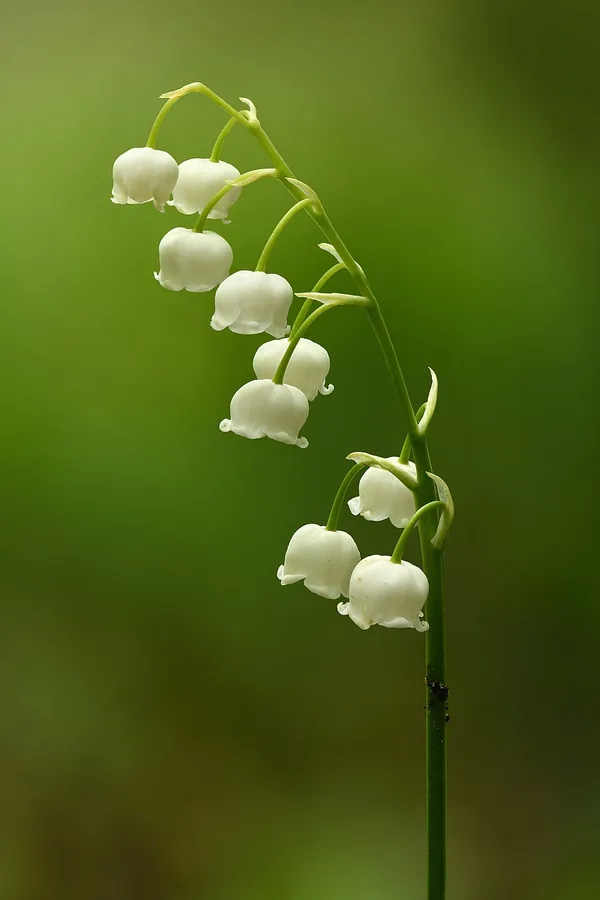
Rows of small white bells nodding on arching stems above broad green leaves, and every part is poisonous.
Partial shade
Every 5–10 days
USDA 3–8
6–12 in · 15–30 cm
Overview
Lily of the valley is a low woodland perennial, and up close its flowers are the draw: rows of small, white, nodding bells strung along one side of a slender arching stem, each little cup tipped downward as if listening to the ground. The scent that lifts off them is among the sweetest in the spring garden. Broad paired leaves rise beside the flower stems and hold their smooth green surface long after the bells have gone.
The plant keeps its color low and dense. It creeps outward underground on pale rhizomes called pips, and the paired blades close ranks overhead until the ground reads as one unbroken sheet of green beneath trees or along a shaded north wall. Hardy from zone 3 to 8, it holds that green through cold winters and thrives in the dappled to full shade where most flowers fade. Give it moist, rich soil and it runs so freely it can crowd out neighbors, and it has been flagged as invasive in some regions.
By late spring the flowers give way to small, round, bright red berries that stand out sharply against the leaves. Handsome as they are, every part, the white bells, the green blades, and those red berries, holds cardiac glycosides that can throw the heart into a dangerous rhythm, so it belongs well out of reach of pets and children.
Care
The short version: set the pale pips in dappled to full shade, keep the rich soil evenly moist, and divide crowded clumps every few years. Wear gloves whenever you handle it.
Light
Plant it in dappled to full shade, the dim, cool ground beneath trees or on the shaded side of a wall where the green blades hold their color best. A little morning sun does no harm, but hot afternoon light scorches the leaves brown and pushes the colony into early decline.
Water
Keep the rich soil evenly moist, watering roughly every 5 to 10 days and more often in a dry spell. An established colony rides out a summer drought, but the broad blades turn ragged and dull when they run short, so a drink during long dry stretches keeps them smooth and green.
Soil
It wants moist, fertile, organically rich ground that still drains well. Heavy clay and drier patches are no obstacle, but the densest, glossiest, fastest-spreading colonies form where the soil stays damp and full of compost.
Temperature
Cold leaves it untouched. This iron-hard perennial takes winters down to -40°F (-40°C) and grows well up to about 84°F (29°C), past which heat and sun dry and brown the foliage.
Humidity
Ordinary outdoor air suits it, so there is no number to chase. Air movement matters more than humidity, since a crowded, stagnant, damp pocket is what lets leaf spot fleck the green blades.
Feeding
Feed once in spring as the new shoots push up. A top-dressing of compost or a balanced general-purpose fertilizer is all it asks, and a yearly mulch of leaf mold keeps the blades broad and deep green.
Pruning
There is little to do. Snip off the spent flower stems and cut back the tired foliage in late summer or fall once the blades yellow. Always wear gloves, because every part of the plant is poisonous to handle and to eat.
Repotting
In the ground, the job is dividing rather than repotting. Every 3 to 5 years, lift the congested colonies and split the pips to keep the clumps vigorous, since crowded plantings flower less and grow smaller, thinner blades in the center.
Size & spacing
The plants stay low, reaching just 6 to 12 inches (15 to 30 cm) tall, and each spreads 9 to 12 inches (23 to 30 cm) wide before the broad blades overlap into one continuous green sheet. Space the pips with that creeping habit in mind, since they will close the gaps in time.
When to plant
Lily of the valley follows the seasons in plain sight. The pips go into the ground in fall or early spring, the small white bells open along their arching stems from April into early summer, and the broad leaves then hold the ground in solid green through the summer.
Northern hemisphere
Southern hemisphere
Typical months for a temperate climate: start earlier in warm zones, later where spring frosts linger.
- Plant: Plant rhizomes (pips) in fall or early spring.
- Harvest: Blooms early to mid-spring (April to early summer).
Hardiness
USDA hardiness zones: 3–8
Temperature: down to -40°C
Troubleshooting
This is a tough, easygoing plant, so most trouble is minor and reads plainly on the leaves and stems. A brown fleck on a green blade or a soft patch at the base of a stem tells you what is wrong before it spreads. Match what you see below, then act while it still helps.
Stems gone soft and dark, buckling at the base
Stems that turn soft and dark and slump at the base are showing stem rot, which sets in where the soil stays wet and drainage is poor. The base goes mushy and discolored until the stem can no longer hold itself upright. Lift out and bin the rotted tissue, open the drainage, and cut back the water so the planting firms up again.
Fix:
- Improve soil drainage
- Reduce excess moisture
- Remove and dispose of rotted material
Small brown and tan flecks freckling the green blades
Small brown and tan flecks on the green blades are the mark of fungal leaf spot, leaf blotch, or anthracnose, which take hold in the cool, damp shade. Each spot starts as a pinpoint, then widens and bleeds into its neighbors once the weather turns wet. Pull the blotched leaves, clear the fallen litter, and water at the soil line so the blades dry.
Fix:
- Remove and dispose of affected leaves
- Improve air circulation and avoid wetting foliage
- Water at the soil line
Broad green blades paling to yellow and brown in summer
When the broad green blades pale to yellow and crisp to brown in high summer, the cause is usually heat and drought stress rather than disease. Too much sun bleaches the color and too little water curls the edges, speeding the fade. Mulch to hold moisture, water through the dry weeks, and fresh blades push up again next spring.
Fix:
- Provide shade and consistent moisture
- Mulch to conserve soil moisture
- Site in dappled to full shade
New blades puckered by clustered insects or silky webbing
Two pests warp the tender new blades. Aphids crowd the soft young growth in dense little clusters and pucker it out of shape, while spider mites stretch fine, silky webbing across the undersides in dry weather. Turn the leaves over to spot them, strike the pests off with a strong jet of water, and use insecticidal soap only if they hold their grip.
Fix:
- Spray with a strong jet of water
- Apply insecticidal soap if needed
- Remove heavily infested foliage
Toxicity
This is one of the most poisonous plants in the garden, so treat every part with care. The sweet white bells, the broad green leaves, the bright red berries, and even the water a cut stem has stood in all hold cardiac glycosides. Swallowing any of it can cause vomiting and dangerous changes to the heartbeat, and a large enough dose can be fatal to pets, livestock, and people alike.
Toxic to
Cats · Dogs · Horses · Rabbits · Livestock · Birds · People
Cats Severe
For a cat, even a nibble of the leaf or flower is dangerous. Drooling and vomiting come first, then weakness as the heartbeat slows and slips out of rhythm, and a large enough dose can stop the heart.
Dogs Severe
A dog shows vomiting, a pulse that runs slow or races, low blood pressure, and collapse. The same cardiac glycosides that poison cats can kill a dog, so any chewing on the plant is an emergency.
Horses Severe
A horse that grazes the green blades can develop colic, a dangerously irregular heartbeat, and a staggering gait. The poisoning is severe and can prove fatal without fast veterinary help.
Rabbits Severe
The cardiac glycosides hit rabbits hard, bringing gut upset, a faltering heart rhythm, and sudden weakness. Keep them well clear of every part of the plant.
Livestock Severe
Cattle, goats, and sheep are poisoned by the leaves, flowers, and red berries alike, with heart-rhythm failure that can be deadly. Dried plants caught in hay stay just as toxic.
Birds Severe
Birds are highly sensitive to these heart toxins, and even a small amount can throw the heartbeat into a fatal rhythm. Keep the plant and its red berries away from them entirely.
People Caution
No part of this plant is food. Eating the white flowers, the green leaves, or the red berries, or even drinking the water a cut stem has stood in, can cause vomiting and dangerous changes in heart rhythm. Keep it well away from children and call poison control if any is swallowed.
Wear gloves when handling, and keep all parts including the sweet-smelling flowers and red berries away from pets and children. Wash hands after contact.
Helpline numbers

United States
ASPCA Animal Poison Control: (888) 426-4435 (fee applies)
Poison Control: (800) 222-1222



Canada
Poison Centres: 1-844-764-7669
Varieties
Most plantings show the plain white bells of the species, but a couple of named forms shift the color, whether in the flower or in the leaf.
var. rosea
Its nodding bells emerge in soft, light pink rather than the usual clean white.
Golden Slippers
Its leaves carry the color instead of the flowers, glowing from chartreuse to golden yellow.
Companions
Lily of the valley pairs best with shade-loving plants that share its taste for moist, rich soil, the kind of company it keeps on a woodland floor.
Plant near
Hosta: Shares the same shade and moist, rich soil preferences as a woodland groundcover companion.
Ferns: Thrive in the same dappled to full shade and moist conditions.
How to propagate
Making more is simple, since the plant multiplies underground on its own pale, creeping rhizomes. You can split what it has already grown or start from seed, though one route is far quicker than the other.
DivisionEasy
Fall or early spring · One to two growing seasons
Division is the dependable way to make more, and the one most gardeners reach for. In fall or early spring, lift an established clump and tease the pale, fleshy rhizomes, known as pips, apart into separate pieces. Set them back in the soil and they knit in over one to two growing seasons. Wear gloves, since every part of the plant is poisonous.
SeedModerate
Fall · Several years
Seed is the slow road. Sown in fall, it comes up thin and patchy, and several years pass before the seedlings bulk into anything substantial. Division fills in far sooner, so most gardeners leave seed alone.
Myths
The little white bells and glossy red berries are safe to pop in the mouth.
Every part of this plant is poisonous, from the fragrant white bells to the glossy red berries that so easily catch a child's eye. Those tissues carry cardiac glycosides that can throw the heart into a dangerous rhythm. A taste is never safe, and a larger amount can be fatal.