Bulb · Asparagaceae
Tuberose
Polianthes tuberosa
Tall spikes lift creamy white blooms above narrow, grassy leaves and scent late-summer evenings.
Full sun
Every 5–10 days
55–84°F · 13–29°C
90–120 days
Overview
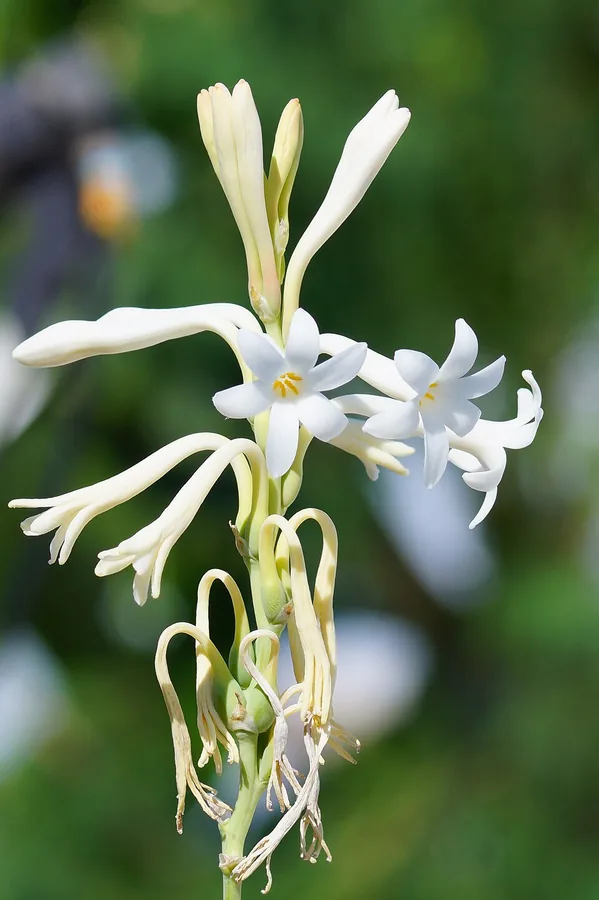
Tuberose shows itself as a tall, slender flower spike crowded with creamy white blooms that open in succession from late summer. The spike rises well above the foliage, and its flowers release a scent that holds in the air after dark. The common name suggests a rose, but the plant looks nothing like one. It is a tuberous-rooted relative of the agaves, native to Mexico and grown there for centuries.
From a swollen underground tuber, the plant throws up narrow, grassy leaves and reaches 2 to 3 feet (61 to 91 cm) tall. The flower spike follows, opening its blooms a few at a time over several weeks rather than all at once. It is a tender perennial. Where winters turn cold, the fleshy tubers are lifted in fall and stored, as dahlias are.
Up close, a healthy tuber is firm to the touch, and that firmness is what care protects. The plant wants warmth, sun, and soil that drains, with the tubers set out in spring and watered through summer until the leaves yellow and fade in fall. Left in wet, heavy ground the tuber turns soft, so sharp drainage keeps its flesh sound.
Care
The short version: tuberose wants full sun, rich soil that drains fast, and steady moisture through the summer growing season, when the grassy leaves and tall spike are in full growth. Feed monthly, cut back water as the leaves yellow in fall, and divide the swollen tubers every few years to keep the blooms coming.
Light
Tuberose needs full sun to raise its best spikes, ideally a spot lit for most of the day. It stands a little afternoon shade, but under heavier shade the grassy leaves stretch soft and floppy while the flowers thin out.
Water
Keep the soil evenly moist through the summer growing season, letting the top half dry between waterings so the fleshy tubers never sit wet. Most gardens want water every 5 to 10 days. As the leaves yellow in fall, taper off and let the plant settle into dormancy.
Soil
Tuberose wants rich, well-drained loamy or sandy soil, the loose, gritty kind that water slips through. It takes a wide pH from 6.0 to 8.0, so most beds suit it, as long as water never gathers around the tuber.
Temperature
Tuberose grows in warmth, around 55°F to 84°F (13°C to 29°C). It is tender and cannot survive frost, so in cold-winter areas the tubers are lifted and stored before the first freeze.
Humidity
Ordinary outdoor humidity suits tuberose, with no number to chase. Its warmth and drainage matter far more than any moisture in the air around its leaves.
Feeding
Feed monthly through spring and summer while the plant is in active growth, using a balanced general-purpose garden fertilizer. Steady feeding pushes up the tall spikes and keeps fresh blooms opening along them.
Pruning
Tuberose needs no routine pruning. Cut the flower spikes once the blooms have faded, and leave the grassy foliage to yellow and die back on its own in fall, feeding the tuber for next year's bloom.
Repotting
Tuberose is lifted and divided rather than repotted, which keeps its flesh firm and its bloom strong. Split the crowded clumps every 2 to 3 years when offsets multiply, flowers thin, or tubers push up into view at the surface.
Size & spacing
24–36 in (61–91 cm) tall
When to plant
Tuberose runs on a warm-season cycle and cannot take frost. The tubers start indoors in early spring, then move outside once the cold passes. From August into September the creamy white spikes open along their length, carrying scent through late summer.
Northern hemisphere
Southern hemisphere
Typical months for a temperate climate: start earlier in warm zones, later where spring frosts linger.
- Sow: Early spring, started in containers before last frost
- Plant: Spring after the last frost date, planted 2 inches deep and 6-8 inches apart
- Harvest: August to September (late summer to early fall)
Hardiness
USDA hardiness zones: 7–10
Temperature: down to -18°C
Troubleshooting
Most tuberose trouble either sits hidden in the tuber below or shows in the leaves and spike above, as thick foliage with few flowers. The early physical signs are easy to read once you know them. Match what you see below and act before the tuber goes soft.
Tubers gone soft and mushy under yellowing, sagging leaves
The tuber has fallen to tuber rot, its once-firm flesh turned mushy and foul-smelling where the soil stayed too wet. Set deep in heavy ground, it sits in trapped water and breaks down from the inside. Lift the plant, cut away every soft, discolored piece, and replant only the firm tubers in loose sandy or loamy soil that drains at once.
Fix:
- Stop watering and improve drainage
- Lift affected tubers and discard rotted ones
- Replant healthy firm tubers in well-drained sandy or loamy soil
A thicket of grassy leaves but almost no flower spikes after the first season
The clump comes up all leaf and little bloom, a sign of crowded clumps packed too tightly in the same soil, or foliage cut away before the tuber could refill. Divide the clump every 2 to 3 years and let the leaves yellow and fade on their own each fall. Keep only the largest, firmest tubers, since small offsets need a season or more before they flower.
Fix:
- Divide clumps every 2-3 years
- Allow foliage to die down naturally before lifting
- Replant only the largest tubers for reliable bloom
New shoots curling and puckered under a film of tiny insects
Clusters of aphids coat the soft new shoots, and as they drink the sap the growth curls, puckers, and turns sticky with honeydew. Thrips, spider mites, and scale may gather on the leaves as well. Wash them off first with a strong jet of water, and turn to insecticidal soap only if they return.
Fix:
- Spray off with a strong jet of water
- Apply insecticidal soap if needed
Toxicity
Tuberose is safe around pets, livestock, and children. Its leaves, flowers, and tubers carry no known toxins, and it never appears on the ASPCA's toxic plant lists, so a nibble is nothing to fear. The one thing to note is the sap, which can mildly irritate sensitive skin, so rinse your hands after cutting stems.
Safe for
People · Cats · Dogs · Horses · Rabbits · Livestock · Birds
Cats None
Tuberose is safe around cats and never appears on the ASPCA toxic list. A curious nibble of a grassy leaf might bring a little mild stomach upset, as any unfamiliar plant can, but nothing serious.
Dogs None
Dogs can share a garden with tuberose safely. Nothing in its leaves or flowers is toxic, so a chewed leaf or bloom does no harm.
Horses Safe
Horses are in no danger from tuberose. It holds no known toxic compounds and is not flagged as a problem for grazing animals.
Rabbits Safe
Rabbits can browse the grassy tuberose foliage safely, since the plant holds nothing harmful to them.
Livestock Safe
Cattle, goats, and sheep face no risk from tuberose, which has no toxicity on record for farm animals.
Birds Safe
Birds are safe around tuberose, whether they peck at its leaves and blooms or just share the space.
People Safe
Tuberose is safe for people, and its creamy white flowers are prized for their scent. The only catch is the sap, which can mildly irritate sensitive skin, so rinse your hands after handling cut stems.
The flowers are intensely fragrant; the strong scent may be overwhelming to some people in enclosed spaces.
Varieties
Only a few tuberose forms turn up often, and they are told apart mostly by the shape and color of their flowers. These are the ones worth knowing by sight.
The Pearl
A double-flowered form whose fully petaled, waxy white blooms are packed so tightly they look like a small gardenia.
Mexican Single
A single-flowered form, its simpler open blooms said to carry the strongest fragrance of any tuberose.
Sensation
A fragrant form whose flowers carry a soft pink tint.
Marginata
A miniature form whose leaves are variegated, grown as much for that patterned foliage as for its bloom.
How to propagate
The simplest way to increase tuberose is to lift the swollen tubers and split them apart, which also revives an old, crowded clump so it flowers again.
Offsets & pupsEasy
Spring, when lifting and dividing dormant tubers · Largest offsets may bloom the next season; small offsets often take a year or more to reach blooming size
Around the base of the parent tuber, tuberose forms small offsets, new tubers of its own. Lift and pull them apart in spring while the plant is dormant. The largest offsets often flower the next season, while the small ones stay too little to bloom and need a year or more of growing on, so they are worth keeping.
DivisionEasy
Spring, every 2-3 years · One or more growing seasons before reliable flowering
A crowded clump of tubers splits cleanly every 2 to 3 years in spring, and dividing it keeps the flesh firm and the spikes coming. Pull the tubers apart and replant only the largest for the fullest show. A growing season or more passes before the divisions root in and flower reliably.
SeedModerate
Spring · Several years to reach flowering size
Tuberose can be grown from seed sown in spring, but the seedlings are slow. They take several years to swell into blooming-size tubers, far longer than offsets, so most gardeners divide instead.
Myths
Tuberose is a kind of rose.
The name misleads the eye, since nothing about tuberose resembles a rose. It is a tuberous-rooted member of the Asparagaceae family, Polianthes tuberosa, also classified as Agave amica. The name points to its swollen tuber, taken from the Latin tuberosa, not to any bloom.