Herb · Lamiaceae
Lemon Balm
Melissa officinalis
Crush one crinkled leaf between your fingers and it happens at once: lemon balm gives up a bright, lemony scent and asks for almost nothing.
Full sun
Every 5–7 days
50–86°F · 10–30°C
70–90 days
Overview
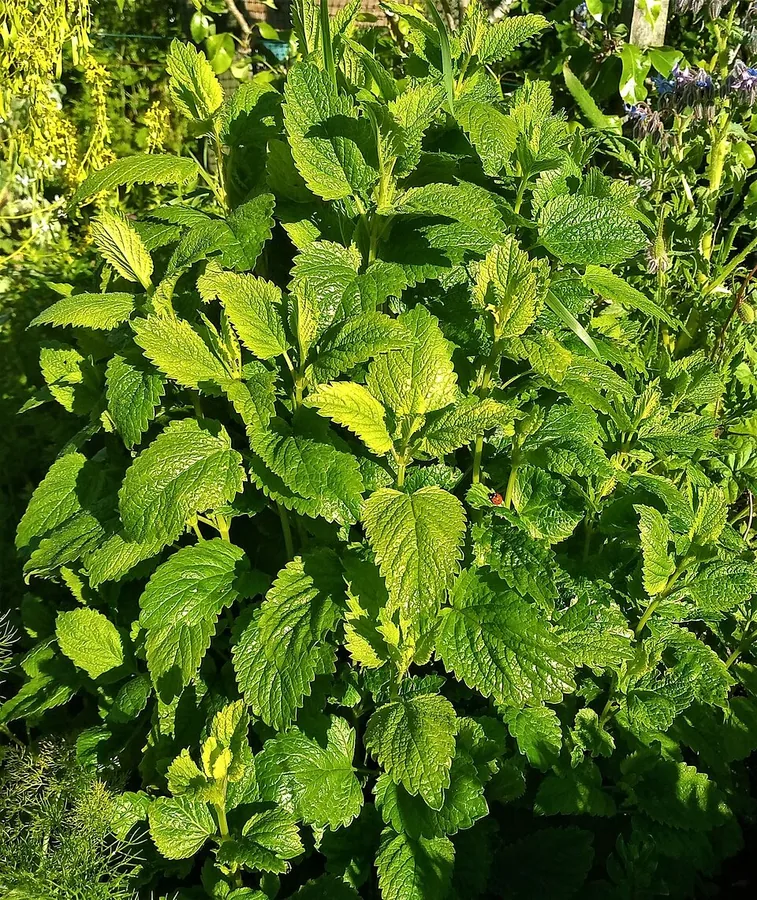
Lemon balm is a hardy perennial in the mint family, grown for its soft, deeply crinkled leaves, which are a fresh mid-green and toothed along the edge, textured with a fine network of veins that shows when the light catches them. Bruise or crush one and it releases a clean lemon scent from the oils in the leaf. The plant carries its foliage on upright stems above a low, rounded crown, and it came to gardens from the eastern Mediterranean and western Asia as a long-loved cottage garden staple.
It is a broadly tolerant plant, at home on poor, sandy, or rocky ground, in full sun or a pocket of shade, and quick to push out new shoots after a hard cut. What defines its character in the ground is its habit of spreading, both from the fine seed it scatters and from creeping roots, so many growers keep the clump inside a pot or a bounded bed. The whole plant forms a soft, leafy mound rather than anything stiff or spiny.
In summer the stems lift small flowers, white to pale yellow, tucked in tight whorls where the leaves meet the stem, modest against the mass of green foliage. Leaves gathered before those flowers open carry the cleanest, sweetest lemon scent for tea, salads, and cooking. As bloom passes the foliage coarsens, and a hard shearing after bloom brings back a flush of tender, fine-textured new leaves.
Care
The short version: lemon balm wants full sun to part shade in average, well-drained soil, with steady water while young and far less once its crown has settled. Feed it lightly, gather the crinkled leaves before it flowers, and cut it back hard after bloom to keep the mound dense and fresh.
Light
Lemon balm holds its densest, most fragrant leaves in full sun, where the mound stays compact and deep green. It takes partial shade as well, a help in hot climates, though in too little light the stems stretch and the leafy mound goes thin and floppy.
Water
Young plants want the soil kept evenly moist while the crown roots in, then far less, since an established plant handles drought and needs water only about every 5 to 7 days in dry spells. Soggy ground is the real danger, above all over winter, when wet soil rots the crown, so drainage must be free.
Soil
The roots run through almost any ground, from poor sand to heavy clay to shallow rocky soil, as long as water drains away. Average, well-drained loam at a pH of 6.0 to 7.5 suits it best. Rich soil grows a bulk of soft leaf but a fainter lemon scent, so leaner ground pays off.
Temperature
Green growth is comfortable between 50°F and 86°F (10°C to 30°C) through the season. As a perennial hardy to USDA zone 3, the crown and roots survive hard frost underground and throw up fresh leaves each spring.
Humidity
Ordinary outdoor humidity in the 40% to 60% range suits the foliage. Air moving through the leaves matters more than moisture, since a crowded, still clump is where the chalky powdery mildew settles.
Feeding
This is a herb that asks for very little feeding. A single light balanced feed in spring covers it, and heavier fertilizer only swells the plant with soft leaf and a weaker lemon scent.
Pruning
A shear taken across the plant after flowering, with the spent stalks cleared, draws out fresh, fragrant leaves and curbs the seeding. Picking the leaves often, before bloom, works as pruning too and keeps the finest scent in them.
Repotting
A potted clump is lifted and divided or moved up every 1 to 2 years, ideally in spring. Roots winding around the pot or poking from the drainage holes, along with slowed growth and fast drying, show the plant has filled its space.
Size & spacing
A mature plant forms a leafy mound 18 to 35 inches (45 to 90 cm) tall and spreads about as wide. Each one is set 18 to 35 inches (45 to 90 cm) apart so air threads between the clumps and mildew stays off the leaves.
When to plant
Lemon balm is hardy and simple to time. The fine seed starts indoors in late winter, the young plants go out in spring once frost has passed, and the leaves come in through summer, with the fullest harvest taken before the small flowers open around June to August.
Northern hemisphere
Southern hemisphere
Typical months for a temperate climate: start earlier in warm zones, later where spring frosts linger.
- Sow: 6-8 weeks before the last spring frost
- Plant: Spring, after the last frost
- Harvest: Small white to pale-yellow flowers in summer (about June-August); harvest leaves before flowering for best flavor
Hardiness
USDA hardiness zones: 3–9
Temperature: down to -40°C
Troubleshooting
Lemon balm is seldom troubled by anything grave. Nearly every issue traces to crowding, still air, or the plant's own reach across the soil. Match what the leaves and stems are showing below, and a plain fix usually sets it right.
A scatter of tiny seedlings ringing the parent clump
Once its flowers ripen, lemon balm sheds fine seed across the soil and also runs pale, creeping rhizomes just under the surface, so a single rounded clump thickens into a spreading patch within a season or two. Cutting it back before the seed sets, and lifting the small green seedlings while they are shallow, holds it in check. A pot pens the roots in and keeps the shape tight.
Fix:
- Deadhead and cut back before seed set
- Pull volunteer seedlings
- Grow in a container to contain spread
A chalky white bloom dusting the crinkled leaves
That flat, floury film is powdery mildew, a fungus that takes hold on crowded plants where the air lies still. The worst leaves come off, the clump opens up so a current can slip through, and the foliage stays dry. Set in full sun, the plant usually sheds the coating and the green comes back clean.
Fix:
- Remove and discard affected leaves
- Improve air circulation by thinning and spacing plants
- Avoid overhead watering
Square stems splaying open and baring their woody bases
After the flowers fade, the upright square stems sprawl open and stiffen into pale wood near the ground, so the leaves thin to a sparse tuft at the tips. A hard cut low down clears that leggy framework and lets fresh, compact shoots crowd back in within a few weeks. A firm shear each year after bloom keeps the clump low, rounded, and thickly leaved.
Fix:
- Cut plants back hard after flowering to force fresh compact growth
Toxicity
The verdict is an easy one: lemon balm is safe across the board. The ASPCA lists it as non-toxic to cats, dogs, and horses, and its leaves are a culinary herb that people eat every day. The only thing it truly wears down is a gardener's patience with its spread.
Safe for
People · Cats · Dogs · Horses · Rabbits · Livestock · Birds
Cats None
A cat is safe beside the plant. Should one bite into the oil-rich leaf, the strong scent may bring a brief, mild stomach upset, and nothing worse than that.
Dogs None
A dog runs no toxic risk here. A chew on the soft, lemon-scented foliage does no harm.
Horses None
Horses can crop the leafy growth without harm.
Rabbits None
Rabbits nibble the tender leaves without trouble, and many take to the fragrant foliage as a treat.
Livestock None
Cattle, goats, and sheep can browse the leafy stems freely, with no ill effect.
Birds None
The leaves hold no danger for backyard birds or poultry.
People None
Lemon balm is a kitchen herb, its leaves steeped into tea and chopped into food. They are safe to eat for adults and children alike.
Non-toxic culinary herb; leaves are edible and commonly consumed.
Varieties
Most gardens grow the plain green species, its leaves a soft even mid-green, but a few selections stand apart for the color or scent of that foliage. These are the ones worth seeking out by name.
Aurea
Its crinkled leaves are splashed and streaked in gold against green, and that marbling flares brightest in cool weather and partial shade.
All Gold
Its foliage glows an even golden yellow all over, holding that color best where a little shade shields the leaves from scorching.
Lime
Its leaves give off a sharper, lime-like scent in place of the usual lemon fragrance.
How to propagate
Lemon balm is among the easiest herbs to increase. A clump splits cleanly, a green cutting roots fast, and the fine seed sprouts readily, and left alone the plant sows itself around the beds without any help.
DivisionEasy
Spring or early fall · 4-6 weeks
Splitting an established clump is the surest way to hold a named cultivar true to type. A mature plant is lifted in spring or early fall, its dense crown of roots teased apart into pieces, and each piece set back in the ground. Every division takes hold and roots within about 4 to 6 weeks.
Stem cuttingsEasy
Late spring to summer · 3-4 weeks
Soft, green stem tips root with almost no coaxing. Cut them from late spring through summer and stand them in moist mix or a clear glass of water, where fine white roots thread out in roughly 3 to 4 weeks.
SeedModerate
Spring; surface-sow as seed needs light · 2-3 weeks to germinate, several weeks more to establish
The tiny seed is the slow route, and it will not hold a cultivar true, since the plant already sows itself so freely. It is pressed onto the bare surface in spring rather than buried, because it wakes only with light and warmth. The green sprouts show in 2 to 3 weeks, with several weeks more before the seedlings firm up.
Myths
Lemon balm is a kind of true mint.
It does grow within the mint family, Lamiaceae, beside the true mints, yet it holds its own genus, Melissa, and is no Mentha. Its lemon scent and its softer, more wrinkled leaves set it apart once you look closely.
Lemon balm stays put and will not run like mint.
It travels just as far, only by a quieter route. Left to flower, it self-seeds heavily and creeps on rhizomes, slipping past the bed unless the flower heads are cut off or the plant is penned into a container.