Shrub · Berberidaceae
Japanese Barberry
Berberis thunbergii
Tough, thorny, and richly colored, but look closely before you plant it where it can spread.
Full sun
Every 7–14 days
USDA 4–8
3–6 ft · 0.9–1.8 m
Overview
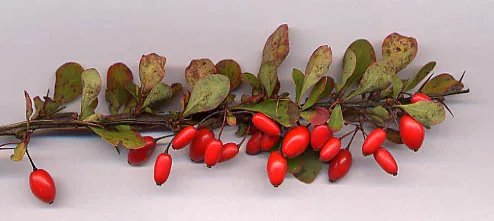
Japanese barberry is a dense, rounded deciduous shrub whose small, spoon-shaped leaves crowd tight along arching stems. It reaches 3 to 6 feet (91 to 183 cm) tall and spreads even wider, and those little leaves flush red, purple, or gold depending on the cultivar. Pale yellow flowers dangle in loose clusters in late spring, giving way to small, bright red berries that ripen in fall and cling to the bare branches deep into winter.
Run a hand near the stems and you meet its defense at once: a sharp single spine stands at every node, close-set and needle-fine, sheathing the whole shrub. Behind that armor the plant is unbothered by drought once settled, by poor soil, and by city air, and deer turn away from the prickled growth. The same spines make it a low, impenetrable hedge.
For all its handsome color there is a hard truth to face. Across much of the eastern and midwestern US this shrub has escaped the garden and turned badly invasive, its thickets standing thick enough to shelter and boost deer-tick numbers. In several states it is a regulated noxious weed, so confirming whether you can legally plant it comes before anything else.
Care
The short version: full sun draws out the deepest leaf color, any well-drained soil will do, water it while it settles and then mostly leave it be, and pull on thick gloves before you reach into those spiny stems to prune.
Light
Set it in full sun to pull the richest color into the small leaves, above all on the purple and gold forms where the pigment runs deepest. It takes partial sun and even partial shade, but there the leaves drift back toward green and the whole shrub loosens.
Water
Water it through the first season while the roots knit into the ground, then taper off, since it is drought tolerant once established. Let the top half of the soil dry between waterings, roughly every 7 to 14 days, and never leave the roots sitting in wet ground.
Soil
Few shrubs care less about their footing, taking dry to medium soil of nearly any grain, from heavy clay to loam to loose sand. The one thing it will not stand is poor drainage, so a spot that sheds water counts for more than rich earth.
Temperature
It is a hardy thing, at ease across a wide swing from about -29°F to 100°F (-34°C to 38°C), a range that spans much of the country. Bitter winters and blazing summers pass over it without a mark.
Humidity
Plain outdoor humidity is all its leaves ask, so there is no level to chase. What tells more is air movement, because a damp, crowded canopy is where the few leaf diseases first stain the foliage.
Feeding
It seldom asks to be fed and holds good color in average soil with nothing added. Where the small leaves come thin and pale, a light application of balanced granular fertilizer in spring restores them.
Pruning
Keep pruning light unless a formal hedge is the aim. Cut just after the pale flowers fade or in late winter, and an overgrown, tangled shrub can be taken down hard in late winter. Always wear thick gloves, because the stems bristle with close-set spines.
Repotting
A potted plant rarely needs moving up. Shift it only when roots circle the pot or push out the drainage holes, water runs straight through, or the small new leaves stall.
Size & spacing
A mature shrub stands 3 to 6 feet (91 to 183 cm) tall and spreads wider still, about 4 to 7 feet (122 to 213 cm) across, its thorny stems arching out to fill the room. Give it that much space so the canopy stays open and air slips through.
When to plant
This is a spring-and-fall shrub, not a seasonal crop. Set new plants out in spring or fall where it is legal, watch the pale yellow flowers open along the stems in late spring, and follow the small red berries as they color in fall and hang on through winter.
Northern hemisphere
Southern hemisphere
Typical months for a temperate climate: start earlier in warm zones, later where spring frosts linger.
- Plant: Spring or fall where legal to plant
- Harvest: Pale yellow flowers in late spring (April to May), followed by bright red berries in fall persisting into winter
Hardiness
USDA hardiness zones: 4–8
Temperature: down to -34°C
Troubleshooting
Japanese barberry is rarely troubled, and most of what marks its small leaves or slumps its stems traces back to wet soil or a crowded, airless canopy. Match what you see below and act early, before a small blemish settles in.
Thorny branches slumping and browning as the shrub fails
When whole branches sag and brown, wet soil is nearly always underneath it. Root rot takes over in that soggy ground, and once the roots below have gone dark and mushy the stems will not firm up again, whatever the watering. Sharpen the drainage, lift out any shrub too far gone, and keep the plant off low, waterlogged ground.
Fix:
- Improve soil drainage
- Remove severely affected plants
- Avoid planting in wet sites
Dark blotches on the small leaves, then early leaf fall
Dark, irregular lesions creeping across the small leaves point to anthracnose or a bacterial leaf spot, which deepen in wet weather within the crowded heart of the shrub. Pick off the blotched leaves, gather the fallen ones from the soil, and thin the branches so air threads through the middle. Water low at the base to keep the foliage dry.
Fix:
- Remove and dispose of infected leaves and debris
- Thin the shrub to improve air circulation
- Avoid overhead watering
Curled shoots, a glossy sticky film, and bumps on the stems
Two pests leave marks on the growth. Aphids cluster on the tender spring shoots and coat them in a glossy, sticky honeydew, while scale insects fasten on as hard waxy bumps ridged along the stems. Wash the soft-bodied aphids off with a jet of water or insecticidal soap, and clear the scale by pruning the worst stems or coating them with horticultural oil.
Fix:
- Spray aphids off with water or apply insecticidal soap
- Prune out heavily scale-infested branches
- Apply horticultural oil for scale
Toxicity
This shrub is only mildly toxic, but it is not harmless. Deep in the leaves, bark, and roots sits berberine, a bitter compound that can upset the stomach if a pet, child, or animal eats much of it. The sharper everyday danger is physical, since the stiff single spines ranged at every node prick and puncture skin, so wear gloves and keep small children clear of the branches.
Toxic to
Cats · Dogs · Horses · Rabbits · Livestock · People
Safe for
Birds
Cats Caution
A light nibble at the small leaves does a cat little harm, though the berberine held in the foliage and roots can turn its stomach if it eats much, showing as drooling, vomiting, or loose stools. The sharp spines are the bigger worry, ready to prick a mouth or a paw.
Dogs Caution
A dog that works through a mouthful of leaves or roots may drool, vomit, or pass loose stools from the berberine, while a passing taste seldom shows. The needle-fine spines deserve a close eye around a busy nose.
Horses Caution
Horses tend to leave the bristling stems untouched, and the berberine amounts to only a mild gut irritant if any is taken. It is the single spines at each node that do the damage when a horse leans into the canopy.
Rabbits Caution
The close-set spines usually turn rabbits back at the edge of the shrub, which serves them well, since the bitter berberine can upset a small animal's stomach. It is no plant to offer as forage.
Livestock Caution
Cattle, goats, and sheep skirt the thorny growth, and it acts as no more than a mild gut irritant on the rare browse. The dense thickets are better known for harboring ticks than for poisoning stock.
People Caution
The berries and bark carry a long herbal history, yet eating much of any part brings stomach cramps, nausea, and diarrhea from the berberine. Far more often it is the sharp single spines at every node that draw blood, so wear gloves and keep children clear.
Birds None
Birds pluck the bright red berries clean off the winter branches with no ill effect and carry the seed far across the land, a habit behind much of this shrub's spread.
Stems are densely covered with sharp single spines at each node that readily scratch or puncture skin; wear thick gloves and long sleeves when handling or pruning, and keep children and pets clear of the thorny canopy.
Helpline numbers

United States
ASPCA Animal Poison Control: (888) 426-4435 (fee applies)
Poison Control: (800) 222-1222



Canada
Poison Centres: 1-844-764-7669
Varieties
The named forms are picked for the color of their small leaves rather than for flower or fruit. These are the ones you will meet most.
'Atropurpurea'
The classic purple-leaved barberry, its small leaves glow a reddish-purple that deepens to burgundy and holds that tone right through the season.
'Crimson Pygmy' (var. atropurpurea)
A low, dense mound of tiny deep crimson-purple leaves packed close along short stems for low edging and tight borders.
'Aurea'
A golden-yellow form whose small leaves shine their clearest, brightest yellow when full sun falls on them.
How to propagate
Japanese barberry multiplies all too easily, which is at once why a cutting roots so readily and why its seedlings and rooting branches overrun the wild.
Stem cuttingsEasy
Softwood cuttings in early summer or hardwood cuttings in late fall/winter · 4 to 8 weeks to root
Cuttings root with little fuss. Soft green shoots taken in early summer, or firm hardwood taken in late fall and winter, sink new roots in 4 to 8 weeks. Low branches root themselves too, wherever they rest against the soil, a habit called layering that lets the shrub creep outward on its own.
SeedEasy
Seed ripens in fall and is widely bird-dispersed · Germinates the following spring, often at very high rates
Inside the bright red berries the seed ripens in fall, rides off in the birds, and sprouts the next spring at very high rates. That heavy self-seeding is exactly why the plant runs wild, so do not raise it from seed where it is prohibited.
Myths
Japanese barberry is a harmless, well-behaved shrub you can plant anywhere.
In truth it is one of the worst invasive shrubs across the eastern and midwestern US, slipping out of gardens on bird-dropped seeds and on low branches that root wherever they press into the ground. Several states now ban or restrict its sale as a noxious weed, and its dense, prickly thickets are tied to higher black-legged tick numbers. Check your state and local rules before you plant it, and lean toward the sterile cultivars or a native alternative.