Ornamental · Balsaminaceae
Impatiens
Impatiens walleriana
In shade kept evenly moist, impatiens spills its jewel-toned blooms across a shaded bed all summer.
Partial shade
59–75°F · 15–24°C
60–90 days
USDA 10–11
Overview
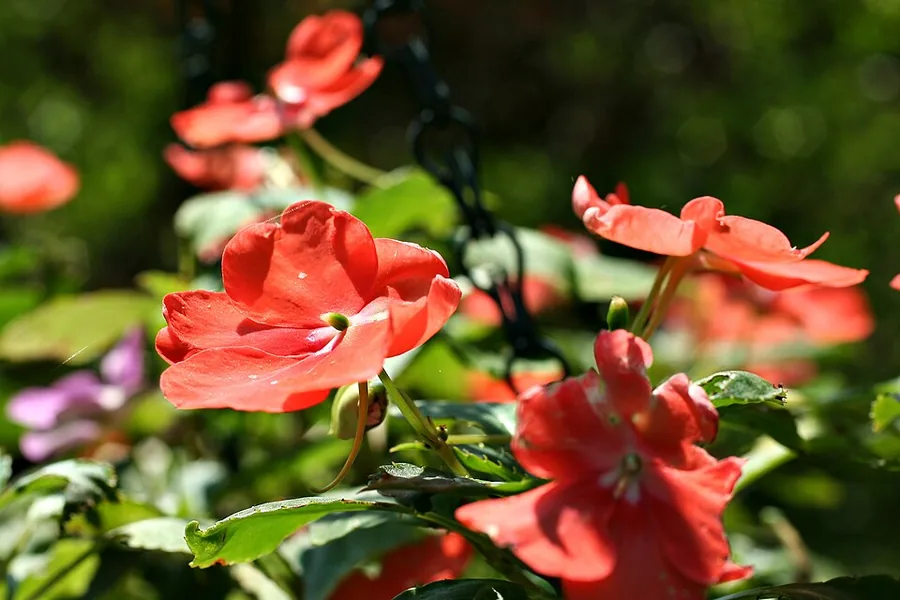
Impatiens carries flat, five-petaled flowers in bright, saturated color above soft green leaves, and few plants light up a shady spot the way it does. This tender perennial from East Africa is grown almost everywhere as a warm season annual, opening bloom after bloom from late spring until the first frost. Where most flowers pale without sun, it holds its color deep in the partial to full shade under trees and along the north side of a house.
It picked up the nickname Busy Lizzie for the way it keeps opening flowers, needing little more than moist soil and shelter from the hot afternoon sun. The stems are soft and succulent, and the whole plant builds into a low, rounded mound 6 to 24 inches (15 to 61 cm) tall and about as wide, so a group of them fuses into one continuous cushion of blooms.
One flaw marks the classic seed impatiens up close: downy mildew, which leaves a white fuzz on the leaf undersides before the foliage yellows and drops away. Newer resistant varieties carry the same flowers without that fate, which is why a name like Beacon matters when you choose what to plant.
Care
The short version: grow impatiens in partial to full shade, keep the soil evenly moist, feed monthly, and pinch off the faded blooms to keep fresh flowers opening.
Light
Impatiens are shade plants whose soft green leaves and open petals color best in partial to full shade, out of any harsh glare. Hot, direct sun scorches the thin foliage and drops the whole plant into a wilt, so keep it in the dappled light under trees or a north-facing spot where the light stays gentle.
Water
Keep the soil consistently moist, because the succulent stems and leaves wilt and go limp within hours of drying out, though they usually plump back up once watered in time. Water at the base, not over the top, since droplets left on the foliage invite downy mildew and gray mold. In heavy, poorly drained soil, ease off, as the roots rot when they sit wet.
Soil
Plant in fertile, organically rich ground that stays moist yet drains freely. Compost worked into it feeds the shallow roots and holds the steady, even dampness the soft-tissued plant leans on.
Temperature
Impatiens holds its color best in the mild band between 59°F and 75°F (15°C to 24°C). Its tender leaves and stems cannot take frost, so wait for warm, settled weather before setting plants outside.
Humidity
Everyday outdoor humidity suits the foliage, so there is no number to chase. Airflow around the leaves is what matters, since crowded, stagnant growth traps the damp that downy mildew and gray mold need to settle on the undersides.
Feeding
Feed monthly through the growing season with a balanced fertilizer, or a weaker liquid feed more often, and plants in pots empty faster. Too much nitrogen pushes soft, sappy new growth that draws aphids to the tender shoots.
Pruning
Pinch off the faded flowers to keep fresh buds opening, and cut away any damaged or fuzz-coated leaves as you find them. That small grooming keeps the mound covered in bloom and the air moving through the stems.
Size & spacing
The plants rise 6 to 24 inches (15 to 61 cm) tall and spread about as wide into rounded cushions of foliage. Leave room between them so air slips through the leaves, which keeps disease off the crowded undersides.
When to plant
Impatiens has no tolerance for frost, which blackens its soft leaves and stems in a single cold night. Sow seed indoors in late winter, set the plants out after the last frost once the soil has warmed, and watch it flower from late spring to the first fall frost.
Northern hemisphere
Southern hemisphere
Typical months for a temperate climate: start earlier in warm zones, later where spring frosts linger.
- Sow: 8 to 10 weeks before the last spring frost
- Plant: After the last spring frost once soil has warmed
- Harvest: Late spring to the first fall frost
Hardiness
USDA hardiness zones: 10–11
Temperature: down to -1°C
Troubleshooting
The leaves and flowers of impatiens show trouble first, whether a white fuzz in damp weather or a fine speckling in dry heat. Read those changes on the foliage early and you can act before the whole planting turns. Match what you see below, then step in while it still helps.
Yellow-mottled, downcurled leaves above bare, leafless stems
This is impatiens downy mildew, the disease that stripped bedding impatiens from gardens across much of the country. The leaves pale to a stippled yellow and curl under at the edges, a soft white fuzz coats their undersides, and within days the foliage drops to leave the naked stems standing bare. An infected plant is beyond saving, so pull it, bag it, and keep it out of the compost.
Fix:
- Remove and bag infected plants including fallen leaves and do not compost them
- Note that fungicides cannot cure infected plants and only protectant fungicides slow spread
- Replant with resistant types such as Beacon or Imara XDR, New Guinea impatiens or SunPatiens, or switch to begonia, coleus, or caladium
Bronze-flecked leaves veiled in fine webbing during heat
A dusting of fine pale speckles and a dull bronze sheen across the leaf points to spider mites, which crowd the foliage in hot, dry air. Tap a leaf over a sheet of white paper and the tiny specks scatter and crawl. Rinse the leaves clean, lift the humidity around the plant, and treat with insecticidal soap or horticultural oil on the label's schedule.
Fix:
- Rinse foliage and raise humidity
- Apply insecticidal soap or horticultural oil, repeating as directed
Cobweb-gray mold cloaking withered blooms in cool damp
Botrytis blight, the gray mold, takes hold on faded blooms and soft tissue when the air turns cool and damp. A pale gray, cobweb-like fuzz creeps out from the dying flowers and onto the leaves and stems, leaving soft, water-soaked patches behind. Pinch off the spent flowers and rotted parts, open the planting for airflow, and keep water off the foliage.
Fix:
- Remove spent flowers and affected tissue
- Improve air circulation and avoid wetting foliage
Pinhead insects crusting the tender new shoots
Those tight clusters riding the soft new shoots are aphids, small and soft-bodied, and the shine on the leaves below them is their sticky honeydew. Their feeding puckers and twists the tender young leaves, though it seldom leaves lasting harm. A sharp jet of water washes them off, and insecticidal soap or horticultural oil clears any that creep back.
Fix:
- Dislodge them with a strong jet of water
- Apply insecticidal soap or horticultural oil as needed
Toxicity
For homes with pets or children, impatiens is safe. The ASPCA lists it as non-toxic to cats, dogs, and horses, and it poses no poisoning risk to the other common household animals or to people. Its soft leaves and bright petals can sit wherever pets graze and children play without worry.
Safe for
People · Cats · Dogs · Horses · Rabbits · Livestock · Birds
Cats None
Safe around cats, since a curious nibble on the soft leaves or petals will not poison them.
Dogs None
No toxins run through it, so dogs are fine near it. A dog that bites through the juicy stem might get a mild, passing stomach upset, as with any plant.
Horses None
Horses graze it safely; the plant is listed non-toxic, so nibbled leaves and blooms do no harm.
Rabbits Safe
Rabbits can browse the tender foliage without harm, and some keepers even grow impatiens as a safe nibble for them.
Livestock Safe
Cattle, goats, and sheep can crop the leafy stems with no risk of poisoning.
Birds Safe
Aviary and garden birds come to no harm near its leaves and bright blossoms.
People Safe
Not poisonous to people, and the flat petals are sometimes scattered on a plate as a garnish. Even so, it is an ornamental and not a food crop, so don't make a meal of it.
Varieties
Hundreds of impatiens have come and gone, but a few are worth knowing by their flowers and their staying power against downy mildew.
Super Elfin
An early, compact seed series that opens flowers across a wide sweep of colors, though like most older Impatiens walleriana it falls hard to downy mildew.
Beacon
Bred for strong resistance to impatiens downy mildew, it lets seed impatiens flower again in gardens where the disease had taken over.
Double-flowered (rosebud) types
Their blooms pack many petals into a full, rose-like double form rather than the usual flat, five-petaled single flower.
How to propagate
Impatiens is easy to multiply, whether you start pale seedlings indoors in late winter or root a soft tip cutting from a plant you already love.
SeedModerate
Sow indoors 8 to 10 weeks before the last spring frost · Germinates in about 1 to 3 weeks; flowers roughly 10 to 13 weeks after sowing
Sow seed indoors 8 to 10 weeks before your last spring frost. The seed rests on the surface uncovered, since impatiens need light to sprout, over a mix held warm at around 75°F (24°C) and humid. The first pale seedlings push up in 1 to 3 weeks, and the earliest flowers open roughly 10 to 13 weeks after sowing.
Stem cuttingsEasy
Spring through summer · Roots in about 1 to 2 weeks
A tip cutting snipped from the soft, translucent stem spring through summer puts out fine white roots in 1 to 2 weeks in a glass of water or a pot of moist mix. This is the sure way to carry a favorite plant through winter indoors. Take the cutting only from healthy stock with no trace of downy mildew.
Myths
Impatiens need full sun to bloom well.
The truth runs the other way. Impatiens walleriana is a shade plant that flowers best in partial to full shade, and hot, direct sun scorches the leaves and leaves it wilting.
Fungicide can heal impatiens leaves already taken by downy mildew.
A fungicide only shields plants that are still healthy and cannot cure one already infected, which has to come out. Replanting with resistant varieties is the reliable fix.