Ornamental · Aspleniaceae
Hart's Tongue Fern
Asplenium scolopendrium
Long, glossy, strap-shaped fronds of bright green rise from a tight crown and hold their color right through winter.
Full shade
Every 5–10 days
USDA 5–9
12–18 in · 30–46 cm
Overview
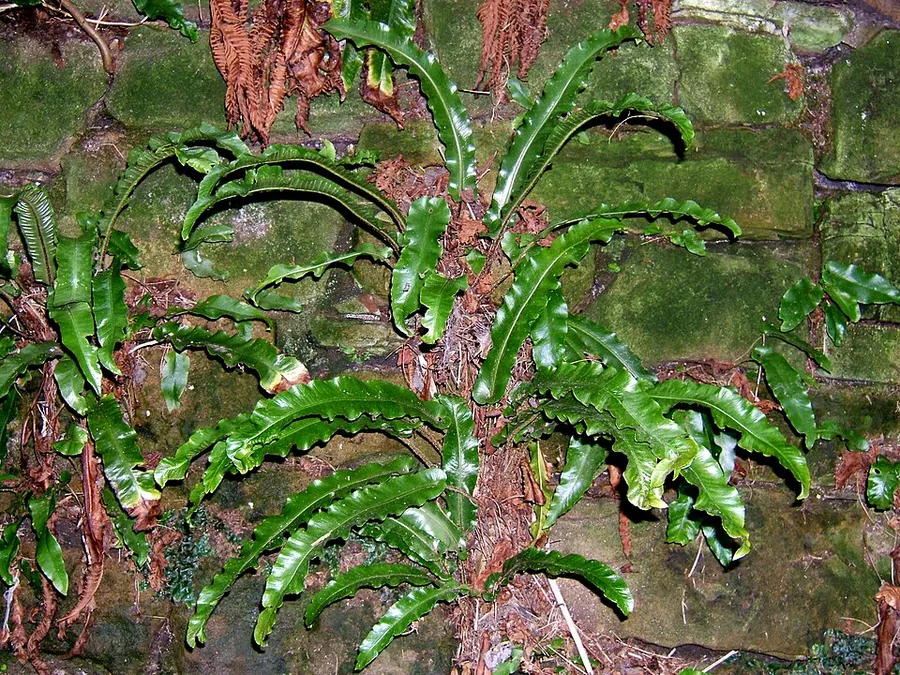
Run a hand along a hart's tongue fern and the surprise is how little it feels like a fern. There is no lacy, feathery cutwork here. Each frond is a long, undivided strap of bright, glossy green, smooth-faced and slightly leathery, tapering to a soft point and often waving a little along its length.
The fronds all spring from a single tight central crown, arching outward so the plant reads as a low, rounded shuttlecock of blades rather than a spreading tuft. Turn a frond over and the underside carries the fern's signature: neat, slanting rows of spore cases set in a herringbone pattern across the back of each strap. It belongs to the spleenwort family and grows wild on shaded limestone walls, rocky banks, and cave mouths across Europe.
In color it stays a deep, even green year-round, since the plant is evergreen and the strap blades persist through winter. Fresh fronds arrive tightly coiled as croziers, unrolling from the crown into the same smooth, glossy straps, and the whole rosette holds a bold, almost reptilian texture up close.
Care
The short version: those glossy strap fronds hold up best in full to partial shade, in soil kept evenly moist yet sharply drained, in a sweet alkaline mix with a little lime, and under the higher humidity of the shaded rock it came from.
Light
Those glossy straps hold their deep green in shade, so give it full to partial shade, the dappled or deep cover found under trees or against a north wall. Direct sun scorches the blades and dulls their sheen, so keep it clear of hot afternoon light.
Water
Keep the soil evenly moist but never waterlogged, watering every 5 to 10 days and more often through a dry spell or the first season after planting. Drainage counts as much as moisture, since standing water rots the roots that feed those fronds while drought crisps their edges, so a moist, sharply drained soil is the aim.
Soil
Plant it in humus-rich, well-drained soil that leans alkaline, ideally a pH between 6.5 and 8.0. It is one of the few ferns that genuinely takes to lime, so a chalky or limestone-rich mix keeps the crown firm where fussier plants would fail.
Temperature
The strap blades are tough, riding out winter lows down to -20°F (-29°C) and summer warmth up to about 75°F (24°C). That hardiness is why the green fronds stay put across zones 5 to 9 rather than dying back underground.
Humidity
Grown on shaded rock and cave mouths, it wants air on the damp side, around 50% to 80%. Dry air browns and crisps the frond tips, so group it with other plants or set it where the air stays still and moist to keep the blades whole.
Feeding
Ferns are light feeders, so go easy. A diluted, balanced liquid fertilizer once in spring keeps the fronds a healthy green, and overfeeding does more harm than good.
Pruning
There is little to do. Pull off any dead or damaged straps as you spot them, and cut back the tatty, winter-burned old fronds in late winter, just before the tight new croziers begin to unfurl.
Repotting
A potted plant needs moving only every 2 to 3 years, or sooner if roots push through the drainage holes, the crown looks congested, or water runs straight through. Step it up into a slightly larger pot with fresh, lime-rich, gritty mix.
Size & spacing
The rosette stays compact and slow, reaching about 12 to 18 inches (30 to 46 cm) tall and roughly the same across. Allow each plant 12 to 18 inches (30 to 46 cm) of room so the crown can open its full ring of arching straps.
When to plant
This fern is hardy and slow to build. Ripe spores are sown indoors in spring to raise new plants, and young rosettes go out in spring once hard frost has passed. It stays evergreen in zones 5 through 9, so the strap blades persist year-round rather than dying back to the ground.
Northern hemisphere
Southern hemisphere
Typical months for a temperate climate: start earlier in warm zones, later where spring frosts linger.
- Sow: Sow ripe spores indoors in spring at about 15°C (60°F)
- Plant: Spring, after the danger of hard frost has passed
Hardiness
USDA hardiness zones: 5–9
Temperature: down to -29°C
Troubleshooting
Most of what mars those glossy straps comes down to water and light, not pests. Wet roots and too much sun cause nearly all of it. Match the look of the fronds below, then adjust the conditions before the damage spreads across the blades.
Straps flopping down over blackened, mushy roots
Those slumping straps trace back to root rot from soil left too wet, not to any disease. Draw the plant up and the roots betray it, gone soft, dark, and sour-smelling where healthy ones stay firm and pale. Pare off the blackened roots, mend the drainage, and reset the crown into a gritty, lime-rich mix before it gives way.
Fix:
- Improve drainage immediately
- Reduce watering frequency
- Repot into a gritty, well-drained, lime-rich mix and trim away rotted roots
Scorched brown tips and edges along the glossy blades
Brittle brown edges on the once-glossy blades are sun scorch, usually with dry air or thirsty soil behind them. The browning bites hardest on the side that faces the sun while the shaded straps keep their deep green. Draw the plant back into shade, thicken the humidity around it, and hold the soil evenly moist so the new blades come up whole.
Fix:
- Move to a shadier spot
- Raise humidity around the plant
- Keep soil evenly moist
Old outer straps browning and tattering through winter
The frayed, browning straps on the outer edge are winter burn, the price cold and drying wind exact from an evergreen. The ragged look sits only on the oldest fronds; the tight green crown at the center holds firm and coils out fresh growth in spring. Cut the tattered blades away in late winter, just as the new croziers begin to unfurl.
Fix:
- Cut back damaged fronds in late winter before new croziers unfurl
Toxicity
For a shade planting shared with pets and children, this fern is safe. As a true fern it carries no known toxin, so cats, dogs, and grazing animals can be around it without risk. The one real caution is physical, since the fronds and their spore-bearing undersides can scratch or irritate sensitive skin, so wash your hands after handling it.
Safe for
People · Cats · Dogs · Horses · Rabbits · Livestock · Birds
Cats None
The glossy straps hold no toxic risk for cats. A curious bite of the leathery frond may bring the mild stomach upset any greenery can, and nothing worse.
Dogs None
There is no poison in these fronds for dogs. A chewed strap may prompt a little drool or a brief loss of appetite from the tough roughage, though the plant itself does no harm.
Horses None
Horses can graze beside the fern safely. A true fern of this kind carries no toxin in its leathery fronds that would trouble them.
Rabbits None
A rabbit can nibble the strap-shaped blades without harm. It is best as one part of a varied diet rather than the whole meal.
Livestock None
Cattle, goats, and sheep take no poisoning from this fern and can share a shaded paddock among its low green rosettes.
Birds None
Birds are in no danger around the plant, whether they settle among the arching fronds or pick at a blade.
People None
The fern is safe to handle and grow around children. The one thing to note is that the fronds and their spore-bearing undersides can scratch or irritate sensitive skin, so wash your hands after pruning.
Fronds and spores may cause mild mechanical irritation in sensitive individuals; wash hands after handling.
Varieties
Beyond the plain-bladed species, a few selections are prized for the way their strap fronds twist, ripple, and flare. These are the forms worth a close look.
'Crispum'
Its strap-shaped fronds carry margins frilled and crisped into tight, ruffled waves along both edges.
'Undulatum'
Each blade ripples with pronounced wavy edges that run unbroken from base to tip.
'Angustatum'
Its fronds are slimmer and more narrowly strap-like than the broad blades of the plain species.
'Sagittatum'
The foot of each frond splits into a distinct arrow- or fishtail-shaped pair of pointed lobes.
var. americanum (American hart's-tongue fern)
A rare North American native of shaded limestone sinkholes, federally protected and not the form sold on garden-center benches.
How to propagate
You can multiply this fern two ways: split an established crown-clustered clump for quick results, or grow it the slow way from spores.
DivisionModerate
Late winter to early spring · 2-3 months for divisions; spore-grown plants take 1-2+ years to reach garden size
The simplest route is division in late winter to early spring. Lift a mature clump that has thrown up several tight crowns, tease them apart, and each piece knits in over two to three months. Spores are the other option, dusted across the surface of a sterile mix as they ripen and held at about 60°F (15°C), but the wait is long, and a spore-grown plant needs one to two years or more to reach garden size.
Myths
Because its fronds are undivided and strap-like, it is not a real fern.
It is a true fern despite the plain, undivided blades. It reproduces by spores, laid out in tidy herringbone rows of sori across the frond undersides, even though those leaves never break into the lacy cutwork people picture.
Hart's tongue fern is endangered and illegal to grow.
The widespread European species is common and sold freely for the garden. Only the North American native variety, var. americanum, is rare and legally protected, and that plant is not the one on the nursery bench.