Shrub · Grossulariaceae
Gooseberry
Ribes uva-crispa
A thorny, cold-hardy berry bush of arching canes and round fruit, happiest with cool conditions, an open shape, and steady moisture.
Full sun
Every 5–7 days
USDA 3–8
3–5 ft · 0.9–1.5 m
Overview
The gooseberry is a thorny, deciduous shrub grown for its tart-sweet berries, its bare winter canes bristling with sharp spines set along the stems and clustered at the leaf joints. It sits in the Ribes genus beside the currants, and it is remarkably hardy, its woody frame riding out winters down to -22°F (-30°C) with the leaves long since shed.
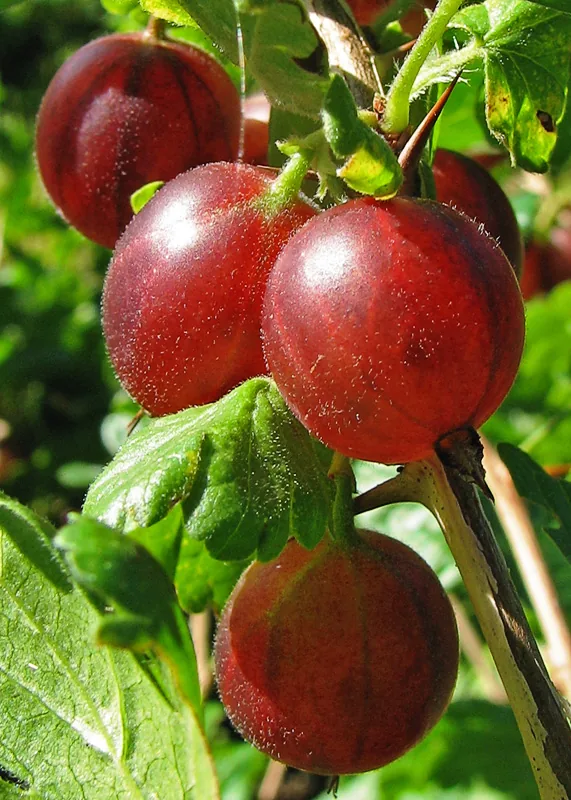
In leaf, the bush rounds into a mound about 3 to 5 feet (90 to 150 cm) across, its arching canes bending under fruit that hangs from spurs of two- and three-year-old wood. The berries ripen as small rounded orbs in green, red, and the shades between, their color set by the variety. Most stems wear a rough armor of spines, though the near-smooth canes of Captivator and Pixwell carry barely a thorn.
Every part of the plant tells you what it wants. Beneath the prickly canes it reaches for cool roots, even moisture, and open air threading through the center of the bush, and it wilts and stalls in heat and drought. Give it the right footing and a yearly prune, and the same spiny frame keeps fruiting for well over a decade.
Care
The short version: full sun to partial shade in a cool, moist spot, rich well-drained soil, about an inch of water a week, and a hard yearly prune in late winter to keep the center of the bush open.
Light
Gooseberries take full sun to partial shade, and a little afternoon shade suits them where summers run warm. At heart these are cool-climate plants, so a spot that bakes the canes all day brings stress and sunscald rather than fuller fruit.
Water
Give the bush about 1 inch of water a week through the growing season, and keep it from drying while the small berries swell toward ripe. A blanket of mulch over the roots holds them cool and moist, the very footing a gooseberry wants.
Soil
Plant into fertile, well-drained loam thick with organic matter. A pH between 6.0 and 7.0 suits the roots, and free drainage counts, since they will not sit in cold, wet ground.
Temperature
This is a tough, woody shrub, hardy from -22°F to 86°F (-30°C to 30°C). It leans on winter cold to crop well, and it would sooner face a cool summer than a scorching one.
Humidity
Everyday humidity of 40% to 70% is nothing to fuss over outdoors. Far more telling is the air moving through the bush, since still, damp air trapped among crowded leaves is where the white bloom of powdery mildew takes hold.
Feeding
Feed once in early spring before the buds break, with a balanced fertilizer or composted manure. Add a touch more nitrogen only where the growth looks weak and thin, since a rush of soft new shoots simply invites mildew.
Pruning
Prune each year while the bare canes are dormant in late winter. Keep an open center, cut out canes older than 3 years along with any low, crowded, or damaged wood, and leave the short spurs on 2- and 3-year-old wood where the fruit forms.
Repotting
A field-grown bush is never repotted, but a container specimen wants a larger pot every 2 to 3 years. Roots circling the pot, small leaves, slowed growth, or water running straight through all show its moment has come.
Size & spacing
A settled bush stands 3 to 5 feet (90 to 150 cm) tall and spreads about as wide. Give each plant that much room so air moves freely between the arching, spiny canes and disease has less foothold.
When to plant
Gooseberries are woody perennials, their spiny frame planted once and cropped for years. Set new bushes out in early spring as soon as the soil can be worked, or in late fall once the leaves have dropped and the canes stand bare. Pale blooms open in early spring, and the round berries color up and ripen through June and July.
Northern hemisphere
Southern hemisphere
Typical months for a temperate climate: start earlier in warm zones, later where spring frosts linger.
- Plant: early spring as soon as soil is workable, or in late fall while dormant
- Harvest: blooms early spring; berries harvested June to July
Hardiness
USDA hardiness zones: 3–8
Temperature: down to -40°C
Troubleshooting
Nearly all of a gooseberry's trouble shows on the leaves, whether a pale fungal bloom on still, damp air or green larvae chewing out from the heart of the bush. Look closely and early, and an open, well-pruned plant sheds most of it. Match the mark you see below, then act before it spreads.
Felted white powder cloaking shoot tips and berries
A dusting of pale white felt over the soft shoot tips and young berries is American gooseberry mildew, a fungus that settles where the air stays still and the growth stays soft. The white bloom hardens over time into brown, corky scabs that scar the skin of the fruit. Cut the bush more open, strip away the worst-coated shoots and berries, and lean on resistant types like Invicta or Captivator.
Fix:
- Prune to open the canopy and improve airflow
- Remove and destroy infected shoots and berries
- Apply sulfur or an approved fungicide on a protectant schedule
- Replant with mildew-resistant cultivars such as Invicta or Captivator
Orange-yellow spots stippling leaf undersides before they fall
Flip a leaf and find warm orange-yellow pustules speckled across the underside, and the trouble is white pine blister rust, which uses the gooseberry as its alternate host. The bright spots surface in summer, and heavily marked leaves sometimes let go early. Take out any badly spotted bushes, set resistant cultivars in their place, and keep the plants well away from eastern white pine.
Fix:
- Remove and destroy heavily infected Ribes
- Plant immune or resistant cultivars
- Keep bushes well away from eastern white pine
Leaves reduced to naked stems inside a few days
Green leaves reduced to bare, naked stems in short order is the signature of the imported currantworm, the larva of the gooseberry sawfly. The green, dark-spotted larvae start deep in the middle of the bush and eat their way outward, leaving skeletonized branches within days. Pick the larvae off, wet young ones with insecticidal soap or spinosad, and part the lower inner leaves early in spring to catch the first feeding.
Fix:
- Handpick larvae
- Apply insecticidal soap or spinosad to young larvae
- Inspect lower interior leaves in early spring for first feeding
Brown angular spots and naked lower canes by midsummer
Small brown, sharp-edged flecks that spread across the leaf and blush it yellow are fungal leaf spot, among the milder marks a gooseberry carries. The fungus waits out winter in the fallen leaves below and climbs from the base, leaving the lowest branches bare and stripped by midsummer. Rake off and destroy the spent leaves, thin the bush for airflow, and spray an approved fungicide only when the leaves are dropping fast.
Fix:
- Rake and destroy fallen leaves
- Improve air circulation by pruning
- Apply an approved fungicide if defoliation is severe
Toxicity
For a household with animals, the gooseberry is easy company: it is not toxic. Its leaves and round ripe berries are safe for pets, livestock, and people, and the fruit is genuinely worth eating. The one thing to respect is the fringe of sharp spines along the stems, a physical hazard rather than a chemical one.
Safe for
People · Cats · Dogs · Horses · Rabbits · Livestock · Birds
Cats None
No part of the bush holds a poison that can reach a cat. The one thing with teeth is the sharp spines bristling along the stems, which can rake a curious nose or paw.
Dogs None
A dog can mouth the leaves or the round berries and take no harm from either. Only the thorns studding the canes ask for care around a chewer or digger.
Horses Safe
Nothing in a gooseberry carries a toxin that reaches a horse, so a stray mouthful of foliage passes without trouble. The stiff prickly stems are the part to keep clear of a soft muzzle.
Rabbits Safe
The leaves and the ripe, rounded berries are both safe for rabbits, and the fruit makes a fine occasional treat. Only the spines running down the woody stems call for a little care.
Livestock Safe
Cattle, goats, and sheep can browse around a gooseberry with no poisoning to fear. The thorny canes prickle and catch, but they are a nuisance rather than a danger.
Birds Safe
Birds pluck the plump berries freely and often clear a ripe crop before anyone else does. No toxin lurks in the fruit, leaving only the bristly stems to thread through.
People Safe
The ripe berries are good to eat straight off the bush or cooked, and no part of the plant holds poison. Slip on gloves for picking and pruning, since the spines are the single sharp hazard the bush presents.
Most gooseberry bushes carry sharp spines or thorns on the stems and at the nodes that can prick skin and pets; the hazard is physical, not chemical. Wear gloves when pruning and harvesting.
Varieties
Named gooseberries run to dozens, told apart mostly by the color of the round berries, how thickly the canes are spined, and how well they resist disease. These are the ones most worth knowing.
Captivator
A nearly thornless American-European hybrid whose smooth canes carry sweet red dessert berries and resist powdery mildew.
Invicta
A heavy-cropping European cultivar hung with green berries and prized most for its strong resistance to powdery mildew.
Hinnonmaki Red
A cold-hardy Finnish type set with sweet-tart red berries that also stands up well against disease.
Pixwell
An exceptionally hardy American variety with near-smooth, nearly thornless canes and pink-blushed fruit.
Companions
Gooseberries do best beside plants that deter pests or feed the soil, and worst near the white pines that share their worst disease.
Plant near
Chives and other alliums: Their strong scent can help deter some foliage pests around the bush.
Comfrey: Deep roots draw up nutrients and the cut leaves make a useful potassium-rich mulch for fruiting shrubs.
Keep apart
Eastern white pine: Five-needle pines are the other host of white pine blister rust, so planting them nearby spreads the disease between the two.
How to propagate
Gooseberries are easy to multiply from their own wood and shoots, and three methods work depending on your patience and the size of the bush already growing.
Stem cuttingsModerate
Late autumn while dormant · Roots over one season; bushes bear fruit in 1-3 years
Cut 8 to 12 inch hardwood cuttings of firm, bare wood from this season's growth in late autumn while the bush is dormant, then sink them two-thirds deep into moist soil. Roots form through the following season, and the young bush sets its first fruit within 1 to 3 years.
LayeringEasy
Spring to summer · Rooted by the following spring
The simplest route is layering. Draw a low, arching outer shoot down to the soil at any point from spring through summer, pin and bury a length of it, and by the following spring that buried stretch has rooted enough to cut free from the parent.
DivisionModerate
Dormant season · One season
An established clump can be divided in the dormant season. Lift the whole plant and pull the suckering growth apart into pieces, each holding its own roots and shoots, and the divisions take hold over a single season.
Myths
No state in the US will let you grow a gooseberry bush.
The old federal ban was lifted in 1966. What decides your planting now is your own state and county rules, and many places allow rust-resistant cultivars.
Sweet gooseberries come only from strong heat and full, blazing sun.
These are cool-climate plants that take partial shade in stride. A hot, dry spot only brings on sunscald and stress rather than sweeter berries.