Houseplant · Oxalidaceae
False Shamrock
Oxalis triangularis
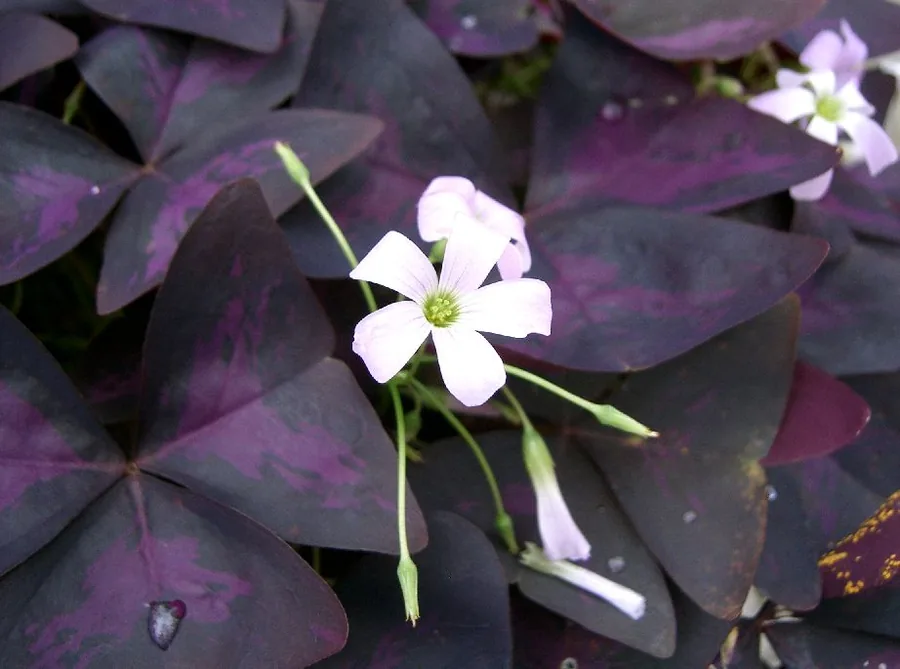
Deep purple, three-cornered leaflets that spread flat by day and fold into little tents at night, rising from small bulbs.
Bright indirect
55–75°F · 13–24°C
USDA 8–11
6–18 in · 15–46 cm
Overview
False shamrock is grown for its foliage more than its bloom. Each leaf breaks into three deep purple, triangular leaflets, broad at the tip and tapering to the stalk, that spread open in the morning and fold down at dusk into little closed tents. It comes from Brazil and Paraguay, rising on slender stalks from small bulbs, and the pale pink to white flowers that follow sit modestly above the dark leaves.
The strangest thing it does is shed its color entirely. After a hot stretch or in autumn, the purple leaves yellow, go limp, and collapse onto the soil until the pot looks bare. The plant is not dead. It is going dormant, the leaves gone while the small bulbs sit underground, and once a cool spell and fresh water reach them the dark leaflets push back up.
Its needs match its quiet looks. Bright indirect light to hold the purple, soil kept barely moist, and a rest now and then are about all it takes. The one hidden trait is that every part holds oxalic acid, the same sharpness that makes the leaves taste tart, so keep it away from pets that like to chew.
Care
The short version: bright indirect light, soil kept barely moist but never soggy, and room warmth between 55°F and 75°F (13°C to 24°C). Let the leaves wither and rest when they will, then water again to draw fresh purple shoots up.
Light
Set it in bright, indirect light and the leaflets hold their darkest maroon-purple. It takes some full sun and copes with partial shade, but in dim light the stalks stretch thin and leggy and the purple drains away toward a flat green.
Water
Keep the soil barely moist but never wet, letting the top inch or so dry between drinks, since soggy soil rots the pale bulbs below. As the leaflets start to yellow and droop, ease off and then stop watering altogether so the plant can rest.
Soil
Settle the bulbs into a loose, free-draining potting mix, whether soil-based or soilless. Texture hardly matters to it, and it copes across a broad pH span of 6.0 to 8.0, so nearly any everyday houseplant blend does the job provided excess water clears away readily.
Temperature
Ordinary room warmth suits it, ideally 55°F to 75°F (13°C to 24°C) with cooler nights. It dislikes real heat, which often wilts the leaflets and tips it into an early dormancy.
Humidity
Plain room air suits it, and there is no target reading to chase. What the plant answers to is even dampness down at the bulbs, far more than any moisture drifting around the leaves.
Feeding
Offer a balanced houseplant fertilizer about once a month, and only across the spring-to-fall stretch while fresh purple leaflets keep rising. The moment the foliage retreats into dormancy, halt feeding altogether, since resting bulbs draw nothing from it.
Pruning
Pruning is mostly tidying. Pull or snip off any yellowing or dead leaves that flop against the soil, and cut out any leaflet flecked with rust as soon as you see it to stop the fungus spreading.
Repotting
Move it to a fresh pot every few years, or earlier when packed bulbs fill the container and the leaflets emerge stunted. Nestle the pale bulbs a touch below the surface of a free-draining mix; this same moment is ideal for splitting a clump that has thickened up.
Size & spacing
Grown out, it forms a squat cushion of stalked leaflets reaching 6 to 18 inches (15 to 46 cm) in height and fanning 12 to 24 inches (30 to 61 cm) across. Compact and unhurried, it tucks neatly onto a sill or a shelf.
Troubleshooting
Little goes wrong with this plant, and the one change that looks dire is just the foliage retreating. Tell a natural withering apart from real trouble and the rest is simple. Match what you see on the leaves below before you reach for the watering can.
Raised orange to brown spots speckling the leaves
The culprit is oxalis rust, a fungus that pushes up orange to brown blisters across the blade, each ringed by a faded, discolored halo. Cut away and throw out any leaf showing them the moment it turns up. Open the air around the plant and keep droplets off the leaves, because wet foliage is how the spores travel.
Fix:
- Prune and dispose of diseased foliage
- Improve air circulation and avoid wetting foliage
Purple leaves yellow, go limp, and collapse onto the soil
This is almost always natural dormancy, not a sick plant. False shamrock grows from small bulbs that rest each year, usually after a hot spell or in autumn, and the purple leaflets yellow and fold flat while the bulbs wait underground. Stop watering, clear away the withered foliage, and set the pot somewhere cool and dark for about a month before you bring it back into the light and start watering again.
Fix:
- Stop watering and let the leaves dry out
- Remove dead foliage and place the pot in a cool, dark spot for about a month
- Resume watering and return to light when new growth appears
Toxicity
Those glossy purple leaflets carry more than color. Soluble oxalic acid runs through all of them, tip to bulb, and the ASPCA flags the plant as poisonous to dogs, cats, and horses. Taste a single leaf and the worst is likely a stinging mouth or a churned belly; work through a whole fistful and that same acid can pull blood calcium low and tax the kidneys. For that reason, set the pot where curious pets and small children cannot reach the foliage.
Toxic to
Cats · Dogs · Horses · Rabbits · Livestock · Birds · People
Cats Caution
A small nibble of the tart leaves usually causes nothing worse than drooling and a queasy stomach. It takes a big mouthful to do real harm, and even then the sharp bitter taste tends to stop a cat well before that point. Watch for vomiting or tremors if one eats a lot.
Dogs Caution
A dog nosing at one or two of the leaves may drool a bit and go off its stomach for a spell. The hazard rises only when a dog eats its way through a real heap of leaves, which can trigger vomiting and, rarely, a fall in blood calcium.
Horses Caution
One idle mouthful of the leaves rarely bothers a horse at all. The real worry is steady or bulk grazing, where the soluble oxalates build up and can bring on colic and the gradual signs of a calcium imbalance.
Rabbits Caution
Rabbits meet the very oxalates that trouble dogs and cats, so this belongs well away from them. One odd nibble does little, but letting a rabbit browse the leaflets is a bad idea.
Livestock Caution
For goats, cattle, and sheep the danger climbs with how much is eaten. Damage comes of grazing the plant down in quantity rather than nipping a single leaf, so set larger clumps out of their reach.
Birds Caution
Best treated as off-limits for pet birds. The oxalic acid in the leaves can irritate the gut, and there is no reason to let a bird pick at the foliage.
People Caution
This is not a plant grown to eat, and the leaves are tart with oxalic acid. A child who chews one might get a sore mouth and an upset stomach, so keep it out of small hands, though the sharp bitter flavor usually cuts a taste-test short.
All parts have toxic potential; keep out of reach of pets and children.
Helpline numbers

United States
ASPCA Animal Poison Control: (888) 426-4435 (fee applies)
Poison Control: (800) 222-1222



Canada
Poison Centres: 1-844-764-7669
Varieties
What is sold as false shamrock is nearly always the deep purple form, and its color is the reason to know it.
Oxalis triangularis subsp. triangularis
This is the plum-colored version most people have in mind, its three-part leaflets a deep wine-dark maroon and shaped as blunt triangles that clap shut come nightfall or at any sharp bump to the plant.
How to propagate
Below the soil the plant crowds itself with small, pale bulbs, and they come apart at the lightest pull, each one ready to send up its own purple shoots.
Bulbs & cormsEasy
During dormancy · A few weeks once watering resumes and new growth begins
Hold off until dormancy has fully set in, then lift the whole clump free and tease the crowd of small pale bulbs apart, a task that needs almost no force since they let go of one another so easily. Nestle them a handful at a time into fresh soil, each sitting just below the surface. Once watering picks up, dark young leaflets break ground within a few weeks.
DivisionEasy
During dormancy or at repotting · A few weeks
Once a container turns overcrowded, ease it out during dormancy or at repotting and break the tight cluster of pale bulbs into a few smaller bunches. Pot each bunch on its own and it takes hold within a few weeks.
Myths
Those purple leaves are no worse than a pothos or philodendron, giving only a passing sting to the mouth.
The oxalate inside each plant is not the same thing. Pothos packs needle-like insoluble crystals that scratch and sting the lips the instant they touch, and no further. The dark leaflets of false shamrock instead carry soluble oxalate that the body absorbs, and taken in quantity it can drop blood calcium and burden the kidneys. Because the ASPCA marks the plant poisonous to dogs, cats, and horses, one heavy mouthful genuinely matters, even where a single tart bite does not.
Once the purple leaflets shrivel and drop, the plant is gone and the pot is fit only for tossing out.
Empty soil reads as a dead plant, yet the plump little bulbs below are only resting through a normal dormancy. Hold off on water, tuck the pot into a cool, dark corner for about a month, and once watering starts again the dark leaflets unfurl right back up out of the surface.