Shrub · Celastraceae
Evergreen Euonymus
Euonymus japonicus
A tough, shade-friendly evergreen dressed in glossy leaves that shears into a hedge and asks for almost nothing.
Full sun
Every 7–14 days
USDA 6–9
10–15 ft · 3–4.6 m
Overview
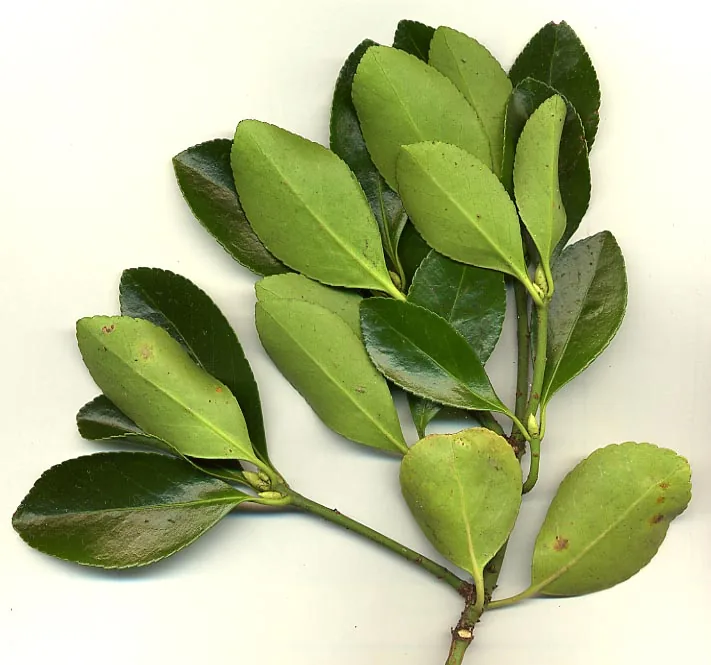
Evergreen euonymus carries thick, leathery leaves with a hard polish, oval blades of deep green that hold their shine through every season. The foliage sits close and dense along woody stems, and the whole shrub stays clothed through winter, taking cold as low as -9°F (-23°C). That glossy, year-round cover is why it ends up sheared into hedges and clipped foundation plantings so often.
It belongs to a large genus of spindle trees, and the upright Japanese species (Euonymus japonicus) is one of the most planted. Up close the appeal is in the leaves: a firm, waxy surface that takes a clean cut, plus variegated forms where bright gold or crisp white edges ring the green margin of each blade.
The flowers are tiny, greenish-white, and easy to miss among the foliage, so this is a plant read by its leaves and form rather than its bloom. Give it well-drained ground and open air around the canopy and the leaves stay glossy and unblemished for years. Let the air go still and damp, though, and two flaws creep across that smooth surface, scale and mildew.
Care
The short version: sun to full shade, well-drained soil, and a deep drink only when the top half of the root zone dries. Shear the glossy growth to shape in late spring, feed lightly once in early spring, and watch the leaves and stems for the crusty specks of scale.
Light
This shrub grows across the whole light range, from full sun to full shade. Sun packs the leaves in dense and dark and sharpens the gold or white edging on variegated forms, while a shadier spot still keeps it green but spaces the leaves out into a looser, more open shape.
Water
Water deeply, then let the top half of the root zone dry before the next drink, roughly every 7 to 14 days. The glossy leaves ride out drought once the plant is established, but soggy roots will not do, so drainage matters more than how often you pour.
Soil
It roots into clay, loam, or sand, though a moist, humusy, well-drained soil grows the fullest, glossiest leaves. The pH range runs wide, from 5.5 to 8.0, so most garden ground suits it without amendment.
Temperature
Cold-hardy and heat-tolerant, the foliage holds firm from -9°F to 100°F (-23°C to 38°C). That long span covers many climates, which is part of why the shrub turns up almost everywhere.
Humidity
Ordinary outdoor humidity is all the leaves ask for, so there is no level to manage. What counts far more is airflow around the foliage, since still, damp air clinging to the leaf surface is what lets scale and powdery mildew settle in.
Feeding
A light hand keeps the leaves firm and tight. Work in a balanced general-purpose shrub fertilizer once in early spring and stop there, because heavy feeding pushes out soft, loose growth that pests favor.
Pruning
Few shrubs take a shearing as cleanly as this one, the firm stems and leaves cutting to a crisp line. Clip it to shape in late spring after the new growth flushes, and cut out any scale-crusted or diseased branches whenever you spot them.
Repotting
In a container it seldom needs a larger pot. Repot only when roots circle the pot, water runs straight through, or growth stalls, since the plant is slow to outgrow its space.
Size & spacing
Left unsheared it climbs to 10 to 15 feet (3 to 4.5 m) tall and broadens 5 to 8 feet (152 to 244 cm) wide. Give a hedge that much room, or shear the glossy mass down and plant closer for a tighter wall of green.
When to plant
This is a four-season evergreen rather than a seasonal crop, so its leaves never fully drop and there is no sowing window to chase. Set new plants out in spring or fall while the soil is workable, and the roots take hold across the cool, damp weeks before summer heat arrives.
Northern hemisphere
Southern hemisphere
Typical months for a temperate climate: start earlier in warm zones, later where spring frosts linger.
- Plant: Spring or fall
- Harvest: Inconspicuous greenish-white flowers in late spring to early summer (June)
Hardiness
USDA hardiness zones: 6–9
Temperature: down to -23°C
Troubleshooting
Most euonymus trouble shows on the leaves first, written across that glossy surface as spots, dusty films, or curled tips, and the worst of it traces back to crowded, stagnant air. Catch scale and mildew early and they stay manageable. Match the look below, then act before it spreads through the hedge.
Pale and dark scale crusts pebbling the leaves and stems
Brown-to-yellow spotting, an overall fade, and leaves let go before their time all trace to euonymus scale, an armored insect that drills into the tissue and siphons the sap. Two shapes pepper the leaf undersides and the bark of the stems: slender, chalky white males like grains of rice and dark, ridged females curved like tiny oystershells. Cut away the most encrusted branches, then coat the pinpoint orange crawlers in horticultural oil as they appear in late winter or spring.
Fix:
- Hand-scrape or prune out lightly to heavily infested branches and discard them
- Apply horticultural oil with thorough coverage timed to crawler emergence in late winter or spring
- Use a soil-applied systemic such as dinotefuran once in spring for heavy infestations
- Conserve natural enemies such as predatory beetles (Chilocorus species) and parasitic wasps
Rough corky knobs swelling at the base and stems
Coarse, corky knobs the size of a few inches, rough and tumor-like where they ring the crown and lower stems, are the mark of crown gall, a soil bacterium that slips in through a wound and pinches off the flow above it until the leaves yellow and whole branches die back. No treatment softens a stem once it has galled. Sever the affected stems below the swelling, wipe the blades with rubbing alcohol between cuts, and leave that soil bare of a susceptible shrub for a few years.
Fix:
- Prune affected stems below the galls and sterilize tools with rubbing alcohol between cuts
- Destroy severely infected plants
- Avoid replanting susceptible species in contaminated soil for 2 to 3 years
A flat white-gray dusting over the leaf tops
A flat, chalky white-gray film lying across the upper leaf, the kind that smears under a fingertip, is powdery mildew, a fungus that warps the soft new leaves into curls and leaves dull scars behind. It creeps in where shade and stagnant, damp air sit against the foliage, so thinning the shrub and moving it into sun strips away those conditions. Gather the dropped leaves, keep droplets off the surfaces, and bring in a labeled fungicide only if the bloom of fungus widens.
Fix:
- Prune out diseased branches and remove fallen leaves
- Improve air circulation with proper spacing and plant in sunny areas
- Avoid overhead watering
- Apply a labeled fungicide such as myclobutanil, propiconazole, sulfur, or horticultural oil, rotating products to prevent resistance
Curled tender shoots glossed with sticky honeydew
Soft, pinhead-sized bodies packed along the tender new shoots are aphids, and the clear, sticky honeydew they leave glazes the growth and later blackens into sooty mold. A hard jet of water rolls most of the cluster off the buckled, curling tips. Treat any that cling on with insecticidal soap or horticultural oil, and hold back the nitrogen, since the lush, soft shoots it forces are exactly the tissue aphids swarm.
Fix:
- Dislodge aphids with a strong spray of water
- Apply insecticidal soap or horticultural oil to affected growth
- Conserve beneficial predators such as lady beetles
Toxicity
For all its handsome foliage, this is a hands-off shrub around animals and small children. The leathery leaves, the bark, and the bright fruit hold alkaloids and cardiac glycosides that upset the stomach and, in larger amounts, disturb the heart rhythm. Nothing on it is food, so keep dropped berries and prunings cleaned up where pets and kids gather.
Toxic to
Cats · Dogs · Horses · Rabbits · Livestock · Birds · People
Cats Toxic
A cat that bites into the firm, glossy leaves or the colorful fruit usually drools and vomits, with diarrhea and a sore stomach to follow. A larger mouthful reaches the heart, where the cardiac glycosides can throw off the rhythm and bring on collapse.
Dogs Toxic
Most dogs that chew the leathery foliage or the seeds inside the fruit start vomiting, drooling, and passing loose stool within hours. Enough of it carries the same heart-rhythm trouble, so a vet call beats waiting it out.
Horses Toxic
A horse that strips the leaves or gnaws the bark goes colicky and dull, with loose manure and weakness setting in. The cardiac glycosides press on the heart, so even a light nibble of the hedge is worth heading off.
Rabbits Toxic
From the glossy leaf to the woody stem, every part of the shrub carries alkaloids and glycosides that make it unsafe for a rabbit. Even a few leaves can set off diarrhea and a fast, struggling decline, so keep rabbits clear of it.
Livestock Toxic
Cattle, sheep, and goats that browse the tough green foliage can drop into digestive upset and the same heart effects. Fence the shrub off from pasture, and never leave prunings where stock can reach them.
Birds Toxic
The bright fruit catches the eye, but the seeds tucked inside hold the toxins, and pet birds in particular can suffer gut upset and heart trouble from a taste. Keep dropped berries out of any aviary or run.
People Caution
No part of this shrub is food. A child drawn to the bright fruit can end up with vomiting and diarrhea, and a large amount risks heart-rhythm effects, so plant it where small hands cannot reach the berries.
Keep fallen fruit, seeds, and prunings away from pets and children; wash hands after pruning.
Helpline numbers

United States
ASPCA Animal Poison Control: (888) 426-4435 (fee applies)
Poison Control: (800) 222-1222



Canada
Poison Centres: 1-844-764-7669
Varieties
The named forms sort out by the look of the leaf, its color and its size, from gold-edged uprights to fine-textured box-leaf dwarfs. These are the ones you will see most.
'Aureomarginatus'
A popular variegated form whose deep green leaves are rimmed with a band of bright golden-yellow right along the leaf edge.
'Microphyllus'
A dwarf box-leaf form built from small, closely set leaves on a dense, compact frame, the same tidy low texture gardeners get from boxwood.
'Microphyllus Variegatus'
A small-leaved dwarf with that identical fine, packed texture, here brushed with white variegation across the foliage.
'Green Spire'
An upright, columnar form sheathed top to bottom in dense, glossy dark green leaves.
How to propagate
Multiplying this shrub is straightforward, and cuttings beat seed both for speed and for holding the leaf color of a variegated form true to the parent.
Stem cuttingsEasy
Summer using semi-hardwood cuttings · Several weeks to a few months to root
Cuttings are the easy and reliable way to multiply this shrub. Take semi-hardwood cuttings in summer, the firm, half-ripened stems that snap rather than bend, and they root well over anywhere from several weeks to a few months. Each one grows into a copy of the parent, which keeps the leaf color of a variegated form true.
SeedModerate
Sow ripe seed after cleaning the fleshy fruit · Slower and more variable than cuttings
Seed is possible, though few gardeners go that way. Rub the soft, fleshy coat off the ripe seed before sowing, then expect slower, more uneven results than cuttings give, and no promise the offspring will carry a variegated parent's markings.
Myths
Evergreen euonymus is the same plant as the invasive wintercreeper.
These are two different species. Evergreen euonymus (Euonymus japonicus) stands as an upright, woody-stemmed shrub, while wintercreeper (Euonymus fortunei) trails and climbs as a groundcover vine that has turned invasive across much of the eastern United States. They share a genus, not a habit, so the form a plant takes, upright bush or creeping vine, is what tells the two apart.
Sources
- NC State Extension Gardener Plant Toolbox
- Missouri Botanical Garden Plant Finder
- Clemson Cooperative Extension Home & Garden Information Center
- NC State Extension Publications
- UC IPM (University of California Agriculture and Natural Resources)
- Pet Poison Helpline
- USDA / University-sponsored Invasive.org (Center for Invasive Species and Ecosystem Health)