Shrub · Aristolochiaceae
Dutchman's Pipe
Aristolochia macrophylla
A woody twiner whose very large heart-shaped leaves overlap into a solid green wall.
Full sun
Every 5–10 days
USDA 4–8
20–30 ft · 6.1–9.1 m
Overview
The leaves are what catch the eye first on Dutchman's pipe: very large, smooth, heart-shaped blades that lie almost flat and overlap one another until the woody twining stems behind them all but vanish. Layered over a porch, arbor, or pergola, they shingle into solid green cover within a season or two. The look is broad and clean-surfaced, leaf upon leaf, with little gap between them.
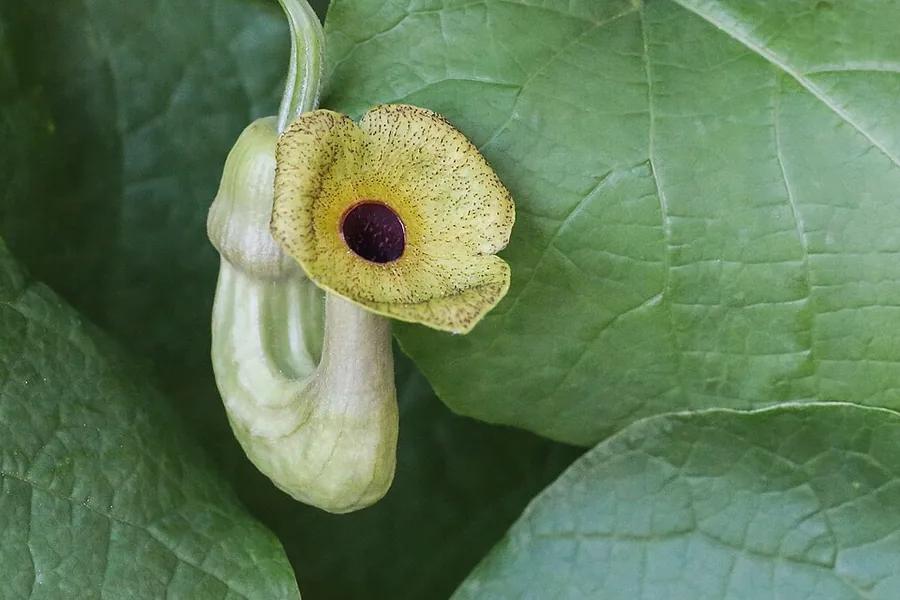
Hidden in that overlapping cover are the small pipe-shaped flowers the plant is named for, curved tubes of yellowish-green tipped with brownish-purple lobes that show in late spring. They sit so deep among the broad leaves that they are easy to miss at a glance. This same vine is the main host for the pipevine swallowtail, whose dark, orange-spotted caterpillars chew along the leaf edges and store the plant's own toxin to turn themselves bitter to birds.
Behind the foliage, the stems are woody and flexible, twining their way upward and thickening as the plant ages. Every part of that growth, leaf, stem, flower, and root, carries aristolochic acid, a compound that damages the kidneys and causes cancer in people, so the plant stays outdoors and never reaches a plate. On a strong support, pruned each winter, it holds its broad-leaved, solid-green character year after year.
Care
The short version: the broad-leaved vine wants full sun to part shade and rich soil kept steadily moist, climbs a sturdy support it cannot pull down, and takes a hard cutback each late winter to keep its overlapping green cover from running away.
Light
Dutchman's pipe takes full sun to part shade, and in good light the broad leaves crowd close and overlap into solid cover. Pushed into deep shade, the blades space out and thin, so the screen turns weak and sparse instead of a packed green wall.
Water
The soil stays consistently moist, since this vine has no tolerance for dry ground, and the broad leaves are the first to flag when it dries. It wants water through dry spells and a good soak roughly every 5 to 10 days while it settles in. A layer of mulch over the roots holds the moisture those large leaves draw on.
Soil
The plant wants rich, well-drained loam thick with organic matter to feed all that leafy growth. It is unfussy about pH, taking anything from 6.0 to 8.0, so the moisture and richness of the soil count for more than its chemistry.
Temperature
This is a tough vine, hardy across a wide span from about -29°F to 95°F (-34°C to 35°C). That deep cold-hardiness is what carries the woody stems through winter and lets the plant return as a perennial vine all the way up into zone 4.
Humidity
Ordinary outdoor air is all the broad leaves ask for, so there is no humidity to manage. Steady moisture at the roots shapes the look of this vine far more than the air around the foliage.
Feeding
A light feed in spring, a balanced fertilizer or some compost worked in at the base, keeps the leaves full. This vigorous native rarely needs much, and rich soil often supplies all the big foliage requires on its own.
Pruning
A hard prune in late winter holds the fast, heavy growth in check and keeps the overlapping leaf cover tidy on the woody framework. The stems take a hard cutback well, so there is no need to hold back, and thinning the tangle lets air slip between the broad leaves.
Repotting
As a plant of open ground rather than a pot, it seldom needs repotting at all. A young vine kept in a nursery container should be moved on before its roots coil around the walls and water begins sliding straight past them.
Size & spacing
The twining stems climb to 20 to 30 feet (6 to 9 m) and the broad-leaved cover spreads 15 to 20 feet (4.5 to 6 m) wide, so the plant needs real room and a real support. A single vine shingles a large arbor on its own, so one sited well beats several crowded close.
When to plant
Dutchman's pipe is a hardy vine for zones 4 to 8 with no narrow planting window. Seed starts in late winter to early spring after a cold spell, or sows outdoors in fall, and young plants set out in spring once frost is gone and the soil works. The small, curved pipe flowers open in late spring, around May and June, deep among the broad leaves.
Northern hemisphere
Southern hemisphere
Typical months for a temperate climate: start earlier in warm zones, later where spring frosts linger.
- Sow: Late winter to early spring (seed needs cold stratification); can also direct sow outdoors in fall
- Plant: Spring after last frost, once soil is workable
- Harvest: Late spring (May to June), with small pipe-shaped flowers hidden among the foliage
Hardiness
USDA hardiness zones: 4–8
Temperature: down to -34°C
Troubleshooting
A settled Dutchman's pipe shows little real trouble, and what surfaces reads in the look of the plant itself: the density of the leaf cover and the load on the stems and support. A prune or a better spot resolves most of it. The chewed, ragged-edged leaves that seem alarming are usually the work of welcome caterpillars.
The vine sprawls past its bounds and buckles the support
This is an overgrown vigorous vine doing what its nature demands, its woody stems twisting up 20 to 30 feet and layering broad leaf over broad leaf faster than a light trellis can bear. Cut it hard in late winter to renew the framework and open up the dense tangle. Set it against a heavy arbor or pergola from the very start, for a slight support will bow and sag beneath all that overlapping foliage.
Fix:
- Prune hard in late winter to reduce size and renew the framework
- Provide a sturdy, substantial support (heavy trellis, arbor, pergola, or strong wires) rated for a heavy woody vine
- Thin tangled stems to improve airflow and keep the screen tidy
Sparse, undersized leaves on spindly, stunted stems
When the leaves come sparse and the stems run weak, the soil is usually too dry, for this plant bears no drought and its broad blades wilt at the first want of water. Deep shade and thin, hungry ground press it down further. Mulch to hold steady moisture, compost worked into the earth, and a place in full sun to part shade coax back the dense, overlapping canopy.
Fix:
- Keep soil consistently moist; mulch to conserve moisture
- Site in full sun to part shade for best density
- Improve soil with compost/organic matter
Ragged leaf margins where dark, orange-spotted caterpillars fed
Those are pipevine swallowtail caterpillars, dark bodies studded with orange, grazing the rims of the broad leaves, and their work is natural rather than a problem. This vine is their chief larval host, and from the foliage they pull aristolochic acid until they are bitter and toxic to birds. Left undisturbed, a healthy vine simply pushes out new blades after the leaves are stripped, and a couple of extra plants keep both the butterflies and full cover.
Fix:
- Do NOT spray or remove the caterpillars - leaf feeding is desirable, not a pest problem
- Tolerate the chewing; a vigorous, established vine readily recovers from defoliation
- Plant extra vines if you want both butterflies and full leaf cover
Toxicity
Every visible part of this vine is poison, from the broad heart-shaped leaves down through the curved pipe-flowers to the woody roots. All of it holds aristolochic acid, a potent kidney toxin and a proven human carcinogen, so none of it is ever eaten or steeped into a remedy. A light nibble might trouble a pet's stomach and nothing worse, yet no part is safe for any person or animal, and children and grazing livestock belong well away from the plant.
Toxic to
Cats · Dogs · Horses · Rabbits · Livestock · Birds · People
Cats Toxic
A cat mouthing the big, smooth blades may foam and be sick, yet the quiet danger is the aristolochic acid threaded through them, which wounds the kidneys. Those broad leaves are best kept well beyond a cat's reach.
Dogs Toxic
A dog gnawing the heart-shaped foliage can drool and heave, the same kidney-harming compound soaking every leaf and woody stem. A true mouthful of the plant is a reason to call the vet.
Horses Toxic
A horse should never crop these woody, leaf-heavy stems. The aristolochic acid running through every pipe-flower, blade, and root is a poison to the kidneys, so the vine belongs far from grazing ground.
Rabbits Toxic
Rabbits belong nowhere near the low, smooth leaves or the twining stems. The toxin steeped through them offers no safe bite, and not one part is fit to eat.
Livestock Toxic
Cattle, goats, and sheep meet the same kidney damage in the broad foliage, where the aristolochic acid pools through leaf and stem alike. Keep the sprawling vine clear of pastures and any fence line they can stretch to.
Birds Toxic
To a bird, every part of the plant is unsafe to swallow. The single exception unfolds on the vine itself, where the dark, orange-spotted pipevine swallowtail caterpillars lock the stored toxin into their bodies and turn it against the birds that would prey on them.
People Caution
For people, nothing among the broad leaves, curved pipe-flowers, or woody roots is food or medicine. The aristolochic acid soaked through them is a proven kidney poison and a known human carcinogen, so it is never brewed into a tea, tincture, or remedy, and hands are washed after handling the stems.
Grow as an outdoor ornamental only. Never consume any part and never use it in teas, tinctures, or herbal remedies - aristolochic acid causes irreversible kidney damage and cancer. Keep pets and children from eating the leaves, stems, fruit, or roots; wash hands after pruning.
Helpline numbers

United States
ASPCA Animal Poison Control: (888) 426-4435 (fee applies)
Poison Control: (800) 222-1222



Canada
Poison Centres: 1-844-764-7669
Varieties
A few pipevines pass under the Dutchman's pipe name, and they differ most in the surface and size of their leaves and stems. These are the ones worth telling apart by sight.
Aristolochia macrophylla (syn. A. durior)
The classic native Dutchman's pipe carries the biggest leaves of the group: broad, smooth, heart-shaped blades that shingle over one another into a dense shade screen. Down among them hide the small, curved pipe-flowers, their tubes yellowish-green and tipped with brownish-purple lobes.
Aristolochia tomentosa (woolly Dutchman's pipe)
Native to the central and southern states, this smaller relative wears a coat of woolly hairs across both leaves and stems, so its whole surface feels soft to the touch. It feeds the pipevine swallowtail every bit as well as its bigger kin.
Aristolochia littoralis / A. elegans (calico or elegant Dutchman's pipe)
For all its flashy bloom, this non-native is a trap to avoid. Female pipevine swallowtails still lay their eggs on its leaves, yet the hatched larvae starve there rather than feed, so the native vines are the ones to set out wherever the butterfly lives.
How to propagate
Increasing Dutchman's pipe takes little effort, whether from seed for those willing to wait or from a quicker copy struck off the long, flexible stems of a vine already in growth.
SeedModerate
Sow in fall outdoors or stratify and start in late winter/early spring · 1-2 seasons to a well-rooted young vine; several years to mature size
Dutchman's pipe drops seed freely, and a cold spell improves germination, so the seed either overwinters in the open ground through fall or takes its chilling indoors before a late-winter to early-spring start. Out of it comes a well-rooted young vine within a season or two, though the full broad-leaved sprawl waits several years.
Stem cuttingsModerate
Take softwood/semi-ripe cuttings in late spring to summer · 1-2 months to root, then grow on
Lengths of softwood or semi-ripe stem, cut between late spring and summer, root down into faithful copies of the parent vine. They strike roots in a month or two, then thicken and grow on before they head outdoors.
LayeringEasy
Spring to summer · One growing season for rooted layers
Easiest of all is layering: the long, whip-like stems are so willing that they root anywhere they press against damp soil. Pin one down from spring through summer and it lifts as a rooted plant by the end of a single growing season.
Myths
Those caterpillars shredding the broad leaves are simply pests to pick off or spray.
Those dark caterpillars, banded with orange spots, are pipevine swallowtail larvae browsing the broad leaves that are their only host. From that foliage they draw aristolochic acid until their own bodies turn bitter and toxic to predators, which is exactly the leaves' role. Let them be, and the vigorous vine will flush out fresh blades to replace what they strip.
Since the caterpillars feast on its leaves, surely the plant is edible or safe to steep.
The chemical those larvae harvest from the leaves, aristolochic acid, is to people a potent kidney poison and a Group 1 human carcinogen, driving irreversible kidney damage and urinary tract cancers. Not a leaf, flower, or root of this vine is ever safe to eat or brew into a remedy.
Any pipevine, native or not, helps the pipevine swallowtails.
A few exotic pipevines, among them the showy calico flower A. littoralis, betray the butterfly: females still dot their eggs across its leaves, but the hatched larvae seldom live to grow. It is the native vines, A. macrophylla and A. tomentosa, whose broad foliage actually sustains the swallowtails.
Sources
- NC State Extension Gardener Plant Toolbox
- Missouri Botanical Garden Plant Finder
- NC State Extension Gardener Plant Toolbox
- ASPCA Animal Poison Control (Toxic and Non-Toxic Plants list)
- University of Florida IFAS Extension (Featured Creatures, Pipevine Swallowtail Battus philenor)
- NIH/NCBI PMC (Systematic Overview of Aristolochic Acids: Nephrotoxicity, Carcinogenicity, and Underlying Mechanisms)