Houseplant · Urticaceae
Chinese Money Plant
Pilea peperomioides
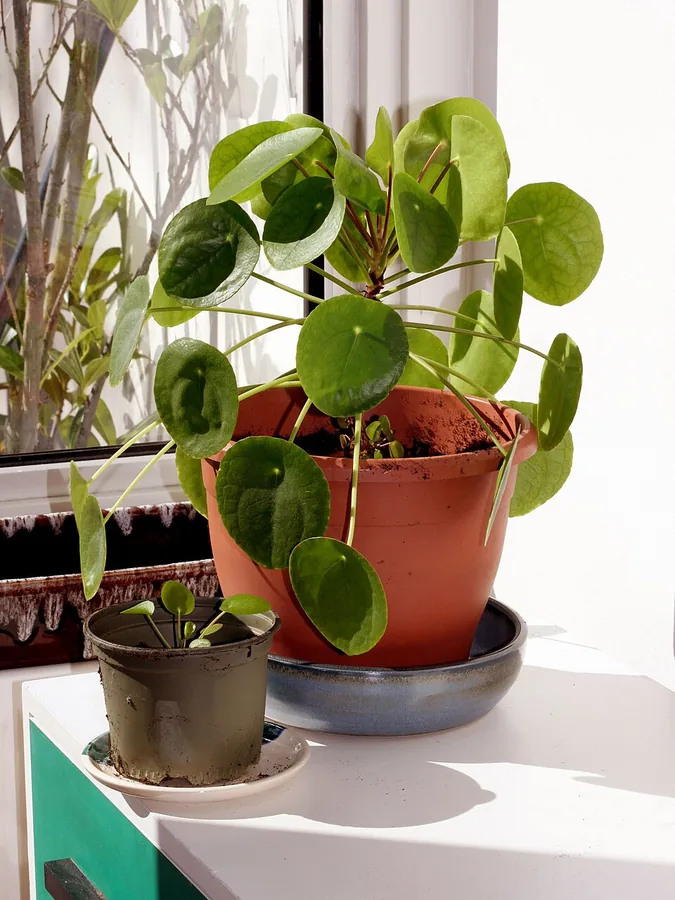
Round, flat, coin-like leaves perched on slender upright stalks above a compact little base.
Bright indirect
55–75°F · 13–24°C
USDA 9–11
8–12 in · 20–30 cm
Overview
The Chinese money plant earns its nicknames the moment you look at it. Each leaf is round and coin-shaped, a flat disc held out on its own slender stalk, and the flatness is exactly why people reach for the word pancake. The plant also answers to UFO plant, friendship plant, and missionary plant, all of them circling back to that distinctive disc.
Native to the mountains of Yunnan in southwest China, this small evergreen perennial is fast-growing and stays neat. The leaves rise on thin upright stalks from a central base, and below the soil a rhizome keeps the whole thing producing. New growth tends to push outward and upward, so the silhouette reads as a tidy cluster of floating discs rather than a sprawling vine.
Up close, the form is the appeal. The leaves sit flat and rounded on their slender stems, and the base of the plant does double duty as a nursery, sending up offsets you can lift and pot. That free sharing, pups passed hand to hand, is what gave the species its names as a friendship plant and missionary plant.
Care
The short version: give this small, compact plant bright indirect light and rotate the pot so it grows evenly; let the top half of the soil dry before a thorough watering, since it rots when it sits wet. Keep it in room warmth of 55°F to 75°F (13°C to 24°C), feed monthly through spring and summer, and lift the pups that push up from the base to make new plants.
Light
Set this plant where it gets bright indirect light and it will grow into a compact, even mound. It also copes with partial shade and medium indirect light, but skimp too far and the change shows in its shape: the stems stretch and elongate, the gaps between leaves widen, and the whole plant leans toward the window chasing what it lacks. Turn the pot regularly so every side fills in.
Water
Let the top half of the soil dry out before you water, then water thoroughly and let the excess drain away completely. This plant is prone to root rot and genuinely hates sitting wet, so a well-drained mix and a free-draining pot do most of the protective work for you.
Soil
Use a well-drained houseplant potting mix. NC State lists loam or sand with good drainage as suitable, and the plant tolerates a pH of 6.0 to 8.0, so the soil reaction is rarely the issue. What it will not forgive is a soggy, waterlogged mix that holds moisture against the roots.
Temperature
Ordinary room warmth suits it, anywhere in the band of 55°F to 75°F (13°C to 24°C). Keep it clear of cold drafts from doors and windows, and just as clear of hot radiators, since both extremes stress a plant built for the steady temperatures of a home.
Humidity
Average household humidity is plenty here, with no number to chase. Pushing the air too damp actually works against you, inviting bacterial leaf spot onto the foliage, so good air circulation around the plant counts for far more than any misting routine.
Feeding
Through spring and summer, while the plant is in active growth, feed it monthly with a balanced houseplant fertilizer. As the light fades into the darker months and growth slows, ease right off and let it rest.
Pruning
Pruning stays minimal. Take off any damaged or leaf-spotted leaves promptly, which keeps the plant looking clean and improves air circulation through the cluster of stalks. You can also pinch out pups at the base, either to tidy the parent or to set them aside for sharing.
Repotting
Plan to repot every 1 to 2 years in spring or early summer, or sooner if the plant turns rootbound. The signs are easy to read: roots creeping out of the drainage holes, the pot crowding and filling with pups, and soil that dries out faster between waterings than it used to.
Size & spacing
This is a small, compact plant. At maturity it reaches about 8 to 12 inches (20 to 30 cm) tall and roughly the same across, so the round leaves stay gathered into a low, neat dome rather than spreading wide. Its modest stature makes it easy to place on a shelf or sill without it taking over.
Troubleshooting
Most of what goes wrong with this plant shows up first on the leaves themselves: a stretched, leggy shape, a curl or cup at the edges, a fading stipple, or dark soft patches. The list below works through the common problems in order, naming what you see and what to do about it.
Wilting And Mushy Stems Despite Wet Soil
A plant that wilts, develops mushy stems, and collapses even though the soil is wet is showing root rot from overwatering. Dug up, the roots are brown, soft, and mushy instead of firm and white. Stop watering, repot into fresh well-drained mix while trimming away the rotted roots, and switch to a pot that drains.
Fix:
- Stop watering and allow soil to dry
- Repot into fresh, well-drained mix, trimming away soft, rotted roots
- Ensure the container drains freely
Fine Webbing With Stippled, Bronzed Leaves
Faint webbing on the leaf undersides, a stippled and faded surface, and an overall bronzed look mean spider mites, pests that thrive in warm dry air. Rinse and wipe the foliage, then treat with insecticidal soap or horticultural oil and repeat the treatment. Keep the affected plant isolated from the rest.
Fix:
- Rinse foliage and wipe leaves to dislodge mites
- Treat with insecticidal soap or horticultural oil, repeating as needed
- Isolate the plant from other houseplants until controlled
Brown To Black Mushy Spots On The Leaves
Dark, soft, mushy patches that turn brown to black are the mark of bacterial leaf spot, brought on by too-humid air and wet leaves. Remove and bin the marked leaves, then cut the humidity and increase air circulation. Water at the soil rather than over the foliage.
Fix:
- Remove and dispose of affected leaves promptly
- Decrease humidity and increase air circulation
- Avoid wetting the foliage when watering
Leggy, Stretched Growth Leaning Toward The Light
When stems lengthen, leaves grow farther apart, and the plant bends steadily toward the window, the cause is light starvation. The form distorts because the plant is reaching for what it cannot get. Move it into bright indirect light, filter a strong window through a sheer curtain, and rotate the pot weekly to even things out.
Fix:
- Move to a spot with bright, indirect light
- Filter strong light through a sheer curtain rather than placing in deep shade
- Rotate the pot periodically so all sides receive even light
Leaves Curling, Cupping, And Distorting
Leaves that curl, cup, or look generally distorted point to light or water stress. Pull the plant out of direct sun into bright indirect light and keep watering steady, and check the leaf undersides for any hidden pests. New leaves should flatten out once the plant settles.
Fix:
- Move out of direct sun to bright, indirect light
- Keep watering even, avoiding both drying out and waterlogging
- Maintain stable temperatures away from drafts and heat sources
Yellowing Of The Lower, Older Leaves
A lower leaf yellowing here and there is often just normal old age. But when several older leaves yellow over soil that stays soggy, the real signal is overwatering in a poorly draining mix. Let the top of the soil dry before watering, make sure the pot drains freely, and remove the spent leaves.
Fix:
- Allow the top of the soil to dry before watering again
- Ensure the pot has drainage and uses a well-drained mix
- Remove yellowed leaves
Toxicity
This is one of the safe ones. NC State Extension lists the Chinese money plant as safe for pets and children, so a curious nibble of those round leaves brings nothing worse than the passing tummy upset any plant matter can cause.
Safe for
People · Cats · Dogs · Horses · Rabbits · Livestock · Birds
Cats None
Cats are in the clear with this plant. NC State Extension lists it as safe, so a swatted, chewed leaf is no cause for alarm beyond the brief upset any greenery might cause.
Dogs None
Dogs can share the room with it freely. The species is rated safe for pets, and nothing in the plant poisons a curious nose or mouth.
Horses None
Horses are covered too. The Chinese money plant carries a safe rating, so it sits comfortably on the non-toxic list.
Rabbits None
Rabbits face no toxic threat from it. The plant is listed safe, with no poisonous compounds to worry about.
Livestock None
Livestock, meaning cattle, goats, and sheep, are equally fine around it. The species is recorded as safe, never a poisoning risk.
Birds None
Birds need no special guarding from this one. It is among the safe plants, free of anything that would harm them.
People None
People, children included, are safe with it. NC State Extension lists it as safe for children, and at worst a nibble brings a passing tummy upset, never poisoning.
No special handling precautions documented by approved sources
How to propagate
Few houseplants hand you new copies as readily. The base of a healthy plant keeps pushing up pups, small offsets rising from the rhizome, and lifting these is the simplest path to more. Division and cuttings round out the options when you want them.
Offsets & pupsEasy
Spring to summer · Several weeks
Pups are the headline method here. Offsets push up from the base and rhizome on their own, and you simply lift each one out and pot it independently; give it several weeks to establish. The ease of passing these along is the origin of the names friendship plant and missionary plant.
DivisionEasy
Spring at repotting · Several weeks
Division suits a crowded clump at spring repotting. Split the clump so that each piece keeps its own roots, then pot the divisions up; expect several weeks before they settle in and resume growing.
Stem cuttingsModerate
Spring to summer · Several weeks to root
Stem and leaf cuttings are the moderate, backup option for when no pups are on offer. Take them from spring to summer, and allow several weeks for roots to form before treating the cutting as established.
Myths
Leaf cuttings are the only way to propagate a Chinese money plant.
Not even close to the truth. The easiest and most reliable route is the pups, offsets that push up from the base and rhizome, which you simply lift and pot on their own. Stem and leaf cuttings work too but run harder, and sharing those pups is exactly why the plant is called friendship plant and missionary plant.
It needs very high humidity to thrive indoors.
It likes moderate humidity, yet NC State notes it does perfectly fine in ordinary household air. Pushing the humidity too high actually invites bacterial leaf spot onto the leaves, which is why air circulation matters more than misting for this plant.