Houseplant · Lentibulariaceae
Butterwort
Pinguicula moranensis
Greasy, sticky leaves and pink-violet flowers on slender stalks, all on a plant that catches your gnats for free.
Bright indirect
Every 2–5 days
41–86°F · 5–30°C
USDA 10–11
Overview
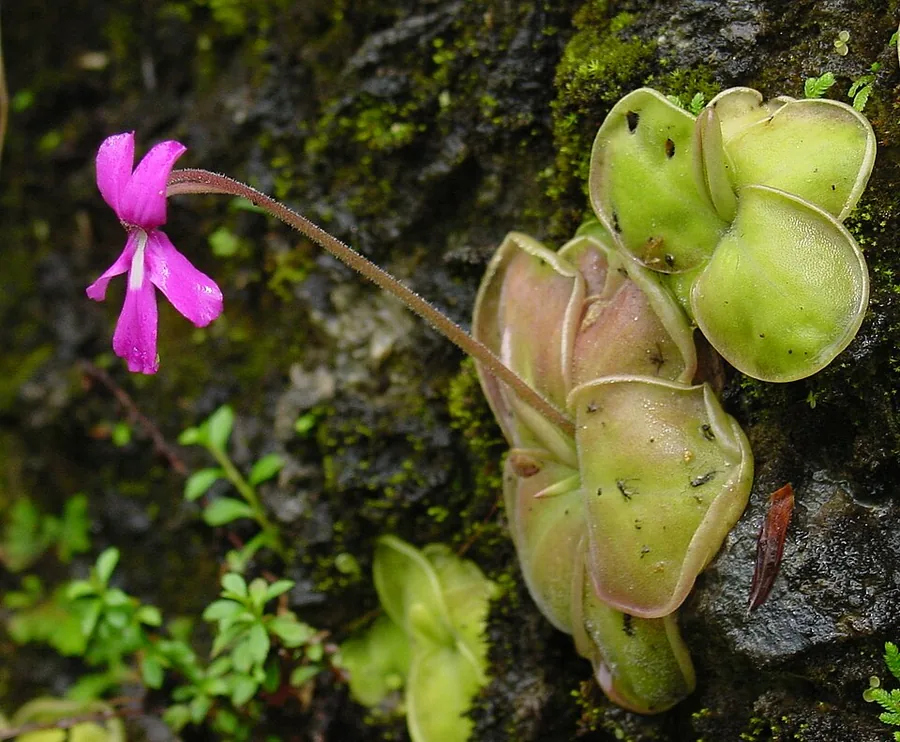
Up close, the butterwort is a flat rosette of soft, greasy leaves that lie open like a wet starburst. Each leaf wears a film of sticky dew that catches fungus gnats and small flies, then digests them for the nutrients its lean soil withholds. This Mexican species, Pinguicula moranensis, comes from volcanic country and settles in on a bright windowsill.
Run a fingertip near a leaf and the surface reads tacky and slick, almost buttered. From spring to autumn the rosette spreads wide, glistening carnivorous leaves and lifts slender stalks topped with solitary pink-violet flowers that look much like small violets. When light fades, the plant draws inward into a tight, dry-surfaced succulent rosette and holds there through winter.
What trips up most growers is not difficulty, it is habit. Butterworts want the reverse of normal houseplant care: no fertilizer, no tap water, and no rich potting mix. Hold to those three and this small rosette mostly tends itself.
Care
The short version: bright light, only distilled or rainwater, and a lean gritty mineral mix. Keep it evenly damp through the growing season, let it dry into its winter succulent rosette, and never feed the soil.
Light
Butterworts want bright light, best as bright indirect with a few hours of sun. They take anything from full sun down to partial shade, but a leaf grown too dim pales out and quits making its sticky dew.
Water
Use only distilled, reverse-osmosis, or rainwater, never tap, since dissolved minerals collect in the mix and kill the plant. Keep the gritty medium evenly damp through the growing season, often by standing the pot in a shallow water tray. Once the plant draws into its winter rosette it wants far less, watered lightly only when the medium nearly dries.
Soil
Plant it in a gritty, low-nutrient mineral mix, peat or long-fiber sphagnum cut with sharp sand, perlite, and a little pumice. Any pH from 5.0 to 7.0 suits it. Leave out rich potting soil completely, because the roots are made for lean ground.
Temperature
This Mexican species sits comfortably across a wide band, roughly 41°F to 86°F (5°C to 30°C). That range makes it easy on ordinary household swings, as long as it never drops to freezing.
Humidity
For all its carnivorous reputation, it needs no terrarium. Average household humidity of 40% to 60% suits it well, and steady airflow counts for more than chasing a high reading.
Feeding
Keep all fertilizer out of the pot. The plant feeds itself, snaring fungus gnats and small flies on its sticky leaves, and any feed added to the soil only burns the roots.
Pruning
There is no shaping needed. Now and then pick off dead, blackened, or rotted leaves along with spent flower stalks, which denies fungal rot a place to start.
Repotting
Repot every 1 to 2 years, best in spring as growth resumes. Move it on when the mix breaks down and stays soggy, when the rosette crowds the pot edge, or when new leaves stop coming in sticky.
Size & spacing
This is a small plant, standing only 2 to 10 inches (5 to 25 cm) tall and spreading 3 to 6 inches (8 to 15 cm) wide. One rosette tucks easily into a modest pot on a windowsill.
Troubleshooting
Almost every butterwort complaint traces back to water, feeding, or the season. Match what you see on the leaves and crown against the list below before you act, since the wrong move, such as more water or fertilizer, usually deepens the damage.
Blackened, mushy crown that collapses
When the heart of the rosette goes dark and the leaves soften into mush, you are looking at crown rot. Salts left behind by tap or mineral water collect in the lean mix, and a soggy pot during the winter rosette stage finishes the job. Switch to distilled or rainwater, flush the medium, repot into fresh gritty mix, and cut away every soft brown patch.
Fix:
- Stop watering until the mix is barely moist
- Flush the medium with distilled/RO water to leach salts
- Repot into fresh gritty mineral mix and remove rotted tissue
- Increase airflow and light
New leaves lose their sticky dew
Leaves that unfurl matte and dry, with none of the wet beading you expect, are signaling mineral buildup or feeding. Fertilizer and rich soil scorch the roots, tap water packs the mix with salts, and dim light leaves the surface flat. Keep all feed out of the pot, flush with distilled or rainwater, and shift the plant into several hours of bright light.
Fix:
- Never fertilize the soil
- Switch to distilled/RO/rain water and flush the mix
- Move to a brighter spot with several hours of bright light
Rosette pulls tight and loses its tacky film
A rosette that pulls tight and small, with the tacky film gone from its leaves, is showing its winter succulent phase. As light fades, the wide carnivorous leaves give way to a compact, dry-surfaced rosette that sits out the cold. Ease back the water until the mix nearly dries, hold it in bright light, and let regular moisture return in spring.
Fix:
- Reduce watering and let the mix nearly dry
- Keep in bright light and resume normal moisture in spring
Toxicity
Good news for homes with animals: the butterwort is not toxic to pets or people. Its greasy, sticky leaves grip only gnat-sized insects and hold nothing harmful, so the main reason to keep it out of reach is to spare that fragile rosette from curious paws.
Safe for
People · Cats · Dogs · Horses · Rabbits · Livestock · Birds
Cats None
A cat that licks or pats the tacky leaves comes away with nothing worse than a sticky tongue. No toxin sits in that greasy surface.
Dogs None
Dogs have nothing to fear. The leaves hold no poison, and a chewed one leaves only a greasy taste behind.
Horses Safe
Safe around horses, though this little rosette is far too soft and small to survive a grazing muzzle.
Rabbits Safe
Harmless to rabbits. A nibbled leaf does the animal no harm, even when it costs the plant a piece of its rosette.
Livestock Safe
No danger to cattle, goats, or sheep. The leaves carry nothing toxic, and a tray-grown rosette this small rarely crosses their path.
Birds Safe
Birds meet no chemical hazard in the leaves or the slender flower stalks. The sticky film grips only gnat-sized insects, nothing larger.
People Safe
Safe to touch with bare hands, where the leaf reads as plainly greasy under your fingertips. It is no food plant, so no part of it is meant for the table.
The greasy, sticky leaf surface is harmless to handle and to pets; it simply feels tacky.
Varieties
Most growers come to know the butterwort through one of a few common forms. These are the ones you are most likely to find sold by name.
Pinguicula moranensis
The classic large-flowered Mexican butterwort, lifting pink-violet blooms on slender stalks above a flat summer rosette of greasy, glistening leaves.
Pinguicula moranensis var. neovolcanica
A named variety out of Mexico's volcanic mountains, recognized on Kew's Plants of the World Online.
Pinguicula 'Tina'
A tough, quick-growing hybrid that catches gnats readily, an easygoing choice for first-time growers.
How to propagate
Butterworts multiply readily, and the easiest method asks for nothing but a few leaves pulled from a plant you already grow.
Leaf cuttingsEasy
Late winter to spring, especially from the succulent winter rosette · 4-8 weeks to form plantlets
The simplest way to multiply a butterwort is by pulling whole leaves. In late winter or spring, while the plant sits in its tight succulent rosette, ease single leaves away from the base and lay them flat on damp gritty mix. Fresh little rosettes push out at the leaf base within 4 to 8 weeks.
DivisionEasy
Spring at repotting · 2-4 weeks
Mature plants tend to throw offset rosettes clustered around the parent. At spring repotting, tease these side rosettes apart and pot each one on its own, where they take hold within 2 to 4 weeks.
SeedDemanding
Spring on the surface of damp mineral mix · Several months to a year
Seed is the slow path. Scatter the fine seed across the surface of damp mineral mix in spring and wait, since it can take several months to a year to bulk up. It is less dependable than leaf pulling, but it pays off when you want many plants at once.
Myths
A butterwort will die unless you set insects on its leaves by hand or feed it fertilizer.
The sticky-surfaced leaves snare their own fungus gnats and small flies, and that catch covers everything the plant needs. Never fertilize the soil, because the roots are shaped for lean ground and added nutrients burn them.
Butterworts are toxic to cats and dogs.
Pinguicula does not appear on the ASPCA toxic plant list and counts as non-toxic to pets. Its leaves grip only tiny insects and carry nothing that would harm a curious animal.
No carnivorous plant lives without a shut, steamy glass terrarium.
With bright light and water kept low in minerals, Mexican butterworts thrive across ordinary household humidity, no glass box required. Sealing one inside a closed case usually backfires, penning stale, rot-friendly air against the rosette.