Vegetable · Asteraceae
Globe Artichoke
Cynara cardunculus var. scolymus
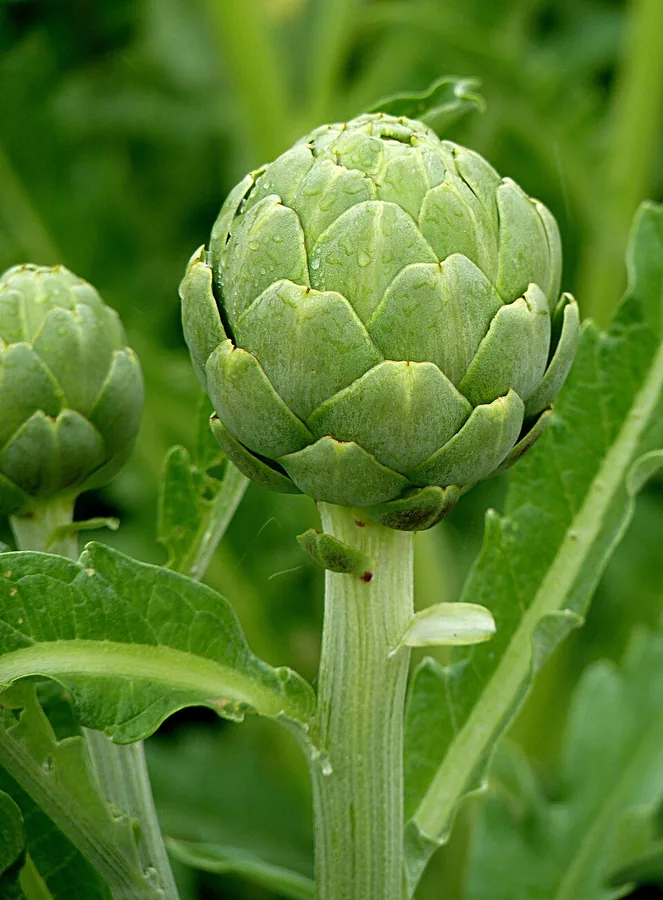
A silver-green thistle whose tight, bract-wrapped buds open to purple if left uncut.
Full sun
Every 3–7 days
45–84°F · 7–29°C
85–110 days
Overview
Stand beside a globe artichoke and you meet a large, architectural thistle, its silver-green leaves deeply cut into lobes and bristly to the touch, spreading several feet across in a coarse, prickly rosette. The whole plant reaches 3 to 6 feet (90 to 180 cm) tall and spreads about as wide, a bold, sculptural presence in the bed.
What you eat is the immature flower bud, the tight green head taken before the bracts loosen. Each bud is wrapped in overlapping bracts, and on spiny cultivars those bracts finish in sharp spine tips that catch the fingers. Leave a head on the plant and it will not stay a bud: it swells and bursts open into a striking purple flower crowning the stalk.
Color and shape vary with the cultivar. Green Globe carries plain green buds, Imperial Star and Green Globe Improved are also green-budded, and Violetto di Romagna breaks the pattern with long, elongated purple buds. Across them all the foliage stays the same coarse, bristly silver-green.
Care
The short version: give it full sun, deep regular water to swell the buds tender, and rich deep loam that drains, since standing water rots the crown. It is a heavy feeder that wants monthly feeding through the warm months. A cold spell near 50°F (10°C) is what tips a leafy plant into forming buds, which you cut tight, before the bracts open.
Light
Plant it in full sun, with no shade to tolerate. The light is what drives the buds; the more of it the silver-green leaves catch, the better the tight heads form.
Water
Keep the soil evenly moist all season. Deep, regular watering at the base is what swells the buds tender and succulent, but water pooling at the crown rots it, so aim low and avoid waterlogging.
Soil
It wants rich, deep, well-drained loam high in organic matter, with a pH between 6.5 and 7.5. On heavy ground, raise it onto a bed so water runs off the crown rather than sitting against it.
Temperature
Comfortable from 45°F to 84°F (7°C to 29°C). A cold spell near 50°F (10°C) is the trigger that tips the plant from growing leaves into setting buds.
Humidity
Ordinary outdoor humidity suits it. Airflow matters more, since damp, crowded foliage invites the pests and rot that show up on the leaves and crown.
Feeding
A heavy feeder. Work compost into the bed, then feed monthly with a nitrogen-rich balanced fertilizer through spring and summer to push the big bristly leaves and the buds they carry.
Pruning
Cut each bud tight, before it opens, and take spent flowering stalks off at the base after harvest. In cold zones cut the foliage to the ground and mulch the crown; in mild zones cut back old growth in late winter.
Repotting
Rarely a container plant. Established crowns are divided every 3 to 4 years to keep them vigorous, lifting and splitting the rooted offshoots.
Size & spacing
It grows 3 to 6 feet (90 to 180 cm) tall and spreads about as wide, so allow roughly 3 feet (90 cm) per plant to give the broad, coarse rosette room.
When to plant
The plant runs on a split need: warmth to grow that bristly silver-green foliage, then a cold spell to set the buds. Seed starts indoors in late winter, the young plants take their chilling, transplanting follows the last frost, and the tight heads are cut from summer into fall.
Northern hemisphere
Southern hemisphere
Typical months for a temperate climate: start earlier in warm zones, later where spring frosts linger.
- Sow: Start seed indoors 8-10 weeks before the last spring frost, then chill/vernalize the seedlings (expose to roughly 50°F / 10°C for 10 or more days) so they will form buds the first year.
- Plant: Transplant after the last frost once soil has warmed, in spring.
- Harvest: Harvest the immature flower buds in summer (and into fall) before the bracts begin to open.
Hardiness
USDA hardiness zones: 7–11
Temperature: down to -18°C
Troubleshooting
Most trouble shows on the plant's surface if you look closely: insects clustered on the youngest leaves, holes and slime across the broad foliage, a soft dark crown, or a leafy plant with no bud at all. Here is what each one looks like up close and how to set it right.
Crown gone soft and dark while the soil stays wet
A plant that slumps and wilts even though the ground is wet has trouble below. At the base, the crown turns soft, dark, and mushy, the firm tissue rotting where soggy soil holds water against it, and the roots decay along with it.
Fix:
- Remove and destroy affected plants
- Improve soil drainage before replanting
- Avoid replanting artichokes in the same wet site
Soft-bodied aphids massing on the youngest leaves
Look closely at the newest shoot tips and the silver-green leaves still uncurling, and you may find them dotted with tiny soft-bodied aphids packed shoulder to shoulder. Ants thread their way among the clusters, and a sticky honeydew film glazes the leaf surface where the insects feed.
Fix:
- Dislodge with a strong jet of water
- Apply insecticidal soap
- Remove and destroy heavily infested leaves
Heavy with leaves but bare of a single bud
Sometimes a plant piles on broad silver-green foliage and grows lush, yet not one bud forms at the center of the leafy rosette. The cause is a missed cold spell: it needs a stretch near 50°F (10°C) for 10 or more days before it will set a flower head.
Fix:
- Vernalize transplants for 10 or more days near 50°F / 10°C before setting out
- Overwinter plants as perennials in mild zones to bud the following year
Aphids wedged deep between the overlapping bracts
Split open a cut bud and the overlapping bracts can hide a surprise: aphids tucked into the tight green layers, out of sight until the head is pried apart. A faint sticky sheen of honeydew clings between the scales where the insects shelter inside the flower head.
Fix:
- Soak cut buds in cold salted water to flush out insects
- Harvest buds promptly while still tight
- Control aphids on plants before they enter the bud
Ragged chewed holes and glistening slime across the leaves
Across the broad, deeply cut leaves you may see ragged holes bitten clean through, edged irregularly rather than nibbled neatly. Catching the light beside them are silvery slime trails, the calling card of slugs and snails (and earwigs) that feed once darkness falls.
Fix:
- Handpick at night
- Set out traps or iron-phosphate slug bait
- Remove damp hiding places near plants
Toxicity
The globe artichoke is an edible vegetable with no listing as toxic to cats or dogs from the ASPCA. The only real hazard is physical, written into the plant itself: the sharp spine tips on the bracts of some types and the bristly foliage, both of which can prick bare skin.
Safe for
People · Cats · Dogs · Horses · Rabbits · Livestock · Birds
Cats None
No poison is involved. The prickly, bristly leaves tend to put a cat off long before it eats enough to matter.
Dogs None
There is no toxin here. A dog that chews through a lot of the coarse, fibrous leaf may pass a loose stool, as it might with any rich plant.
Horses Safe
No poison is present. The coarse, prickly foliage is unappealing and rarely tempts a grazing horse.
Rabbits Safe
The tender young leaves are harmless, though greens should be introduced gradually since a sudden change can loosen a rabbit's gut.
Livestock Safe
Cattle, goats, and sheep graze it and the related cardoon unharmed; only the sharp bract spines of spiny types are worth keeping an eye on.
Birds Safe
No toxin is present. Chickens will peck happily at scraps of leaf and stem.
People Safe
The buds are cooked and eaten worldwide. The only real hazard is the sharp spine tips that finish the bracts on some types, so wear gloves.
The bracts of some varieties have sharp spine tips and the foliage is bristly, which can prick or irritate skin during handling and harvest. This is a physical hazard, not poisoning.
Varieties
Cultivars sort mostly by the color and shape of their buds, from the familiar green heads to one heirloom that turns long and deep purple.
Green Globe
The green buds that give the type its name, the most widely grown of all and the standard choice for perennial growing where winters stay mild.
Imperial Star
A green-budded annual-type cultivar that sets buds the first year from seed with little chilling, the pick where winters run too cold for a perennial crown.
Violetto di Romagna
An Italian heirloom whose buds are long and elongated and deep purple rather than the usual green, a clear shift in color and shape.
Green Globe Improved
A selected strain of Green Globe with the same green buds but more uniform, more productive plants.
How to propagate
There are two routes, and they differ in how true the plant comes. Seed gives variable plants and asks for a cold spell first; dividing a rooted offshoot from the crown hands you an exact copy of the parent.
SeedModerate
Start indoors 8-10 weeks before last frost, then vernalize seedlings before transplanting · First buds in roughly 85-110 days from transplant when seedlings are vernalized
Sow seed indoors 8 to 10 weeks before the last frost and give the seedlings a cold spell before they go out, so they set buds the first year. The first tight heads appear in roughly 85 to 110 days after transplant. Seed plants vary in form, so an annual cultivar like Imperial Star is the dependable pick for a first-year crop.
DivisionEasy
Late winter to early spring · Rooted offshoots establish within one growing season
A rooted offshoot copies the parent exactly. In late winter to early spring, detach a rooted sucker from the crown and pot it on. The rooted pieces establish within one growing season and come true to the parent.
Myths
Artichokes are poisonous to pets.
False. It is an edible vegetable that the ASPCA does not list as toxic to cats or dogs. The only real danger is physical, the sharp spines tipping the bracts on some types.
Artichokes grow true to type from seed like most vegetables.
False. Seed-grown plants vary a lot in look and habit, so detaching rooted offshoots from a parent crown is what gives uniform plants. Only a few cultivars such as Imperial Star reliably bud the first year from seed.