Shrub · Ranunculaceae
Sweet Autumn Clematis
Clematis terniflora
Tiny cross-shaped white flowers open by the thousand until the twining stems all but vanish beneath them.
Full sun
Every 5–10 days
USDA 4–9
15–30 ft · 4.6–9.1 m
Overview
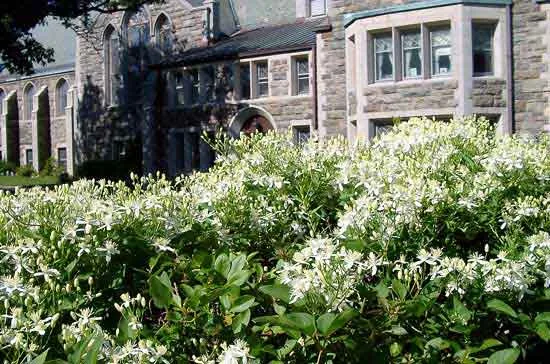
Sweet autumn clematis carries its flowers in a dense froth of tiny white blooms, each one a small cross of narrow, petal-like segments. They open in such numbers from August into September that the froth all but buries the foliage under a white haze, and the air nearby turns sweet with their scent. A fast twining vine in the buttercup family from East Asia, it winds its stems up any support and stretches 15 to 30 feet (4.5 to 9 m) once established.
Look closer and the leaves are compound, split into separate leaflets whose margins run smooth and untoothed, without the fine teeth of the native look-alike. The stems are wiry twiners that spiral around anything they meet and haul the whole plant upward at speed. Beneath that soft-looking canopy sits a genuinely tough constitution, one that takes winter cold down to -29°F (-34°C).
When the flowers fade they give way to silvery, feathery seed heads, each tuft a plume built to ride the wind. Those plumes carry seed far and wide, and across the eastern and central US the vine has seeded itself out of gardens and over native plants, which has placed it on invasive lists in many states. For the same white froth and sweet scent on a plant that stays put, the native Clematis virginiana, with its toothed leaflets, is the close cousin to reach for.
Care
The short version: it grows in full sun with its roots shaded and mulched under average well-drained soil kept evenly moist, takes a hard cut back each late winter, and needs its spent flowers clipped before they turn to those wind-borne seed heads.
Light
The bloom comes thickest in full sun, thinning but still present in partial shade. The old clematis pairing holds: the twining top reaches into the light while the roots stay cool and dark beneath a blanket of mulch or a low plant at the base.
Water
The vine likes even, average moisture, taken about every 5 to 10 days while its roots knit in. Once those roots run deep it turns tough and shrugs off dry weather, though the cool, shaded, mulched ground at its feet keeps the foliage at its freshest.
Soil
Its roots take to almost any well-drained ground, loam, clay, or sand alike. A pH from 5.5 to 7.5 sits well with it, so the soil beneath rarely shows in the plant above.
Temperature
The stems and roots endure a wide swing of weather, from winter lows of -29°F (-34°C) to summer highs of 100°F (38°C). That hardiness written into the plant is a large part of why it ranges so far.
Humidity
The open outdoor air suits it as it is, with no level to chase. Moving air is what the leaves want, since still, heavy air late in the season leaves a dull film of mildew across them.
Feeding
A single spring feed of balanced general-purpose fertilizer colors the whole season's growth. The vine already runs fast and full, so a heavier hand only pushes more stem than the plant needs.
Pruning
Since bloom rides on new wood, the whole vine is taken down to about 1 foot (30 cm) in late winter or early spring, before the buds break. Cutting the faded flowers away before they set seed keeps the plant from turning its energy into those far-traveling seed heads.
Repotting
Rooted in open ground, it seldom asks for a larger home. Where one grows in a pot, the roots signal a move by circling the walls, letting water rush straight through, or slowing the top to a crawl.
Size & spacing
At full stretch the vine runs 15 to 30 feet (4.5 to 9 m) in both height and width, a mass of twining stem that needs a strong frame beneath it. Set plants far enough apart that air slips between their tangled growth, and the late-season mildew has less hold.
When to plant
The flowers form on new wood, the fresh stems of the current year, so the plant is cut hard in late winter to force that new growth. Set out in spring or fall and reduced to about a foot before it stirs, the vine throws up a season's worth of twining stems that carry the white froth from August into September. Clipping the blooms before the feathery seed heads form is what keeps the seedlings from following.
Northern hemisphere
Southern hemisphere
Typical months for a temperate climate: start earlier in warm zones, later where spring frosts linger.
- Plant: spring or fall
- Harvest: August to September
Hardiness
USDA hardiness zones: 4–9
Temperature: down to -34°C
Troubleshooting
The troubles that show up on this vine are written on the plant itself. Watch the seed heads for the plumes that scatter seedlings, watch a stem for the sudden blackening of wilt, and watch the leaves for the pale film of late-season mildew. Match what you see below and act before it spreads.
Feathery seedlings rising all around and twining stems overrunning the neighbors
This is the plant's invasive habit made visible. After the white froth fades, the vine sets clouds of feathery, silvery seed that lift on the wind and root far past the bed, while the twining stems haul themselves over everything close by. Cut the spent flowers away before the seed heads ripen, lift the young seedlings while they are small, and keep the vine clear of woodland. For the same feathery white bloom on a plant that holds still, the native Clematis virginiana is the one to plant.
Fix:
- Deadhead and remove seed heads before seeds mature and disperse
- Pull or dig out seedlings and unwanted runners promptly
- Cut back hard and bag spent flowering/seeding growth
- Do not plant near woodlands or natural areas; consider the native Clematis virginiana instead
A stem turns black and limp from the tip down
That blackening collapse is clematis wilt, a fungus that runs a stem down from the top while the roots stay firm and living below. A bruised stem or dry ground at the base can leave the same wilted, darkened growth. Cut the ruined stem back to sound tissue or right to the ground, clear away the prunings, and keep the roots cool and mulched so new stems climb from the base. This species carries wilt far better than most clematis.
Fix:
- Cut affected stems back to healthy tissue or to ground level
- Remove and dispose of infected material
- Keep roots cool, moist and mulched to support regrowth from the base
A pale, dusty film or dark specks spreading across the leaves
Late in the year the leaf surfaces can turn dull with powdery mildew or freckle with leaf spot, both settling in where the air lies still around dense growth. Thin the crowded stems so air can pass through, pull away the most coated leaves, and lay the water at the base rather than over the tops. A bright, breezy spot keeps the foliage clean.
Fix:
- Improve air circulation by thinning and proper spacing
- Remove badly affected foliage
- Avoid overhead watering
Toxicity
Nothing about the plant's soft looks changes what runs inside it. Every part holds ranunculin, which becomes the irritant protoanemonin the instant a leaf or stem is chewed or crushed, and the ASPCA lists clematis as toxic to cats, dogs, and horses. The taste is bitter and acrid enough that most animals quit before they swallow much, so serious poisoning is rare, yet the sap can raise blisters on bare skin, so gloves belong on your hands at pruning time.
Toxic to
Cats · Dogs · Horses · Rabbits · Livestock · Birds · People
Cats Mild
A cat that bites into the leaves or stems is soon drooling and pawing at a stinging mouth, and vomiting or loose stools tend to follow. The sharp, bitter sap turns it off well before enough goes down to do lasting harm.
Dogs Mild
A dog that chews the vine ends up with a sore, watering mouth and a queasy stomach that brings vomiting or diarrhea. The acrid sap tastes bad enough that most let go of it fast.
Horses Mild
A horse cropping the foliage is left slobbering over a raw, stinging mouth, and the irritant can churn up colic-like belly pain and loose droppings. The bitterness usually cuts the grazing short.
Rabbits Mild
The protoanemonin that burns the mouths of cats and dogs blisters a rabbit's mouth and gut just the same, so the vine and every trimming stay out of reach. Only greens known to be safe belong in the hutch.
Livestock Mild
Cattle, goats, and sheep that crop the plant come away with a stinging mouth and a churned-up gut, though the bitter sap rarely lets them past a mouthful.
Birds Caution
Barely any record exists of birds feeding on it, but the irritant sap is enough to keep poultry and pet birds off the foliage and the fresh-cut stems.
People Caution
None of the plant is food, and the sap can blister skin where it touches bare hands. Gloves on for pruning, a wash after, and no chewing on the stems by children keeps the irritation away.
Sap can irritate skin; wear gloves when pruning and wash hands after handling.
Helpline numbers

United States
ASPCA Animal Poison Control: (888) 426-4435 (fee applies)
Poison Control: (800) 222-1222



Canada
Poison Centres: 1-844-764-7669
Varieties
The differences worth spotting here are physical ones, read off the leaves and traced through the names on the label. Two points bring the plant into focus.
Clematis terniflora (species)
Run a finger along the leaflets and this non-native species reads smooth, its compound leaves edged without teeth, and that toothless margin is the surest mark that parts it from the finely toothed native Clematis virginiana.
'Clematis paniculata' (name confusion)
On the sales bench it hides behind the wrong labels C. paniculata, C. maximowicziana, and C. dioscoreifolia, yet the true C. paniculata is a separate species that grows in New Zealand.
How to propagate
The same plumed seed that makes this vine so free with itself is exactly what a gardener wants to avoid multiplying. Cuttings and layering reproduce the plant from its stems instead, cleanly and without the drifting seed.
SeedEasy
After seed ripens in fall · 1-2 seasons
The plumed seed that drifts off this vine already sows more of it than anyone wants, so raising it from seed on purpose makes little sense. Seed left to ripen in fall grows into a plant over about 1 to 2 seasons, but reining that seed in is the smarter path.
Stem cuttingsModerate
Late spring to summer · 1-2 seasons
Cuttings pull a new plant straight from the stems, with none of the drifting seed. Softwood or semi-ripe lengths taken from late spring through summer root down, and the young cutting fills out over roughly 1 to 2 seasons.
LayeringEasy
Spring to summer · 1 season
Layering leans on the stems' own habit of rooting wherever they press against the soil. A stem pinned to the ground in spring or summer usually anchors and grows away within a single season.
Myths
The white-flowered vine sold as sweet autumn clematis is the same plant as the native virgin's bower.
Set side by side they are two separate species that only wear the same look. The native Clematis virginiana shows fine teeth along its leaflet edges and keeps its bounds, while the non-native Clematis terniflora shows smooth, toothless edges and seeds itself into a takeover. For that same feathery white bloom without the spread, plant the native virgin's bower.