Houseplant · Aizoaceae
Split Rock
Pleiospilos nelii
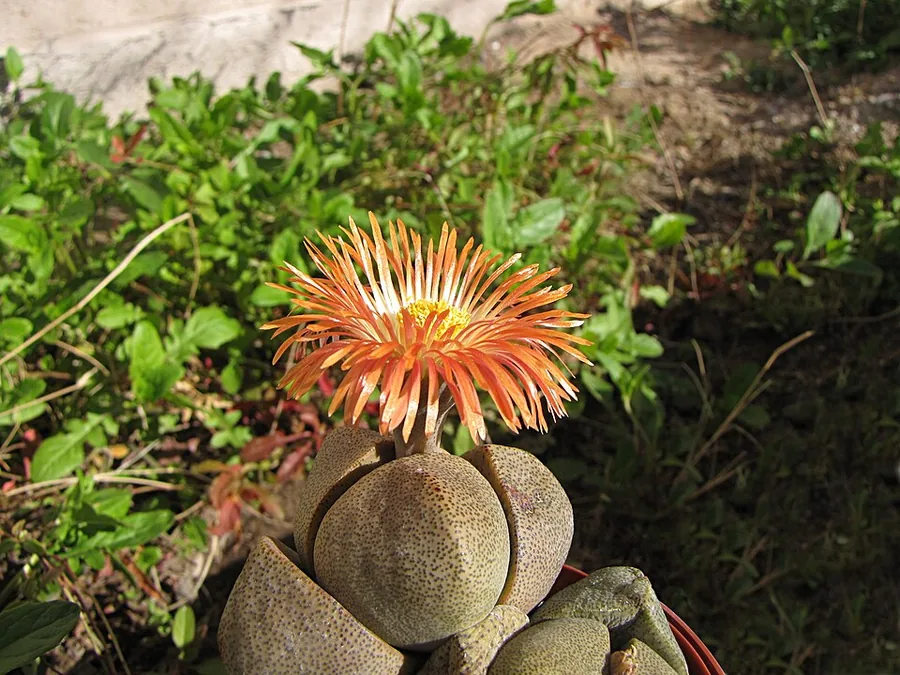
Two fat, grey-green leaves split down the middle like a cracked pebble, crowned in season by a daisy-like bloom.
Full sun
50–86°F · 10–30°C
USDA 9–11
2–3 in · 5–8 cm
Overview
Up close, split rock looks exactly like its name: a plump, grey-green body cleft straight down the middle, as though a small stone had cracked in two. This South African succulent belongs to the mesemb branch of the family Aizoaceae, and its pair of fat, fissured leaves swells into a rounded lump about the size of a large pebble. Sitting low in coarse grit, the whole plant reads as weathered, cracked granite rather than anything alive.
The plant is tiny and thickset, rising only 2 to 3 inches (5 to 8 cm) tall, with the smooth, firm feel of a water-filled stone. At any time it wears just one or two leaf pairs, each deep cleft marking where the next pair will push through. Once a year that new pair heaves up from inside the old one, drawing the outer leaves thinner and thinner until they collapse into dry, papery husks.
For all its stony looks, the surface stays taut and succulent, holding stored water beneath a firm skin. The real change comes in bloom, when a large, daisy-like flower in yellow to orange unfurls in late winter or spring. Its many slender petals stand out sharply against the muted grey-green body.
Care
The short version: split rock wants the brightest light you can give it, a coarse, sharply draining gritty mix, and water only during spring and autumn growth, never through dormancy or leaf renewal.
Light
Split rock holds its tight, stone-like body only under the brightest light you can offer, ideally full sun at a south-facing window. Strong sun keeps the two leaves plump, low, and firmly cracked down the center. Starve it of light and the body pales and stretches upward, losing the compact, rocky shape.
Water
Water decides everything about how the fat leaves look and feel. Give it only during active growth in spring and autumn, and only once the soil has dried out completely. Keep it bone dry through summer dormancy and while a new pair is emerging, because water then swells the leaves until they split their skins and rot into mush.
Soil
Root it in a very gritty, sharply draining mineral or cactus mix, coarse enough that water drains straight through. A pH of 6.0 to 7.5 suits it, so the texture of the grit matters far more than any exact reading.
Temperature
The plant stays firm and healthy between 50°F and 86°F (10°C to 30°C), the range ordinary rooms hold all year. A cooler, dry spell in summer lets the body rest as it would in habitat.
Humidity
Low humidity keeps the taut skin of the leaves intact, which is exactly what this desert plant wants, with no level to chase. Dry air preserves the firm body, while damp, still air softens it toward rot.
Feeding
Feed rarely, and only across the spring and autumn growth spells. A dilute, low-nitrogen cactus or succulent feed is plenty, since heavier feeding bloats the leaves into soft growth that breaks the plant's tight form.
Pruning
Nothing here needs cutting, and the body should never be sliced into. The old leaf pair simply thins and shrivels as the new one drinks it away, leaving dry, papery skins you can lift off once they are spent.
Repotting
Lift and repot only every 2 to 3 years, or when the swollen body crowds its pot. Roots creeping from the drainage holes or the plant pushing itself up out of the soil show it is time for fresh, coarse grit.
Size & spacing
The whole plant stays small and squat, only 2 to 3 inches (5 to 8 cm) tall and 3 to 4 inches (7 to 10 cm) across, a single cleft body filling a small pot. One is enough to hold the eye on its own.
Troubleshooting
Nearly every problem with split rock is written on the leaves themselves, and it starts with water at the wrong time. Look closely at whether the fat body stays firm, softens and clears, or piles up into extra pairs. Match what your eyes tell you to the signs below, then act before rot spreads.
Fat leaves splitting their skins or turning to mush
When the plump leaves split their skins or turn soft, translucent, and mushy, that is rot from too much water. It nearly always follows a drink at the wrong time, most dangerously during summer dormancy and while a new leaf pair pushes out. Stop watering, cut the mushy tissue away with a clean blade, and move the body into a grittier, faster-draining mix.
Fix:
- Stop watering immediately
- Cut away rotted tissue with a clean blade
- Repot into a much grittier, faster-draining mix
- Allow the plant to dry out fully before any further water
Leaf pairs stacking up instead of thinning away
A healthy split rock shows only one or two fat leaf pairs. When three or more stack up and the old ones stay swollen, the plant has been watered or fed during leaf renewal, so the outer pair never drew down. Withhold water and let the plant thin the old leaves itself, then return to the dry cycle once the extras have shriveled.
Fix:
- Withhold water so the plant draws on the old pair
- Resume the normal dry-cycle once excess pairs are reabsorbed
Pale, stretched leaves losing their stony shape
Leaves that grow tall, pale, and slack have been starved for light. The firm, stone-mimicking body keeps its shape only under strong sun, and a dim sill draws it upward and thin. Move it to the brightest position you have, where it can take several hours of direct sun.
Fix:
- Move to the brightest available position with several hours of direct sun
Toxicity
Split rock is not toxic. The ASPCA does not list it, and the mesembs in its family carry no known poisons. The only mild risk lies in the gritty soil and the tough, fibrous leaf, which could give a pet a passing stomach upset if a large mouthful goes down.
Safe for
People · Cats · Dogs · Horses · Rabbits · Livestock · Birds
Cats None
A cat is safe alongside split rock. Bite into one of the tough, fibrous leaves and it may cause a brief, mild stomach upset, though nothing in the plant is toxic.
Dogs None
Dogs face no poisoning from it. A determined chewer working at the gritty leaf might drool or pass loose stool for a short while, and that clears on its own.
Horses None
Horses are in no danger of poisoning here. The little cracked body offers barely a mouthful for a horse to take anyway.
Rabbits None
Nothing in the plant will poison a rabbit. A nibble of the dense, water-filled leaf may bring on a little gas, since that succulent tissue is not part of a normal diet.
Livestock None
Goats, sheep, and cattle meet no toxic threat from it. A grazing animal chewing the gritty leaf might feel only a mild, brief digestive grumble.
Birds None
Pet birds are safe around it, with no poisoning on record. A bird that pecks the firm leaf risks nothing worse than a briefly upset crop from the fibrous bite.
People None
The plant is safe to handle and grow around adults and children. It is not a food plant, though, so the fleshy leaves are not for eating.
Its sharp gritty soil and fibrous leaf tissue could cause minor mechanical or digestive upset if a pet chews and swallows large amounts.
Varieties
Only two forms show up in collections, and the clearest difference is the color of the leaves. Both are described below.
Pleiospilos nelii (species)
The wild species shows grey-green, deeply fissured leaves that swell into an almost round, cracked-stone body.
Pleiospilos nelii 'Royal Flush'
This cultivar carries the same cleft, stony shape but glows in deep purple to reddish tones instead of the usual grey-green.
How to propagate
Split rock builds up slowly, one small body at a time. You can raise more from seed or divide an established clump when you repot it.
SeedModerate
Sow in warm conditions during spring or autumn · Several months to over a year to reach a recognizable plant
From seed, sow in the warmth of spring or autumn, scattering the seed across a gritty surface and keeping it lightly moist until it sprouts, then shifting to the strict dry cycle. The wait is long, since a seedling needs several months to more than a year to swell into a recognizable plant.
DivisionModerate
During active growth when repotting an established clump · Several weeks to a few months
From an established clump, divide during active growth as you repot. Ease off an offset carrying a few roots, let the cut faces dry and callus over, then set it into a dry gritty mix. The division firms up and settles within a few weeks to a couple of months.
Myths
Split rock is a kind of Lithops.
The two are separate genera, for all that both sit in the mesemb group. Split rock is a Pleiospilos, its leaves far fatter and far fewer than the small paired bodies of a true Lithops, so the likeness is only skin deep.
Water it on a regular schedule like any other succulent.
It runs on a strict cycle and needs a bone-dry summer rest. Steady, year-round watering splits the fat leaves and rots them, which is the fastest way to lose the plant.