Vegetable · Fabaceae
Soybean
Glycine max
Fuzzy stems and clusters of plump green pods on a bushy plant that feeds itself in full sun.
Full sun
Every 5–7 days
59–95°F · 15–35°C
75–100 days
Overview
Soybean is a warm-season legume in the bean family, grown for tender green edamame and for the dry beans behind tofu, soy milk, and oil. Run a hand over it and the stems feel softly furred, the give-away of a plant that carries its own feeding underground, where root nodules and Rhizobium bacteria pull nitrogen from the air. That underground partnership keeps its demands on the soil light, and makes it forgiving for a first-time grower.
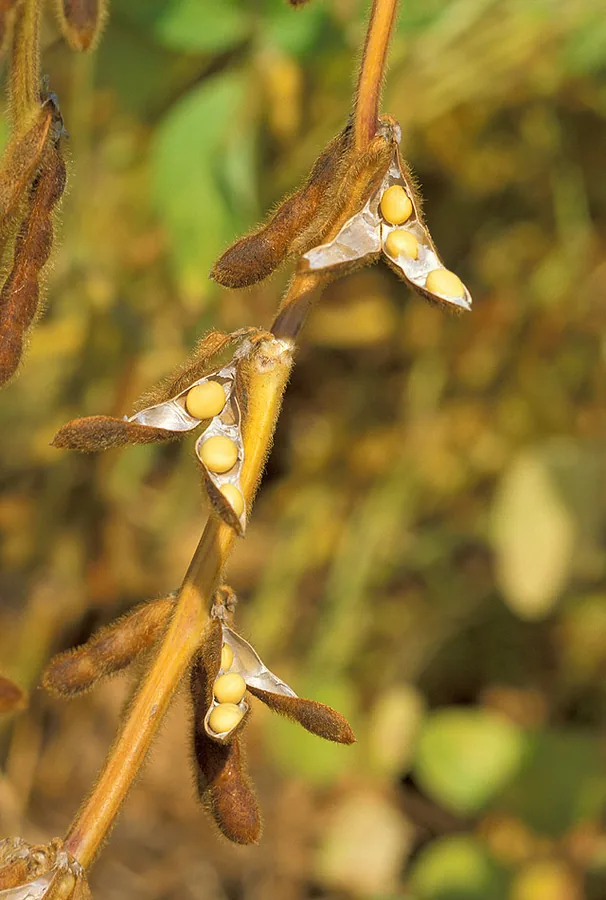
The plant holds itself upright and bushy, rising 1.5 to 3 feet (45 to 100 cm), its branches lined with fuzzy stems and studded with pods that swell in tight clusters. Each young pod is a bright, fresh green, plump where the seeds press against the wall, and that is edamame at its best. Leave the pods to age on the plant and the green fades as they dry, until the loosened beans rattle inside their shells.
For all that fresh green, the mature bean is not one to eat raw. As the pod dries, the bean inside holds compounds that block digestion until heat breaks them down. So the beans go into the pot first, boiled or steamed, before any reach the table.
Care
The short version: full sun and warm, well-drained soil, with about 1 inch of water a week kept steady while the pods fill. Heavy nitrogen is unnecessary, since the plant fixes its own underground.
Light
Soybean wants full sun, eight or more hours of direct light a day, to build its bushy, well-branched frame. Starved of light, the stems draw up thin and lanky, and far fewer pods form along them.
Water
Soybean drinks about 1 inch of water a week, and it wants that steady, most of all while the pods are swelling with seed. Let the ground stay waterlogged and the roots rot below this warm-season legume.
Soil
The roots run best through well-drained loam dark with organic matter. A pH of 6.0 to 6.8, slightly acidic to neutral, is where they settle, and that is the range most garden soil already holds.
Temperature
Warmth drives it, across a broad band from 59°F to 95°F (15°C to 35°C). Cold soil leaves the seed sluggish and slow to sprout, so the sowing waits for warmer ground.
Humidity
Ordinary outdoor humidity near 40% to 70% is enough for the crop. Moving air matters more, since still, damp air trapped among crowded leaves lets rust settle in as those tan pustules.
Feeding
The plant feeds itself for the most part. Its root nodules fix nitrogen underground, so a low-nitrogen starter is all the soil needs, with a little phosphorus and potassium at planting on poor ground. Overfeed the nitrogen and those nodules quit working.
Pruning
Nothing on this plant calls for the blade. The task instead is to clear weeds early, while the plants are small, working gently so the fuzzy-stemmed base and its nitrogen-fixing nodules stay put.
Size & spacing
Full grown, each plant stands 1.5 to 3 feet (45 to 100 cm) tall and 12 to 24 inches (30 to 60 cm) across, a compact bushy mound. Space them so light and air reach in among the leaves, which keeps disease from settling.
When to plant
Soybean holds back in cold, wet ground and only stirs once the soil warms. Sow it after the last frost, when the earth has reached at least 60°F (16°C), and the seedlings soon push through. The bright green pods come ready for edamame in late summer, or dry on the branch for storage.
Northern hemisphere
Southern hemisphere
Typical months for a temperate climate: start earlier in warm zones, later where spring frosts linger.
- Plant: Direct sow after the last spring frost once soil has warmed to at least 60°F (about 15-16°C); soybean germinates poorly in cold, wet soil.
- Harvest: For edamame, harvest when pods are plump and bright green and seeds fill 80-90 percent of the pod (about the R6 stage); for dry soybeans, leave on the plant until pods and seeds dry and rattle.
Hardiness
USDA hardiness zones: 3–10
Temperature: down to -40°C
Troubleshooting
Soybean writes its troubles across the leaves, in chewed holes, sticky films, and rust-colored specks. Read those marks early and a blemished leaf or two never becomes a real setback. Match the look of the damage below, then act while it counts.
Rust-red pustules speckling the leaf undersides
Tan to reddish-brown pustules, raised and rough on the underside of the leaves, with yellowing above and dropping foliage, are the face of soybean rust. It spreads quickly where the climate suits it, so where rust is a regional concern, confirm it through an extension diagnostic service. A labeled fungicide early, plus a clean sweep of infected debris at season end, holds it back.
Fix:
- Apply a labeled fungicide preventively or at first detection in regions where rust occurs
- Remove and destroy severely infected debris at season end
Round holes and lace-worked leaves
Two beetles chew this lacy, hole-punched look into the leaves. Bean leaf beetles wear a reddish to tan shell dotted with black spots, while Japanese beetles gleam a hard metallic green-bronze. In a small planting, drop them into soapy water by hand, and turn to a labeled insecticide only once the feeding strips about 20 to 30 percent of the leaves during leafy growth, or 10 to 15 percent as the pods fill.
Fix:
- Hand-pick beetles into soapy water in small plantings
- Use a labeled insecticide only if defoliation exceeds roughly 20-30 percent during vegetative stages or 10-15 percent during pod fill
Sticky sheen and clustered green specks
The tiny green specks massed on the new growth and leaf undersides are soybean aphids, and the clear, sticky honeydew they leave draws ants and darkens into black sooty mold. Small clusters usually vanish once lady beetles arrive to feed. Hold off on any spray until the count climbs toward 250 aphids a plant and keeps rising.
Fix:
- Tolerate low populations, which natural enemies often control
- Treat only when populations reach economic thresholds (about 250 aphids per plant with rising counts)
Blossoms and small pods shedding early
When heat builds and the soil dries through flowering, soybean yellows its blossoms and tiny pods and lets them fall rather than fill. This is heat and drought stress, not a disease at work. Hold the soil evenly moist through flowering and pod fill, and spread mulch to keep both the warmth and the water even underneath.
Fix:
- Maintain even soil moisture through flowering and pod fill
- Mulch to moderate soil temperature and conserve water
Toxicity
Every green part of soybean is harmless to handle and to graze. It is a food crop, not a poison, so cats, dogs, horses, and grazing livestock take no harm from the plant, and soy turns up in many pet feeds. The one exception waits in the kitchen, where the mature beans are cooked before they are eaten.
Safe for
People · Cats · Dogs · Horses · Rabbits · Livestock · Birds
Cats None
The green foliage is off the ASPCA toxic list, so a cat that mouths a leaf comes to no harm.
Dogs None
Dogs are unharmed by soybean as well, and soy shows up in some commercial pet foods.
Horses Safe
A horse can crop the leafy stems safely, and soybean meal is a familiar protein in many feeds.
Rabbits Safe
Rabbits chew the leaves without trouble, while the green pods and beans are best kept to a moderate share of a mixed diet.
Livestock Safe
Cattle, goats, and sheep graze the leafy plants readily, and soybean is grown widely as forage and feed.
Birds Safe
Hens and other birds peck at soybean freely, a common feed grain, though raw mature beans are better cooked first.
People Safe
For people, the cooked bean is a staple and safe to eat. Raw mature beans hold trypsin inhibitors, so edamame and dry beans are boiled or steamed before serving.
This is a food-preparation note, not a poisoning hazard: raw mature soybeans contain trypsin inhibitors and lectins and should be thoroughly cooked before eating. Edamame is boiled or steamed before consumption.
Varieties
Grown at home, soybean nearly always means edamame, and a handful of varieties turn up over and over, each with its own look and habit. These are the ones worth knowing.
Midori Giant
A large-seeded edamame whose big, sweet beans swell the pods, backed by dependable yields.
Be Sweet
An early edamame with a sweet-tasting bean that ripens even in a shorter season.
Tohya
A compact edamame, low and neat, that matures fairly early and sets its pods well.
Envy
A short-season edamame that fills its pods early enough for northern gardens.
Companions
Soybean pairs well with corn, which feeds on the nitrogen the legume leaves behind, but it sulks next to onions and garlic, which hold back bean growth.
Plant near
corn: Corn is a traditional non-competitive companion that benefits from the nitrogen fixed by the legume.
How to propagate
Soybean starts as a plump seed pressed straight into the ground, sown where it will grow and left to sprout in place.
SeedEasy
Direct sow in late spring after the last frost once soil reaches at least 60°F (about 15-16°C). · Seedlings typically emerge in 7-14 days under warm soil conditions.
Soybean grows from a single plump seed set into the ground. Wait for late spring, once the frost is gone and the soil has warmed to at least 60°F (16°C), then press each seed about 1 to 1.5 inches down. In warm ground the seedlings break the surface in 7 to 14 days, and on soil that has never held soybeans, a coat of Rhizobium on the seed sets the nitrogen-fixing nodules going.
Myths
Soybeans can be eaten straight from the pod raw, the way garden peas are.
They cannot. Raw mature soybeans carry trypsin inhibitors and lectins that block digestion until heat undoes them. Boiled or steamed, the bright green edamame turns both safe and easy to digest.
Soybeans need heavy nitrogen fertilizer to crop well, like most vegetables.
They do not. Down at the roots, soybean partners with Rhizobium bacteria and fixes most of its own nitrogen in small nodules. Extra nitrogen is wasted, and a heavy dose can shut those nodules down.