Houseplant · Araceae
Satin Pothos
Scindapsus pictus
Deep green leaves brushed with cool, metallic silver, thick and softly puckered, trailing on slender stems for years.
Bright indirect
61–84°F · 16–29°C
USDA 11–12
3–10 ft · 0.9–3 m
Overview
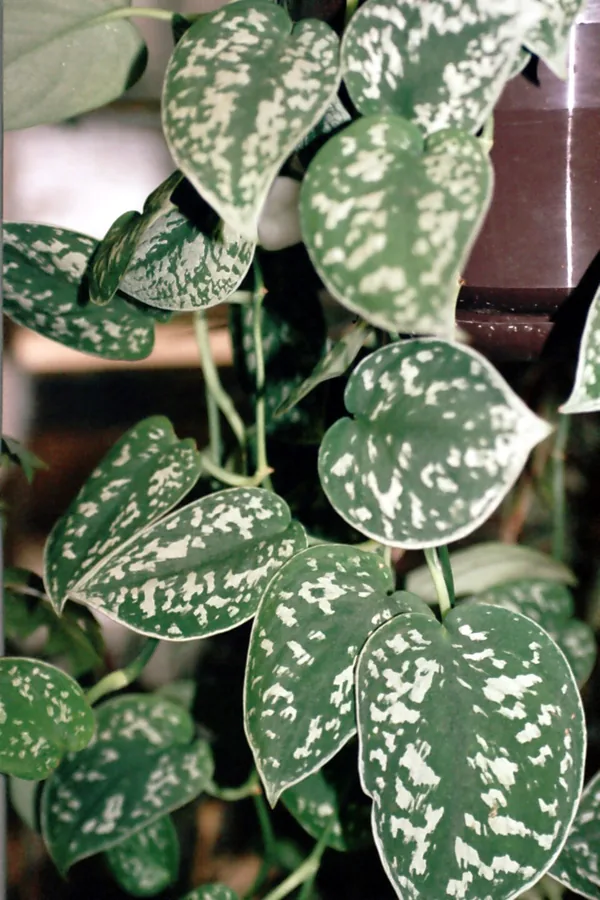
Up close, the leaves of satin pothos carry a deep green ground brushed and dusted with silver, the pale markings scattered unevenly across each blade. On a well-lit plant the silver reads at its brightest, standing crisp against the darker green beneath. The pattern is what gives the whole plant its soft, satiny sheen.
As the leaves mature they thicken and firm up, and the surface takes on a slightly puckered, quilted texture rather than a flat, smooth finish. That raised, uneven surface plays with the light, so the silver seems to shift as the leaf turns. The feel is substantial and a little leathery, not papery.
The stems run long and slender, trailing or climbing, and they carry the leaves in a staggered line along their length. New growth pushes from the tips, unfurling a fresh leaf that firms and colors up over time. Grown well, the plant becomes a hanging column of silver-marked green.
Care
The short version: bright, indirect light and a warm room above 61°F (16°C). The soil stays evenly moist but never soggy, the mix is peaty and well-draining, and a balanced feed goes on monthly through spring and summer.
Light
In bright, indirect light the silver markings stay crisp and hold their metallic shine against the green. In partial shade the pattern dulls toward a flatter gray-green and the growth slows. Direct sun burns the surface, leaving scorched brown patches on the leaves.
Water
The soil stays evenly moist but never soggy, with the surface left to dry a little between drinks. Winter growth slows, so the plant drinks less. Left standing in wet soil, the leaves soften and yellow and the roots begin to rot.
Soil
A peaty, organic mix that drains freely holds the roots, dark and loose and slightly acidic at a pH up to 6.0. The open texture lets water slip straight through, so the roots never sit in a wet mass.
Temperature
Warmth keeps the leaves firm and full, ideally between 61°F and 84°F (16°C to 29°C). Cold air marks the foliage once it drops below the low end of that range, showing as damage on the leaf. Cold drafts leave the same trace.
Humidity
Average household humidity keeps the leaves in good condition, so there is no figure to hit. A more humid spot suits them, and dry winter air is often what brings the fine webbing of spider mites onto the undersides.
Feeding
A balanced houseplant fertilizer goes on monthly through spring and summer, feeding the flush of new leaves as they open. Through the dark months the plant rests and the feeding stops.
Pruning
A pinch at the stem tips keeps the plant full and pushes new leaves lower down instead of a few bare, running vines. Each trimmed length is a cutting with leaves already formed.
Repotting
Fresh soil comes every 1 to 2 years, or sooner once pale roots press out through the drainage holes and water runs straight through. More room and new mix set the roots growing again.
Size & spacing
The stems trail or climb to 3 to 10 feet (90 cm to 3 m) long, spreading 2 to 4 feet (60 to 120 cm) across, with leaves spaced along their whole length. Hanging, they fall in a long silver-flecked column; climbing, they press flat to a support.
Troubleshooting
The leaves record trouble plainly, in changes of color, texture, and surface you can see up close. Most of it comes from watering or a pest that traveled in on another plant. The signs below describe exactly what appears on the leaf, stem, and root.
Blackened, mushy roots with a sour reek
Below the soil line, waterlogging turns the roots dark, soft, and foul-smelling, the mark of root rot. The blackened, mushy roots cut away, and the plant goes into dry, well-draining mix. Lighter watering and a dry-down between drinks stop the spread, which runs fast once it starts.
Fix:
- Remove rotted roots
- Repot in dry well-draining mix
- Reduce watering
Yellow, softening leaves over wet soil
Leaves that turn soft and pale yellow while the soil stays wet are showing overwatering, made worse by poor drainage. The surface needs to dry before the next watering, and the plant moves into a pot that drains freely. Where the roots have already gone soft, fresh mix and lighter watering bring it back.
Fix:
- Reduce watering
- Improve drainage
- Repot in fresh mix
Fine webbing and a bronzed stipple on the undersides
Fine, dusty webbing strung between the stems and a stippled bronze film on the leaf undersides give away spider mites, drawn in by hot, dry air. A hard water rinse strips most of them off, and insecticidal soap or horticultural oil clears the rest over weekly repeats. Higher humidity leaves the foliage far less to their liking.
Fix:
- Rinse forcefully with water
- Apply insecticidal soap or horticultural oil
- Repeat weekly
White cottony tufts in the leaf joints
Small white tufts that look like scraps of cotton lodge where the leaves meet the stem, the sure sign of mealybugs, ringed by sticky, shining honeydew. Each tuft lifts away on an alcohol-soaked swab, with insecticidal soap over the rest and the worst-covered growth cut off. A close look at new plants keeps them from settling in.
Fix:
- Dab with alcohol swab
- Apply insecticidal soap
- Prune infested parts
Waxy brown bumps welded to the stems
Hard, waxy, disklike bumps sit flush against the stems and leaves and stay put, which is exactly how scale insects look. They scrape off under a fingernail or blade, an alcohol swab wipes the spot, and insecticidal soap or oil catches the young crawlers. A careful look over new plants stops them arriving.
Fix:
- Scrape off by hand
- Wipe with alcohol swab
- Apply insecticidal soap or oil
Brown-black spots or a gray fuzz on the leaves
Dark brown-black spots on the blade, or a soft gray fuzz spreading over it, mark fungal leaf spot or botrytis, both feeding on wet leaves and stagnant air. The spotted leaves come off, water stays clear of the foliage, and moving air dries the surface. Watering at the soil and good airflow keep the spots from returning.
Fix:
- Remove affected leaves
- Avoid wetting foliage
- Improve airflow
Leaves curled inward and gone limp
When the soil dries out, the leaves roll inward at the edges and hang limp, the plant's clear look of being thirsty. A deep watering until the base drains firms them up again. The blades flatten and unfurl once the roots have drunk their fill.
Fix:
- Water thoroughly
- Maintain even moisture
Silvery scarring flecked with black dots
Thin silvery streaks scarring the leaf surface, dotted with minute black specks, are the feeding tracks of thrips. Insecticidal soap, blue sticky cards for the adults, and a rinse of the leaves clear them out. New plants kept apart for a while stop them spreading across the rest.
Fix:
- Apply insecticidal soap
- Use blue sticky cards
- Rinse foliage
Toxicity
Every leaf and stem is loaded with insoluble calcium oxalate crystals, and a bite releases them into the soft lining of the mouth. The result is an immediate sting, a burning, and swelling that comes on fast. No part of the plant is edible, so keep it out of reach of pets and small children.
Toxic to
Cats · Dogs · Horses · Rabbits · Livestock · Birds · People
Cats Moderate
One bite frees the calcium oxalate crystals into a cat's mouth, and the sting is instant. Drooling runs, the cat paws at its mouth, vomiting can follow, and the muzzle puffs up and swells.
Dogs Moderate
In a dog, the crystals set the mouth burning the moment the leaf is chewed. Drool strings from the jaw, the dog retches, and the lips and tongue swell visibly.
Horses Moderate
In a horse, the crystals rasp the lining of the mouth and throat into heavy drooling and swelling, though vomiting almost never comes. The reaction stays in the mouth and throat.
Rabbits Toxic
For a rabbit the leaves are unsafe to nibble, the crystals inflaming the mouth and then the gut. Trailing stems belong well above where a rabbit can reach.
Livestock Toxic
In grazing livestock the foliage brings the same raw burning of the mouth and upset through the gut, so the plant stays clear of any stock.
Birds Toxic
A bird pecking the leaf catches the crystals in its mouth and crop, leaving both sore and irritated. The plant belongs away from where birds land and feed.
People Caution
No part of the plant is edible, and a bite lights up the lips with burning, swells the tongue, and sets the mouth drooling. Wash your hands after handling the cut stems, and keep the plant out of reach of small children.
Chewing sap causes oral irritation; wash hands after handling
Helpline numbers

United States
ASPCA Animal Poison Control: (888) 426-4435 (fee applies)
Poison Control: (800) 222-1222



Canada
Poison Centres: 1-844-764-7669
Varieties
The named forms differ most in the size and shape of the leaf and in how the silver falls across it. Set side by side, the differences are easy to see.
'Argyraeus'
Its small leaves wear a thin silver-white rim and a scatter of soft gray blotches across the green.
'Exotica'
Its larger, heart-shaped leaves carry broad, bold splashes of silver laid over deep green.
'Silvery Ann'
Its narrow, lance-shaped leaves are drenched in heavy silver splotches that nearly swallow the green.
Shimmering Falls Silver Splash
Its leaves are mottled edge to edge in dense silver, so little of the green shows through.
How to propagate
A cut stem regrows readily, sending pale new roots into water or moist mix within weeks, and a single piece rebuilds the whole plant.
Stem cuttingsEasy
Spring or early summer · Roots in a few weeks
A 4-inch (10 cm) length of stem cut in spring or early summer roots readily, standing in water or moist mix. Pale new roots break within a few weeks, and the piece grows on into a plant identical to the one it came from.
Myths
Satin pothos is a true pothos.
The leaf and habit fool the eye, but this is Scindapsus pictus, of the genus Scindapsus, while the true pothos belongs to Epipremnum. They look and grow so alike that the two get confused, yet they are separate plants.
Satin pothos is safe for pets.
It is not. The ASPCA lists it toxic to cats, dogs, and horses, because the insoluble calcium oxalate crystals packed through its tissue burn and swell the mouth on contact. Keep it well away from animals.
It thrives in deep shade or low light.
Low light dulls it rather than kills it. The silver holds its shine only under bright, indirect light, and in shade the pattern flattens toward plain gray-green, while direct sun scorches the surface.
It tolerates cold temperatures.
It does not, being tropical to the core. The foliage is damaged below about 61°F (16°C), the leaves blemishing in the cold, so a warm room clear of drafts keeps them clean.